
Legal Document Translation: The Definitive 2026 Guide
A single translation error in your summons isn’t just a typo; it’s a jurisdictional landmine that can blow your entire international case apart before it even begins. You’ve worked hard to meet tight court deadlines and build a solid legal strategy. It’s a nightmare to think that your service could be quashed because of a technical language nuance or a misunderstood Hague Convention requirement. We know the pressure you’re under to get this right the first time.
This definitive 2026 guide will help you master legal document translation for service to ensure your international service of process is never rejected by a foreign court. You need court-admissible documents that stand up to the strictest scrutiny. We’ll show you exactly how to get them. Stop worrying about foreign judges and start focusing on your case.
We’re going to dive into the specific language requirements for high-volume jurisdictions, the rising role of specialized AI in legal workflows, and the essential certification steps for 2026. We will also break down the integrated strategy you need for swift, compliant international service that keeps your litigation moving forward without delay.
Key Takeaways
- Understand why accurate translation is a jurisdictional requirement to prevent foreign Central Authorities from rejecting your service immediately!
- Navigate Article 5 of the Hague Convention with confidence by identifying exactly when and how destination countries demand translated documents.
- Secure court-admissible results through professional legal document translation for service instead of risking your case on machine-generated gambles!
- Execute a foolproof strategy by identifying country-specific language preferences and determining the correct service method for your jurisdiction.
- Discover how an integrated approach to Hague form preparation and delivery eliminates the risk of service being quashed due to procedural errors!
Why Legal Document Translation for Service is a Jurisdictional Necessity
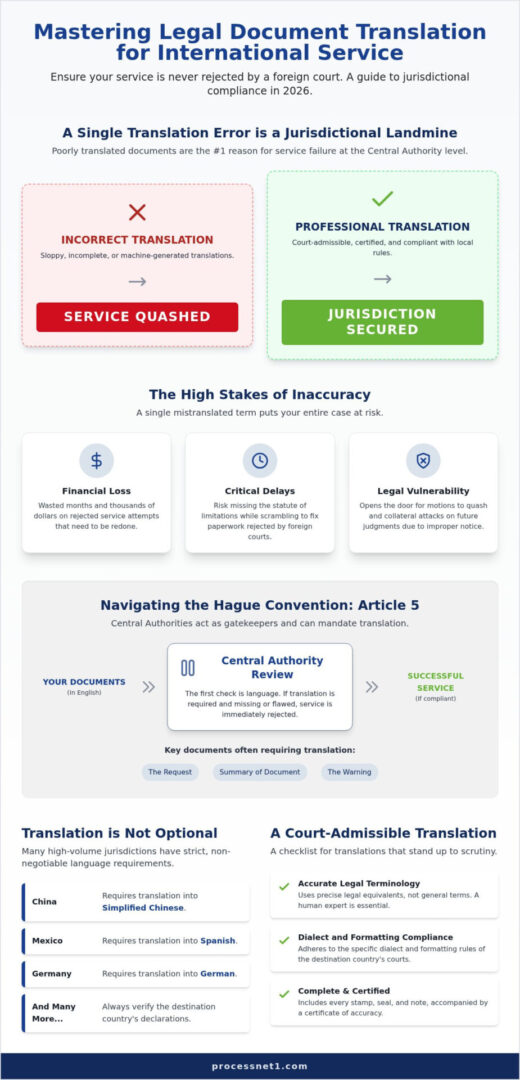
Translating legal pleadings isn’t a courtesy; it’s a hard requirement for jurisdiction. When you initiate legal document translation for service, you’re converting complex American legal documents into the official language of a foreign nation to satisfy their court’s entry rules. If you fail this step, foreign Central Authorities will reject your request instantly. This isn’t a suggestion. It’s the law. Legal translation is a highly specialized field because every word carries the weight of a court order.
Poorly translated documents are the most common reason for service failure at the Central Authority level. When your package arrives in a country like China or Mexico in 2026, the first thing officials check is the language. If the translation is sloppy or incomplete, they’ll send it back without a second thought. You need an integrated approach where the translation is treated as the first step of your service strategy, not an afterthought.
The High Stakes of Inaccurate Legal Translation
A single mistranslated term is all a defense attorney needs to file a motion to quash service. Imagine your case grinding to a halt because a translator used a general term instead of a specific legal equivalent. You’ve now wasted months and thousands of dollars. Even worse, you risk missing the statute of limitations while you scramble to fix the paperwork. Foreign courts prioritize linguistic precision over speed every single time. They don’t care about your trial schedule; they care about their procedural integrity.
A “good” translation that sounds right to a layperson simply won’t cut it. You need a court-admissible version that includes:
- Accurate conversion of technical legal terminology.
- Compliance with the destination country’s specific dialect requirements.
- Proper formatting that mirrors the original pleadings for easy reference.
Due Process and the Right to Notice
International litigation hinges on the concept of meaningful notice. This means the defendant must actually understand the nature of the lawsuit against them. You might think translation is unnecessary if the defendant speaks English, but many jurisdictions still mandate it. The court’s rules require it for the service to be valid under local law, regardless of the defendant’s personal language skills.
Providing a high-quality legal document translation for service protects your eventual judgment from future collateral attacks. Without it, a defendant can claim years later that they never received proper notice because the documents weren’t in their native tongue. Don’t leave that door open. Use a no-nonsense, integrated service provider to ensure your documents are bulletproof from the start.
Navigating Hague Convention Translation Requirements
The Hague Convention is the primary treaty governing international service of process. It’s your global framework. But don’t mistake a treaty for a shortcut. Precise Hague Convention process service demands absolute adherence to the destination country’s language rules. In 2026, Central Authorities are more rigorous than ever. They won’t tolerate English documents in jurisdictions that have formally declared a translation requirement under Article 5.
Article 5 and the Central Authority Protocol
Central Authorities act as the gatekeepers of their nation’s legal borders. Under Article 5(1), a Central Authority can require that documents be written in or translated into the official language of their state. Every formal request includes three critical components: the Request, the Summary of the Document to be Served, and the Warning. These aren’t just administrative hurdles; they’re jurisdictional triggers. If the Central Authority determines the defendant doesn’t understand the documents, they’ll refuse service immediately. You need a legal document translation for service that covers every stamp, seal, and handwritten note. This level of detail aligns with U.S. government certification requirements, which demand a full and accurate translation of the entire record.
Mandatory vs. Optional Translation Jurisdictions
Regional variations create the most confusion for litigators. China requires Simplified Chinese. Mexico demands Spanish. Germany insists on German. Some countries allow English service for certain “voluntary” methods, but this is a dangerous gamble. If the defendant refuses the English documents, you’ve wasted months and court fees. Jurisdictions like Germany are particularly strict. Even if the recipient speaks perfect English, the Central Authority often mandates a German translation to satisfy local due process and public policy. In 2026, the risk of “English-only” service in a non-English speaking Hague country is simply too high for serious litigation.
Don’t guess which dialect you need. Castilian Spanish for Spain isn’t the same as Mexican Spanish. Using the wrong regional variation can be as damaging as no translation at all. We handle these nuances daily, ensuring your paperwork is bulletproof before it leaves U.S. soil. If you want to avoid a rejected filing, start your international service with an expert review today. We ensure your legal document translation for service meets every specific requirement of the target jurisdiction, saving you from the frustration of quashed service and missed deadlines.
Certified vs. Standard Translation: Choosing Admissibility
Don’t confuse a standard translation with one that’s court-admissible. A standard translation is fine for an internal email or a casual business letter. In international litigation, it’s a liability. When you’re securing legal document translation for service, you aren’t just looking for a language conversion. You’re looking for an evidentiary document that a foreign judge will accept without question. Admissibility is the only metric that matters.
Your goal is a certified translation for service of process that stands up to a hostile motion to quash. This requires a level of precision that generalist agencies simply cannot provide. We ensure every document is handled by experts who understand the weight of a court-ordered deadline and the technicality of international law.
The Affidavit of Accuracy: Your Shield in Court
The primary difference between standard and certified work is the Affidavit of Accuracy. This isn’t just a signature; it’s a sworn statement from the translator. Following the American Translators Association guidelines on certified translation, a valid certification must prove the translator’s competence and the document’s absolute completeness. In 2026, many foreign jurisdictions also require this affidavit to be notarized to satisfy local protocols.
Foreign courts will reject translations that lack a named, qualified expert. They need to know exactly who is responsible for the text. A proper certification should include:
- The translator’s full name and professional credentials.
- A specific statement attesting to the accuracy and completeness of the work.
- The date and the translator’s signature.
- Notarization, where required by the destination country’s Central Authority.
Why Machine Translation Fails International Service
Some competitors push machine translation to save time. That’s a dangerous gamble for your case. Generic AI tools often fail to distinguish between common law terms and their civil law counterparts. These “hallucinations” can change the entire meaning of a summons or a complaint. If an AI mistranslates a jurisdictional term, your service is defective from the moment it’s delivered.
Human oversight is mandatory for court-admissible documents. A human expert understands the nuance of “legalese” in both languages. They know how to translate a U.S. “Complaint” into a term that carries the same legal weight in Germany or Japan. Don’t let a software error quash your service. Rely on a no-nonsense, integrated provider that prioritizes accuracy over shortcuts. We provide the legal document translation for service that ensures your case moves forward, not backward.
Strategic Checklist for Translating Legal Documents
Success in international litigation isn’t about luck. It’s about preparation. Effective legal document translation for service begins with a rigorous strategic audit of your paperwork before it ever reaches a process server’s hands. If you miss one procedural requirement, you’re looking at months of delays and thousands in wasted court fees. Use this checklist to keep your case on track.
- Identify target country requirements: Research the specific language and dialect preferences of the destination jurisdiction.
- Confirm the service method: Determine if you’re proceeding via the Hague Convention or formal Letters Rogatory.
- Define the translation scope: Verify if the local Central Authority requires the entire packet or only the primary summons.
- Hire a specialized expert: Choose a certified translator who understands the nuances of international process service.
- Perform a final audit: Compare every page of the translation against the original English to ensure 100% completeness.
Identifying the Correct Language and Dialect
Language isn’t a monolith. Using European Portuguese for a defendant in Brazil is a recipe for a quashed service. Similarly, you must distinguish between Simplified Chinese for Mainland China and Traditional Chinese for Taiwan or Hong Kong. These regional variations are jurisdictional triggers. If you provide the wrong dialect, the court may rule that the defendant didn’t receive meaningful notice. We recommend consulting with international process service experts before you finalize your translation orders to ensure regional compliance.
The ‘Full Packet’ Rule in Foreign Service
Many strict jurisdictions follow what we call the ‘Full Packet’ rule. The ‘Full Packet’ rule is the requirement to translate every page intended for service. This means you can’t just translate the complaint and leave the exhibits in English. If you have a hundred pages of evidence attached to your summons, every single one of those pages usually needs a corresponding translation. Summary-only translations are a dangerous shortcut that often leads to immediate rejection by foreign Central Authorities. When you secure legal document translation for service, you must account for the entire volume of your filing to protect the validity of your service. Don’t let a missing exhibit translation derail your entire litigation strategy. Request a translation audit from our expert team today to ensure your documents are ready for global delivery.
Process Service Network: Assertive Leadership in Legal Translation
Stop wasting time with generalist agencies that don’t understand the high stakes of international litigation. When you secure legal document translation for service through Process Service Network, you aren’t just hiring a linguist. You’re partnering with a global authority that ensures your service is legally bulletproof. We don’t just swap words; we secure jurisdiction. Our veteran team has navigated every possible complication since 1978, possessing the infrastructure to handle difficult cases with ease.
We operate with a no-nonsense, transparent approach to every engagement. You’ll never deal with hidden variables or vague timelines. We understand that court deadlines are absolute, and our commitment to your results is unwavering. This integrated approach ensures that every legal document translation for service is audited against the specific procedural requirements of the destination court before the documents ever leave our office.
Why Integrated Service is the Only Choice
Most firms make the mistake of hiring a translator and a process server separately. This creates a dangerous gap in accountability. We eliminate the middleman by providing a single point of contact for your entire international case. Our integrated team handles the Hague Form Preparation, the translation, and the final delivery in one seamless workflow. This allows us to spot jurisdictional errors that a standard translator would completely miss.
Having a single entity responsible for the entire process provides several critical advantages:
- Immediate Error Detection: We verify that your translations match the requirements of the specific Central Authority handling your request.
- Streamlined Communication: No more playing phone tag between different vendors while deadlines loom.
- Total Accountability: We take full responsibility for the admissibility and delivery of your legal documents.
Expertise Across 100+ Languages and Jurisdictions
Our global reach is expansive, covering more than 100 languages and every major jurisdiction. We provide specialized Spanish legal translation services for complex litigation in Latin America and Europe, ensuring that regional dialects are perfectly addressed. Whether you’re serving a defendant in a high-volume Hague country or a difficult non-Hague jurisdiction, we apply the same tactical precision to every page.
We thrive on challenges that deter others. If you’re dealing with a hard-to-serve case in a country with a restrictive Central Authority, you need a partner who knows the local landscape. We possess the global network and the modern methodology required to keep your litigation moving forward in 2026. Get started today with the global authority in international legal support and experience the speed and accuracy your case deserves!
Secure Your Global Litigation Strategy for 2026
Success in international litigation hinges on treating translation as a foundational jurisdictional requirement. You’ve seen how a single mistranslated term can quash service and how generic AI tools risk your entire case through hallucinations. Navigating the Hague Convention in 2026 requires more than just a linguist; it demands precise legal document translation for service that meets the strict evidentiary standards of foreign Central Authorities. Don’t leave your jurisdiction to chance or a non-specialized middleman.
Process Service Network has been serving the legal community since 1978. We provide an elite global network of process servers and translators who are specialists in Hague Convention compliance. Our team manages the forms, the translation, and the final delivery in one seamless, transparent workflow. We possess the infrastructure to handle the world’s most difficult jurisdictions with absolute reliability and speed. It’s time to eliminate uncertainty and move your case forward with confidence.
Secure Your International Service with Expert Translation—Contact Process Service Network Now!
Your international case deserves the precision of a seasoned veteran. Let’s ensure your documents are served correctly the first time!
Frequently Asked Questions
Is legal document translation mandatory for all international service?
It depends on the destination country and the method of service you choose. Many Hague Convention signatories formally require documents to be in their official language under Article 5. Even if it’s not strictly mandatory, it’s often a jurisdictional necessity to ensure the defendant understands the lawsuit. Without it, you risk your service being quashed. We always check the latest 2026 requirements for your specific target country.
What is a certified translation for court purposes?
A certified translation is a document accompanied by a signed and sworn Affidavit of Accuracy. This statement confirms that the translator is competent and that the translation is a complete, true representation of the original text. For legal document translation for service, this certification is what makes the document court-admissible. It provides the legal weight necessary for foreign Central Authorities to accept your filing without delay.
Can I use Google Translate for a legal summons?
Absolutely not. Using machine translation for a legal summons is a dangerous gamble that leads to immediate rejection by foreign courts. Generic AI tools lack the nuance of specialized legal terminology and frequently hallucinate incorrect meanings. A single mistranslated term can result in a motion to quash your service. You need a human expert who understands both common law and civil law systems to ensure your documents are bulletproof.
Does the Hague Convention require translation for service in Canada?
Translation isn’t generally required for service in Canada if the documents are in English or French. However, you must consider the specific province. Service in Quebec often requires a French translation to satisfy local procedural rules and ensure the defendant receives meaningful notice. It’s vital to verify these regional nuances before initiating service to avoid unnecessary delays or future challenges to your judgment. We handle these checks for you.
How long does it typically take to translate a legal packet for service?
Turnaround times vary based on the volume of documents and the complexity of the target language. A standard summons and complaint might take a few business days, while a full packet with extensive exhibits takes longer. We prioritize accuracy over shortcuts to meet your tight court deadlines. Our integrated team manages the timeline from the moment we receive your files until the documents are ready for international delivery.
What happens if a foreign court finds an error in the translation?
An error in translation can lead to your service of process being quashed immediately. This forces you to restart the entire international service process from scratch, wasting months and increasing your litigation costs. In 2026, foreign courts are increasingly strict about linguistic precision. A defective translation can also leave your final judgment vulnerable to collateral attacks years later. Reliability is the only way to protect your litigation strategy.
Do I need to translate the exhibits attached to my complaint?
Yes, you must translate the entire packet, including all exhibits and attachments. Many jurisdictions follow the Full Packet rule, meaning a partial translation is treated as no translation at all. If you want your legal document translation for service to be valid, every page intended for delivery must be in the destination country’s official language. Leaving exhibits in English is a common mistake that causes Central Authorities to reject filings instantly.
Who is authorized to certify a legal translation for international use?
Authorization typically comes from a professional translator or a specialized agency that provides a formal Affidavit of Accuracy. For international use, this affidavit often requires notarization to satisfy the specific requirements of foreign Central Authorities. We provide these certifications as part of our integrated service. Our team has decades of experience ensuring these documents meet the specific evidentiary standards required for successful service in difficult jurisdictions worldwide.
