

Hague Convention Process Service: 2026 Definitive Guide
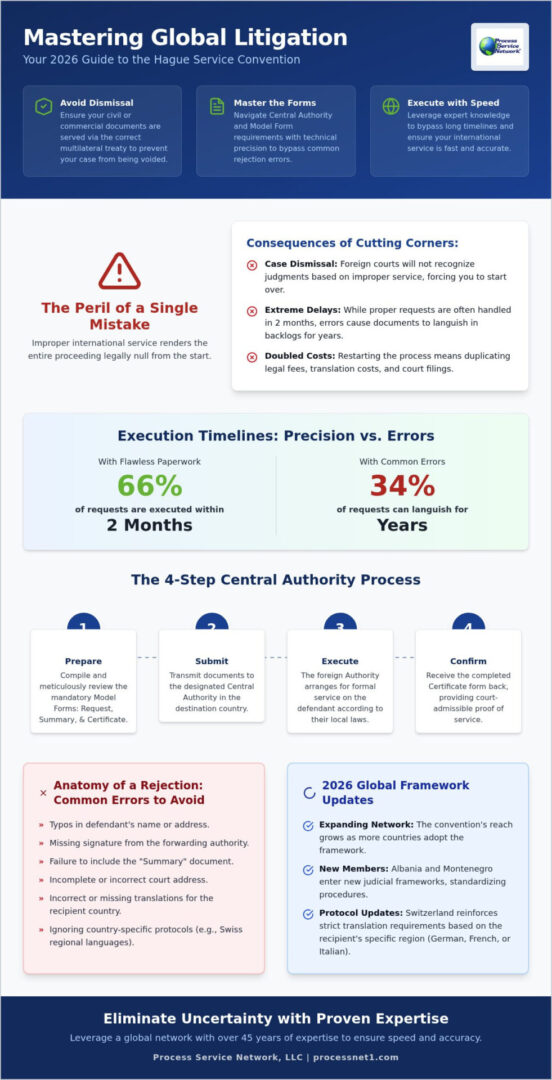
One technical error in your international paperwork can kill your litigation before it even starts! You’ve likely spent months building a high-stakes case, only to face the crushing reality of a dismissal because a Central Authority rejected your documents. It’s an exhausting cycle of confusion over country-specific requirements and anxiety over long timelines. We know the stakes are high. Mastering hague convention process service is not just about following rules; it’s about tactical precision in a shifting global environment where 66% of requests are executed within two months, while others languish for years.
This 2026 definitive guide ensures you master the complexities of the Hague Service Convention and get your documents served with absolute speed. You’ll stop guessing and start executing with confidence. We’ll break down the latest 2026 member updates, including new protocols in Switzerland and the entry of Albania and Montenegro into new judicial frameworks. You’ll learn how to bypass common roadblocks in countries like China and Mexico while securing court-admissible proof of service every single time. Let’s eliminate the uncertainty and get your litigation moving forward today.
Key Takeaways
- Understand the precise scope of the Hague Service Convention to ensure your civil or commercial documents are served through the correct multilateral treaty.
- Navigate the Central Authority and Model Form requirements with technical precision to avoid the common errors that lead to immediate document rejection.
- Master hague convention process service by identifying country-specific reservations on alternative methods like postal or consular channels under Articles 8 through 10.
- Secure court-admissible proof of service by matching your document translation to the specific, rigorous demands of the receiving member state.
- Leverage a global network with over 45 years of expertise to bypass long timelines and ensure your international service is executed with absolute speed and accuracy.
The Authority’s Guide to Hague Convention Process Service
The Hague Service Convention isn’t just a suggestion; it’s the law of the land for cross-border litigation. This multilateral treaty provides a unified path for transmitting judicial documents across international borders. If you are involved in a civil or commercial matter where the defendant resides in a member state, you must follow these protocols. It’s that simple! As of 2026, the network continues to expand with countries like Albania and Montenegro joining related frameworks, making hague convention process service more critical than ever. While modern technology like electronic filing is gaining ground, the Central Authority remains the gatekeeper. Don’t let a digital shortcut ruin your legal standing. We’ve seen cases fall apart because a lawyer tried to save time with an unauthorized email. Precision beats speed every time.
When is the Hague Convention Mandatory?
The treaty applies whenever you need to serve documents abroad and the destination country is a signatory. If the defendant’s address is known, the convention is your only safe harbor. You can’t just hire a local runner and hope for the best! The “Known Address” rule is the threshold. If you truly cannot locate the defendant after a Diligence Search, other methods like Service by Publication might apply, but don’t assume anonymity is an easy out. Voluntary service might seem faster, but it often leaves your judgment vulnerable. Always opt for the involuntary, formal route to lock in your jurisdictional stakes. It’s about building an airtight record that no defense attorney can tear down.
The Consequences of Improper International Service
Cutting corners in international law is a recipe for disaster. In the context of service, improper delivery means the entire proceeding is void ab initio, or legally null from the beginning. Foreign courts have zero patience for U.S. litigants who bypass treaty rules. If you ignore the Central Authority, a foreign judge will likely refuse to recognize your judgment. You’ll be forced to start the entire process over from scratch! This means doubling your legal fees and adding months, or even years, to your litigation timeline. Research shows that while 66% of requests are executed within two months, improper hague convention process service filings can rot in a Central Authority’s backlog for years. Precision isn’t just a goal; it’s your only defense against case dismissal.
Navigating the Central Authority: The Primary Channel
The Central Authority is the officially designated government body in each member state tasked with receiving and executing service requests. It acts as the mandatory gatekeeper under the official Hague Service Convention text. This centralized system replaced the archaic and unpredictable “Letters Rogatory” process to create a more reliable path for litigants. However, don’t confuse “centralized” with “instant.” While the treaty creates a uniform framework, the transmission process from a U.S. court to a foreign authority involves multiple bureaucratic layers. Expectation management is vital here. You’re dealing with government-to-government processing where timelines are dictated by local judicial capacity and civil service efficiency. It’s a methodical path that requires patience and absolute procedural compliance.
Expert Hague Form Preparation: Precision is Non-Negotiable
Your success hinges on the mandatory trio of documents: the Request, the Certificate, and the Summary. These documents comprise the “Model Form” that every Central Authority expects to see. Precision is non-negotiable! A single typo in the defendant’s name or a missing signature from the “forwarding authority” will result in an immediate rejection. Common errors include failing to include the Summary or providing an incomplete court address. Language requirements are equally strict. Many countries, such as Switzerland, demand translations into specific regional languages like German, French, or Italian depending on where the recipient lives. If your paperwork isn’t perfect, it won’t even make it past the initial intake desk. Review our Hague service request form compliance checklist to ensure every field and attachment meets the exact standards required by your destination country’s Central Authority.
The Role of the US Marshall vs. Private Agencies
The days of the U.S. Marshals Service handling international process service for private litigants are long gone. Today, the Marshals only handle service for the U.S. government. For everyone else, the responsibility falls on the attorney or a specialized agency. Private experts like Process Service Network, LLC are essential for navigating these technical waters. We expedite the preparation phase by ensuring every form meets the rigorous Hague Convention Article 5 service standards of the destination country. This includes verifying local laws on how the document must be delivered to the recipient. Using a veteran network ensures your hague convention process service is handled with the same speed and accuracy we’ve provided since 1978. Don’t leave your case to chance when you can secure expert Hague Form Preparation to guarantee compliance.
Articles 8 through 10: Alternative Methods and Global Reservations
The Central Authority isn’t your only option. If you want to move fast, you need to understand Articles 8 through 10. These provisions offer alternative routes that can slash months off your timeline. Article 8 allows for service through diplomatic or consular channels, which is particularly effective when serving U.S. nationals residing abroad. However, the real power lies in Article 10. This is the “alternative methods” provision that covers everything from postal channels to direct service by local officials. You must act with caution. Every signatory has the right to file reservations, which are formal objections to specific methods. If a country objects to Article 10, any service attempted through those channels is legally dead on arrival. Checking these objections is the first step in any successful hague convention process service strategy.
Serving Process by Mail: Risks and Rewards
Serving process by mail under Article 10(a) is a technical minefield. For years, courts debated whether the word “send” in the treaty actually meant “serve.” The U.S. Supreme Court finally settled this in the Water Splash, Inc. v. Menon ruling, confirming that mail service is permissible if the destination state hasn’t objected. Don’t celebrate yet! Major players like China, Japan, and Germany explicitly forbid Article 10(a) service. Even where it is allowed, mail service rarely produces the court-admissible proof of service required by U.S. judges. A simple return receipt often fails to satisfy the rigorous standards of hague convention process service. We generally advise against mail unless no other option exists because it lacks the definitive verification foreign courts demand.
Direct Service via Judicial Officers (Article 10b/c)
If you want speed without the Central Authority bottleneck, look to Articles 10(b) and 10(c). This allows you to bypass the government bureaucracy by hiring a local judicial officer, such as a “huissier” in France or a solicitor in the United Kingdom. This is often the preferred “fast track” method because it puts control back in your hands. You aren’t waiting for a government desk clerk to process your file; you are hiring a professional to walk the papers to the defendant’s door. You must ensure this method complies with U.S. Due Process requirements. The defendant must receive adequate notice and a fair opportunity to be heard. When done correctly, direct service is the most efficient way to handle international legal documents in 2026. It provides the high-quality proof of service that makes your judgment bulletproof in any jurisdiction.
Strategic Preparation: Translation, Formatting, and Proof
Rejection is the ultimate enemy of international litigation. In 2026, translation errors remain the primary reason Central Authorities kick back service requests. It’s a technicality that can cost you thousands of dollars and months of wasted time! You can’t simply translate the main complaint and hope for the best. hague convention process service requires a “Full Pack” submission. This means every single exhibit, summons, and annex must be translated into the destination country’s official language. If you leave out a one-page contract exhibit, the Central Authority in countries like China or Mexico will likely reject the entire filing. Precision is the only way to ensure your international legal documents move through the system without friction. Before submitting, consult the 2026 Hague service request form essential compliance checklist to verify your complete document package meets every country-specific requirement.
Certified Legal Document Translation for Foreign Service
Machine translation is a recipe for litigation disaster. Algorithms can’t grasp the nuances of foreign civil code or the specific terminology required by judicial officers in different jurisdictions. You need certified translations that are court-admissible. Standard, informal translations are often rejected at the intake desk of the foreign Central Authority. We’ve seen cases dismissed because a translator used the wrong word for “service” or “jurisdiction.” At Process Service Network, LLC, we integrate certified translation directly into our workflow. This ensures that your documents are not just translated, but formatted to meet the specific demands of the receiving state. Don’t leave your case to a software program. Secure professional Legal Document Translation to guarantee your paperwork is bulletproof from day one.
Proof of Service: The Certificate of Completion
The final hurdle is securing the Certificate of Completion. This is the specific section of the Hague Model Form that the foreign Central Authority signs and returns once service is successful. It’s the gold standard of proof. However, government bureaucracies can be slow. If a Central Authority fails to return the certificate in a timely manner, you need a proactive strategy. We supplement our filings with Diligence Searches and secondary proof to ensure you have a record for the court. This proactive approach prevents your case from stalling in a procedural vacuum. Your proof of service must withstand the scrutiny of any judge, and we provide the documentation to make that happen. For a deeper understanding of how delivery standards affect your Certificate of Completion, review our comprehensive guide on Hague Convention Article 5 service and international legal delivery. We’ve navigated these complications since 1978, and we know exactly what U.S. courts need to see when the foreign government is unresponsive.
Eliminating Uncertainty with a Global Process Service Network
Why risk your high-stakes case with a solo operator? International law is too technical for trial and error. A veteran global network provides the infrastructure and local clout that a single server simply cannot match. At Process Service Network, LLC, we’ve spent over 45 years perfecting hague convention process service. This means we don’t just “try” to deliver papers; we execute with absolute precision. Our global reach ensures that whether your defendant is in a major financial hub or a remote village, we have the professional boots on the ground to get it done. We provide absolute transparency with no hidden variables or surprise fees. You get relentless execution from a seasoned veteran who has navigated every possible complication since 1978. We are the definitive choice because we deliver results where others fail.
Handling Hard-to-Serve and Evasive Defendants
Some defendants go to great lengths to stay hidden, but we thrive on these challenges! Before we even attempt service, we can deploy an elite Diligence Search to pinpoint an evasive defendant’s location. If hague convention process service becomes impossible due to a truly unknown address or a non-signatory state, we don’t just stop. We guide you toward alternative solutions like Service by Publication or Letters Rogatory. Our “can-do” attitude means we are relentless problem-solvers for your litigation. We possess the veteran infrastructure to handle the difficult cases that deter others. We don’t accept “impossible” as an answer. We move quickly to ensure your case stays on track regardless of the defendant’s tactics.
The PSN Workflow: From Intake to Affidavit
Our workflow is designed for maximum speed and operational efficiency. It starts with a simple, direct intake process. Send us your legal documents, and we handle the rest! We take over the Hague Form Preparation and any required translations immediately. You’ll receive real-time updates and professional assertiveness at every stage of the engagement. We move from intake to preparation to execution with surgical precision. This methodical approach ensures that the most critical information is presented upfront, creating a sense of momentum for your case. Once service is complete, we provide the court-admissible proof you need to move your case forward. Don’t let procedural uncertainty stall your litigation for another day. Start your international service request now and experience the PSN advantage firsthand.
Lock in Your International Litigation Success
You now have the definitive blueprint to navigate the most complex international service requirements. Success in 2026 requires more than just filling out forms; it demands technical precision in translation and a deep understanding of country-specific reservations. Don’t let your case stall because of a minor clerical error or a slow-moving Central Authority. By mastering hague convention process service, you ensure your litigation remains on track and your judgments stay bulletproof across borders.
We’ve been serving the legal community since 1978 with a no-nonsense approach to global reach and absolute transparency. Whether you need comprehensive Hague form preparation or professional legal document translation, we have the infrastructure to handle it all. We thrive on the challenges that deter others, acting as your relentless problem-solver in the complex global landscape. Secure Your International Service with the Experts at Process Service Network, LLC today. Your case deserves the reliability of a seasoned veteran who delivers results with operational precision. Let’s get your documents served with absolute speed and accuracy!
Frequently Asked Questions
What is the Hague Convention on the Service of Process?
The Hague Convention on the Service of Process is a multilateral treaty that creates a uniform path for transmitting judicial and extrajudicial documents abroad. It governs civil or commercial matters where the recipient’s address is known. By establishing a designated Central Authority in each signatory state, the treaty eliminates the unpredictable nature of diplomatic channels. It ensures that defendants receive proper notice while providing plaintiffs with the court-admissible proof of service required to move litigation forward.
How long does it take to serve someone under the Hague Convention?
Service timelines depend on the destination country, though 66% of requests are completed within two months. Efficient Central Authorities in some European nations process papers rapidly. Conversely, countries like China or Mexico often present roadblocks that can extend the timeline significantly. The accuracy of your initial filing is the most critical factor in avoiding delays. If your forms contain technical errors, the foreign government will return them, forcing you to restart the months-long process from scratch.
Can I serve a foreign defendant by email or social media?
Service via email or social media is generally prohibited unless a country has specifically authorized these alternative methods in its treaty declarations. Most member states strictly require service through the Central Authority or local judicial officers under Article 10. Attempting digital service without explicit authorization often leads to a void judgment. While some nations are modernizing their frameworks in 2026 to allow for electronic evidence and videoconferencing, traditional physical service remains the gold standard for compliance.
What happens if a country is not a member of the Hague Convention?
If a country is not a signatory, you must typically utilize Letters Rogatory. This involves a formal request for judicial assistance sent from a U.S. court to a foreign court through diplomatic channels. This process is notoriously slow and can often take over a year to complete. In specific high-stakes cases, you might consider alternative options like Service by Publication or a Diligence Search if local laws and U.S. due process standards allow for such measures.
Is translation always required for Hague service?
Translation is not always required, but it is a mandatory requirement for the vast majority of member states. Each country has the right to demand that documents be translated into its official language before the Central Authority will execute service. In 2026, failing to provide a certified translation of the entire document package remains the most common reason for rejection. You must verify the specific language requirements of the destination country to ensure your filing is successful.
What is the difference between the Hague Convention and Letters Rogatory?
The Hague Convention is a streamlined treaty process, whereas Letters Rogatory are traditional, non-treaty requests for judicial assistance. hague convention process service is faster because it bypasses the Department of State and foreign diplomatic ministries. Letters Rogatory remain a method of last resort used only when the destination country is not a member of the convention. The treaty provides a standardized Model Form that ensures a much higher level of predictability and court-admissible proof.
How much does Hague Convention process service cost?
Total costs vary based on foreign government fees, translation requirements, and the complexity of the service. Different nations require specific payments for local judicial officers or huissiers to deliver the papers. Some Central Authorities also charge administrative fees for processing incoming requests. You should always seek a transparent breakdown of these variables before initiating service to avoid hidden costs that can derail your litigation budget. Professional agencies provide this clarity to ensure your case moves forward without surprises.
Can I serve legal papers by mail to a Hague member country?
Service by mail is only valid under Article 10(a) if the destination country has not filed a formal objection. While the U.S. Supreme Court confirmed this method is legally permissible in the Water Splash ruling, many major countries like Germany and China explicitly forbid it. Even in countries that allow it, mail service rarely produces the definitive, court-admissible proof that U.S. judges demand. A professional hague convention process service provider typically recommends personal service to ensure total compliance.
