

Hague Service Request Form: The 2026 Essential Compliance Checklist
A single clerical error on your Hague service request form can derail high-stakes litigation for six months or more. It’s a brutal reality that many legal professionals face when navigating international waters! You’ve likely felt the pressure of a looming court deadline while staring at a USM-94, wondering if a foreign Central Authority will reject your paperwork over a minor translation technicality. We understand that uncertainty and the high stakes involved. It’s time to eliminate the guesswork and take control of your international service strategy. This guide provides the definitive 2026 compliance checklist to ensure your legal documents are served accurately the first time. We’ll master the complexities of form preparation, clarify strict translation requirements, and identify exactly which authorities need your attention. You will gain a rejection-proof strategy and a clear understanding of the global timeline for successful service of process abroad. We’ve handled the most difficult cases since 1978, and we’re here to ensure your documents reach their destination without delay. Let’s get your case moving with total confidence!
Key Takeaways
- Stop the “US Marshals” confusion and master the USM-94 Model Form as the only path to valid international delivery.
- Identify exactly who has the legal standing to execute the request to avoid immediate dismissal by foreign courts.
- Eliminate the risk of rejection by strictly adhering to Article 5 translation mandates and bilingual form requirements.
- Use our 2026 checklist to confirm the latest Central Authority protocols and submit a perfect Hague service request form every time!
- Transition from clerical uncertainty to operational precision by applying 45+ years of proven global process service strategy.
What is the Hague Service Request Form (USM-94)?
The Hague service request form, officially designated as the USM-94, is the mandatory “Model Form” required for international legal delivery under the Hague Service Convention. Think of it as the universal passport for your legal documents. Without this exact document, your request for service is dead on arrival. Foreign governments will not acknowledge your lawsuit; they will simply return your packet or ignore it entirely. It’s a rigid, non-negotiable standard that governs how civil and commercial matters move across borders.
A common point of confusion is the “USM” prefix, which stands for U.S. Marshals. Many practitioners mistakenly believe the Marshals will handle the physical service of their papers. This is a significant misconception! The U.S. Marshals Service hasn’t physically served these international documents since the 1980s. While the name persists on the form, the Marshals now primarily manage foreign process coming into the United States. For your outgoing cases, the USM-94 is the bureaucratic key that unlocks the legal system of a foreign sovereign state. Even in 2026, as digital filing becomes more common, this paper-based framework remains the treaty bedrock.
The Role of the Central Authority
Every member nation designates a “Central Authority” to act as the official gatekeeper for all incoming legal requests. This office receives your Hague service request form and reviews it for strict treaty compliance. They don’t just deliver mail; they evaluate your documents against local laws and Article 5 translation mandates. Identifying the correct office is critical. Some countries maintain one national authority, while others have regional offices based on the defendant’s specific jurisdiction. One wrong address can lead to months of delays and potential case dismissal.
Outgoing vs. Incoming Requests
When you file a lawsuit in a U.S. court against a foreign defendant, your court or attorney of record acts as the “Requesting Authority.” This is an outgoing request. The USM-94 framework applies whether you’re serving a massive corporation or a private individual. Both federal and state courts utilize this same standardized structure. The form includes three parts: the Request, the Summary of the Document, and the Certificate. You must leave the “Certificate” page blank! That section is reserved for the foreign Central Authority to complete once service is successful. We’ve navigated these precise requirements since 1978, ensuring every box is checked before your documents leave American soil.
Anatomy of a Flawless Hague Service Request
Precision is your only shield against foreign rejection. When you handle a Hague service request form, you aren’t just filling out a document; you’re executing a treaty-level instrument. The USM-94 consists of three distinct parts: the Request, the Summary of the Document to be Served, and the Certificate. Your primary task is the Request and the Summary. You must leave the “Certificate” section entirely blank! This is a frequent point of failure for inexperienced filers. That page belongs exclusively to the foreign Central Authority. They use it to officially confirm service or document a failure. If you mark it up, you’ve compromised the official record before it even leaves the country.
Identifying the correct “Applicant” is equally vital. While U.S. attorneys usually sign, some jurisdictions in 2026 still require a Court Clerk or Judge to execute the request. We’ve seen requests stall for months because the signing party lacked the specific “standing” recognized by the destination country. Address precision is another non-negotiable factor. Never use a P.O. Box for the defendant. Many Central Authorities in Europe and Asia view P.O. Boxes as insufficient for legal service and will issue an immediate rejection. You need a physical street address. If you’re struggling to locate a valid physical address, our diligence search services can provide the verified data you need to proceed.
Drafting the ‘Summary of the Document to be Served’
Foreign judges often rely more on your summary than the actual complaint. Use plain language. Avoid dense American legalese that gets lost in translation. Your summary must clearly state the parties involved, the nature of the claim, and the specific date a response is required. If the summary is vague, the Central Authority may deem the service “contrary to public policy” and refuse to act. Keep it factual, concise, and direct. Don’t let a poorly written summary be the reason your case is dismissed.
Standard vs. Special Methods of Service
Most requests fall under Article 5(a). This asks the foreign authority to serve the papers according to their own local law. This is the safest and most efficient path. Article 5(b) allows you to request a “particular method,” such as personal service in a country that usually serves by mail. Be careful here. If your requested method is incompatible with local law, the entire request will be rejected. Many civil law jurisdictions also utilize “voluntary acceptance,” where the defendant must agree to receive the papers. If they refuse, you’ll need a seasoned veteran to pivot your strategy immediately. Understanding the full scope of Hague Convention Article 5 service is essential to selecting the right method and avoiding costly procedural missteps.
Translation Requirements: The Silent Rejection Factor
Failure to translate is the fastest way to get your case tossed. Under the Article 5 Translation Rule, a receiving country can legally refuse to serve your documents if they aren’t in their official language. This isn’t just about the Hague service request form itself. It covers every single page in your packet. If you attach a fifty-page contract as an exhibit without a corresponding translation, the Central Authority will likely reject the entire request. You don’t want to explain a six-month delay to your client because of one untranslated spreadsheet! We emphasize a “full translation” mandate because foreign judges won’t piece together your argument from untranslated exhibits.
We also recommend using dual-language versions of the USM-94. While English is a treaty language, many authorities in places like France or China prefer, and sometimes demand, bilingual forms. A trilingual form (English, French, and the local language) shows respect for the local authority and streamlines their internal review process. It’s a small step that yields massive results in operational speed. We’ve seen this attention to detail move documents through systems that otherwise move at a snail’s pace. It eliminates the friction that leads to administrative pushback.
Navigating Language Declarations
Don’t assume you know a country’s language requirements. You must check the specific declarations on the HCCH website for the destination nation. Countries with multiple official languages like Switzerland, Belgium, or Canada present unique traps. In Switzerland, the required language depends on the specific canton where the defendant resides. Serving a German speaker in a French-speaking canton with German documents is a recipe for disaster. One clerical slip here can stall your litigation for half a year. We track these shifting declarations to ensure your packet is linguistically bulletproof.
Court-Admissible Translation Standards
A standard commercial translator won’t cut it. You need a certified legal translation that includes an “Affidavit of Accuracy.” This document proves to the foreign judge that the translator is qualified and the content is a verbatim match. At Process Service Network, LLC, we integrate legal document translation for service directly into our preparation workflow. This ensures total terminology consistency between your Hague service request form and the translated complaint. We eliminate the linguistic gaps that gatekeepers use to justify rejections. We handle the complexity so you can focus on the law!
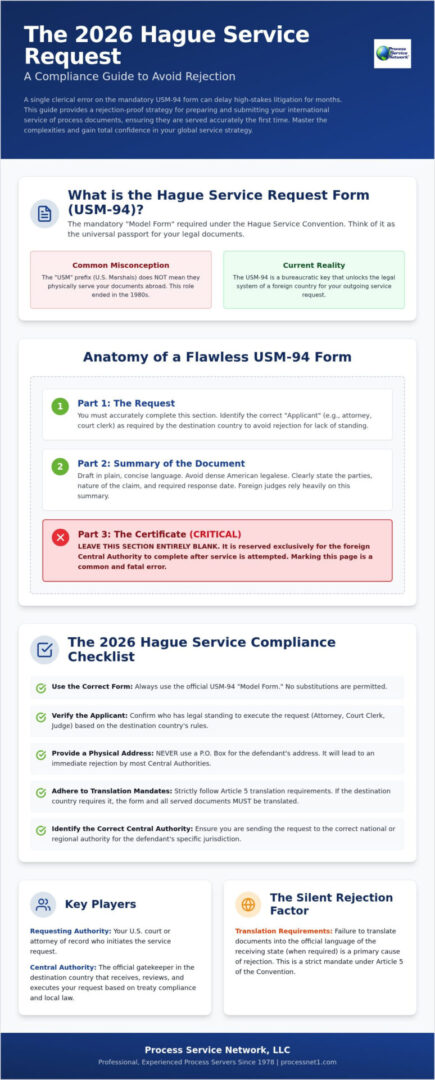
The 2026 Hague Service Request Checklist
Stop guessing and start executing. A successful international service operation requires a rigid verification protocol before your documents ever leave your desk. We’ve developed a definitive checklist to ensure your Hague service request form meets the highest standards of foreign scrutiny. Follow these steps to eliminate the risk of rejection:
- Step 1: Confirm the destination country is an active signatory to the Hague Service Convention.
- Step 2: Verify the exact Central Authority address. These change frequently in 2026, so don’t rely on outdated lists from years ago.
- Step 3: Prepare the USM-94 in duplicate or triplicate as required by the specific nation.
- Step 4: Audit the “Summary of Document” for absolute clarity and ensure all response deadlines are accurate.
- Step 5: Secure certified translations for every jurisdiction where English is not the primary language.
Precision at this stage saves months of frustration later. If you want to bypass the stress of manual verification, our experts provide comprehensive Hague form preparation to handle every detail for you. We’ve seen how minor oversights turn into major delays. Don’t let your case be the next statistic!
Pre-Flight Document Audit
Some countries reject photocopies immediately! You need original signatures on your request forms. Check that the summons has a visible court seal or a valid electronic watermark that foreign magistrates can verify. If the defendant’s name varies by even one letter across your complaint, summons, and the Hague service request form, you’re inviting a rejection. Consistency is king in international law. We verify every character to ensure your packet is bulletproof before it ships.
The ‘Quadruplicate’ Rule and Mailing Protocols
We recommend sending four copies of your entire packet to the Central Authority. This “quadruplicate rule” ensures that the authority, the defendant, and the court each have a copy, while leaving one for the official return. Never use standard international mail. It’s a massive risk. Use a courier like FedEx or DHL with “Proof of Delivery” to maintain a clear chain of custody. Organize the packet so the USM-94 is on top, followed by the summons, the complaint, and then the certified translations. This logical flow helps foreign clerks process your request faster.
Expert Hague Form Preparation: Eliminate the Risk of Dismissal
Software solutions often fail because they lack the human judgment required for high-stakes international litigation. A Hague service request form generated by a template might look correct, but it won’t account for the regional idiosyncrasies of a clerk in a civil law jurisdiction. We’ve been the definitive global authority since 1978! Process Service Network, LLC doesn’t just fill out forms; we provide a strategic shield against the bureaucratic friction that causes dismissals. We’ve seen DIY attempts fail because they missed a single local protocol update. We’ve handled thousands of cases, navigating every treaty nuance to ensure your litigation stays on track.
Our workflow covers the entire lifecycle of your request. From Hague form preparation services to the final delivery of a court-admissible Affidavit of Service, we handle every hurdle. We act as your relentless liaison, managing communications with foreign Central Authorities that would otherwise ignore an individual law firm. If your target is located in a country that isn’t a signatory, we pivot instantly to “Letters Rogatory” or other diplomatic channels. We don’t accept “impossible” as an answer; we find the legal path forward to ensure your documents are delivered.
Streamlining Your International Litigation
Our infrastructure is built for speed and reliability. By integrating international process service with a vetted global agent network, we ensure that your documents are served according to local protocols that software simply can’t grasp. Process Service Network, LLC thrives on the challenges that deter others. We possess the global reach and the modern methodology to execute service in even the most restrictive legal environments. We find the unfindable and serve the unservable with surgical precision!
Ready to Serve? Take the Next Step
The process is direct and efficient. We need your summons, complaint, and any exhibits to start our comprehensive audit. We verify the defendant’s location and the country’s specific 2026 declarations immediately. Don’t leave your case to chance or automated tools. Our veteran team provides the absolute transparency you need to manage client expectations effectively. Trust the authorities at Process Service Network, LLC to handle your Hague Service Request with precision!
Secure Your International Service Strategy Today
Mastering the 2026 compliance standards for your Hague service request form is the only way to ensure your case moves forward without costly delays. You’ve seen how address precision, blank certificate pages, and certified translations aren’t just suggestions; they are rigid treaty mandates. A single clerical error can stall your litigation for six months or more. Don’t let a foreign Central Authority dictate your timeline! You deserve a partner who navigates these complexities with absolute transparency and speed.
We’ve been serving the legal community since 1978 and maintain a global network of professional process servers. Our team specializes in complex international litigation support and handles the most difficult cases with a proven can-do attitude. We eliminate the uncertainty of the USM-94 by managing every detail of the preparation and delivery process. It’s time to move your case from the filing cabinet to the courtroom with total confidence. Get Expert Hague Form Preparation Now and ensure your international legal documents are served accurately the first time. Your success abroad starts with the right partner. Let’s get to work!
Frequently Asked Questions
Where can I download the official Hague service request form (USM-94)?
You can download the official Hague service request form directly from the U.S. Marshals Service website or the HCCH official portal. Ensure you are using the current version of the USM-94 Model Form. This document consists of three mandatory parts: the Request, the Summary, and the Certificate. Using an outdated or unofficial version will result in immediate rejection by the foreign Central Authority! Always verify you have the complete three-page set before filing.
Do the U.S. Marshals still handle the service of Hague Convention requests?
No, the U.S. Marshals Service does not physically serve outgoing international documents. They haven’t performed this function since the 1980s! While the form still bears the “USM” designation, their role is now limited to processing foreign service requests coming into the United States. For your outgoing litigation, you must submit the completed form to the destination country’s Central Authority yourself or through a professional preparation service like ours. Don’t wait for the government to act!
Is a translation always required for a Hague service request form?
Translation requirements depend entirely on the specific declarations made by the destination country under Article 5 of the Convention. Many member nations mandate that all documents, including the Hague service request form, be translated into their official national language. Even if a country accepts English, providing a bilingual form is often a superior strategy for speed. Never assume a translation is optional! Always verify the current language protocols on the HCCH website before you ship.
What happens if the foreign Central Authority rejects my USM-94 form?
A rejection means your documents are returned with a notice of non-compliance, often after a delay of four to six months. You must then correct the errors and restart the entire submission process from scratch! This includes paying new courier fees and potentially missing critical court deadlines. Rejections typically occur due to translation gaps, incorrect address formatting, or signing by an unauthorized party. Precision is your only protection against these devastating and expensive litigation delays.
Can I serve a foreign corporation via mail instead of using the Hague form?
You can only serve via mail if the destination country has not filed a formal objection to Article 10(a) of the Convention. However, service by mail is a high-risk gamble! Even if technically allowed, many foreign courts refuse to enforce judgments based on mail service. For example, understanding the specific rules governing service by mail under the Hague Convention in Canada is critical before relying on the postal channel for Canadian defendants. Using the formal Request for Service is the gold standard. It provides a rock-solid Certificate of Service that is recognized globally and protects your judgment from future jurisdictional challenges.
How long does it typically take for a foreign Central Authority to process a request?
Processing times vary by country, typically ranging from four to six months. In some jurisdictions, the process can drag on for a year or more! Factors like local bureaucracy, translation accuracy, and the specific region of the defendant influence the final timeline. You cannot rush a sovereign government. Start your preparation early to account for these unavoidable international windows. Our seasoned experts help you navigate these timelines with maximum efficiency and zero wasted effort.
Who is authorized to sign the Hague service request form in the United States?
In the United States, the form must be signed by an attorney of record, a clerk of the court, or a judge. While any adult non-party can serve process domestically, they are not authorized to execute a USM-94! Some foreign countries are extremely strict and may only recognize a signature from a judicial officer. Verify the destination country’s specific “Applicant” requirements to ensure your signer has the recognized standing to initiate the request successfully.
Does the Hague Convention apply to criminal or family law cases?
The Convention applies strictly to civil and commercial matters. It does not cover criminal cases under any circumstances! However, most family law matters, such as divorce or child support, are considered civil under the treaty and utilize the standard request framework. If you are dealing with a criminal matter, you must use Mutual Legal Assistance Treaties (MLATs) instead. Always confirm your case type fits the “civil or commercial” definition before you begin the preparation process.
