

Due Diligence: International Service of Process Guide 2026
Your entire international litigation could collapse because you didn’t check a specific local registry in a country halfway across the globe. It’s a harsh reality! Courts in 2026 have zero patience for “insufficient effort” when it comes to serving foreign defendants. If you can’t prove you’ve exhausted every treaty-compliant avenue, your case is dead on arrival. Mastering due diligence for international service of process is no longer optional. It’s the absolute bedrock of your legal strategy! You need a process that survives the most aggressive motions to dismiss.
We know that navigating 130 different Hague Service Convention parties, including new signatories like Algeria and Vietnam, is often a logistical nightmare. It’s confusing, expensive, and incredibly high-stakes. This guide provides the definitive roadmap to securing court-admissible proof of service that stands up to any scrutiny. We’ll break down the specific investigative steps required by modern courts, the technical nuances of Hague form preparation, and how to successfully pivot to alternative service when traditional methods fail. Let’s get your case moving forward with total confidence and operational precision.
Key Takeaways
- Learn the exact standards of due diligence for international service of process required to survive a motion to dismiss in 2026!
- Identify the correct Central Authority and execute Hague Convention protocols with absolute precision.
- Discover the elite investigative tactics used to locate evasive defendants across global borders.
- Master the evidentiary requirements to secure court-approved orders for Service by Publication or Service by Mail.
- Leverage a global network of professionals to handle the high-stakes, “hard-to-serve” cases that others decline!
Mastering Due Diligence for International Service of Process
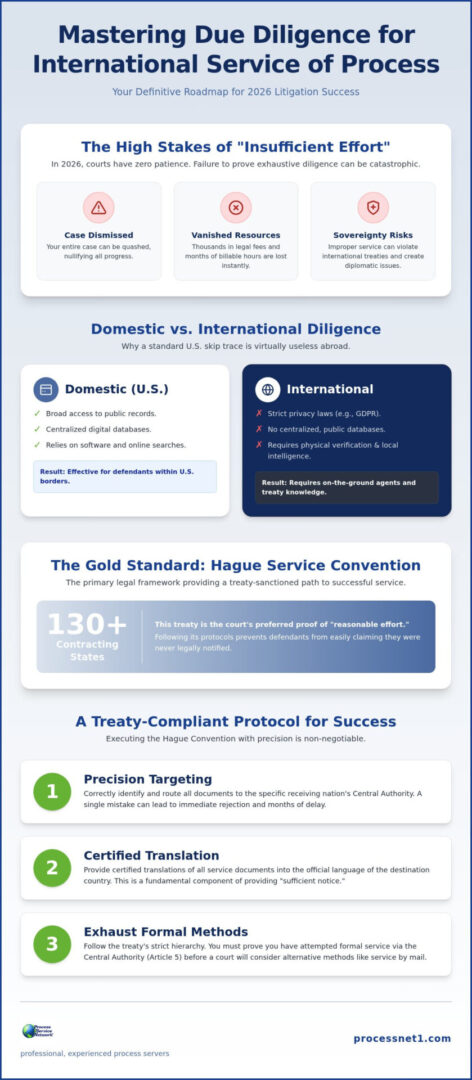
International due diligence is the exhaustive search for a defendant who has crossed U.S. borders. It isn’t just a courtesy; it’s a procedural mandate. Mastering due diligence for international service of process is no longer optional for any serious litigation. If you’re litigating in 2026, you can’t rely on a simple Google search or a domestic skip trace. U.S. courts demand a significantly higher “reasonable effort” for foreign service because the stakes of violating international sovereignty are massive. You have to prove you’ve tried everything before the court will grant you any leeway.
Failing to meet these rigorous standards is a recipe for disaster. You risk seeing your entire case quashed due to “insufficient effort.” That means thousands of dollars in legal fees and months of billable time vanish instantly. The ultimate goal of this exhaustive process is to secure a court-approved Affidavit of Diligence. This document proves to a judge that you’ve done the work, followed the law, and earned the right to proceed with your case.
The Legal Necessity of “Reasonable Effort”
Constitutional Due Process requires that a defendant receives actual notice of a lawsuit. When that defendant is abroad, the court’s scrutiny intensifies. Judges look for evidence that you’ve attempted every viable method allowed under the Hague Service Convention or specific local laws. If the defendant is in a non-Hague country, “Reasonable Effort” often involves navigating complex diplomatic channels or letters rogatory. You must demonstrate a persistent, documented attempt to locate the party. International due diligence is the exhaustive, treaty-compliant search for a defendant across foreign borders to ensure all procedural requirements are met before seeking alternative service methods.
Why Domestic Diligence Fails Abroad
Don’t make the mistake of thinking a standard U.S. skip trace works in Paris or Tokyo. In the U.S., we enjoy broad access to public records, but the rest of the world operates differently. Strict privacy laws like the GDPR in the European Union or tight state controls in Asia make digital tracking nearly impossible from a desk in America. A skip trace that works in Florida is virtually useless for a defendant in China or Brazil. These jurisdictions don’t have centralized, public-facing databases for residential addresses. You can’t just “buy” a report. Due diligence for international service of process requires physical verification and local knowledge that software simply cannot provide. You need a partner who knows how to navigate these foreign landscapes with assertive precision and on-the-ground intelligence.
The Hague Convention and Diligence Standards in 2026
The Hague Convention serves as the primary legal framework for cross-border litigation. In 2026, with the addition of parties like Algeria and Vietnam, the treaty now governs service across 130 contracting states. Due diligence for international service of process under this treaty begins with the precise identification of the receiving nation’s Central Authority. It is a rigorous administrative task. Mistakenly routing documents to the wrong government ministry or failing to adhere to specific state declarations can lead to immediate rejection, causing months of delay and potential statute of limitations issues.
Utilizing Hague Convention process service is the most secure path for any U.S. litigator. It provides a treaty-sanctioned method that prevents defendants from claiming they were never legally notified. Courts view this structured approach as the definitive proof of “reasonable effort,” making it significantly harder for opposing counsel to quash service during the preliminary stages of a trial.
Translation as a Component of Diligence
A frequent pitfall in international service is the failure to provide certified translations. Many Central Authorities will not accept or execute a request if the documents are not in their official language. This is more than a clerical requirement; it is a fundamental part of providing “sufficient notice” to the defendant. Process Service Network, LLC integrates certified legal document translation directly into every service request. This ensures that the recipient cannot claim a lack of understanding and that the foreign authority processes the request without administrative friction.
Exhausting Treaty-Approved Methods
Diligence requires following the treaty’s hierarchy, starting with the formal methods outlined in Article 5. While Article 10 allows for “Service by Mail” in some instances, it is only valid if the destination country has not formally objected to that specific provision. In 2026, relying on mail service without verifying a country’s current standing is a major risk. We provide the assertive leadership needed to navigate these technical objections. If you are struggling with the complexities of Hague Form Preparation, our team at Process Service Network, LLC has the veteran expertise to ensure your filing is accurate and treaty-compliant from the start!
Elite Tactics for Locating Defendants Worldwide
Finding a defendant who has fled the U.S. requires more than a standard search. It’s a high-stakes hunt that demands a “No-Nonsense” operation. When a subject is intentionally evasive, you need a Diligence Search that spans continents and penetrates local barriers. We’ve been perfecting this since 1978! We don’t just look at public records; we leverage a global infrastructure to track subjects who think they’ve disappeared. This level of intensity is the core of due diligence for international service of process in modern litigation.
Our approach is assertive and relentless. We handle the cases other servers decline because we have the reach they lack. If your defendant is hiding in a high-rise in Dubai or a villa in Spain, a simple desk search won’t find them. You need a partner with a seasoned, “can-do” attitude and the resources to back it up. We provide total transparency throughout the search, ensuring you have the evidence needed to move your case forward.
International Skip Tracing and Database Research
Skip tracing on a global scale isn’t about browsing Facebook. It’s about deep-dive cross-referencing. We analyze global shipping manifests, international professional licenses, and foreign utility records. Many competitors rely on social media “diligence,” but that’s a dangerous shortcut. In 2026, courts view social media searches as a starting point, not the finish line. Our methodology covers over 100 countries, utilizing proprietary databases that aren’t available to the general public. We find the “unfindable” by looking where others don’t even know to start.
Field Investigations in Foreign Jurisdictions
Physical site visits are often the only way to secure court approval for an Affidavit of Diligence. If you can’t prove a human being actually went to the “last known address,” a judge might quash your service. That’s why “On-the-Ground” local agents are mandatory. Our experts possess the local language skills and cultural knowledge to uncover hidden subjects. They know how to navigate local municipal records and engage with local authorities without triggering alarms. This field intelligence is vital. It turns a “cold lead” into a verified location, providing the operational precision your case deserves!
- Physical Verification: Mandatory site visits to confirm or rule out residency.
- Local Intelligence: Utilizing agents who understand regional nuances and records access.
- Documented Evidence: Detailed reports that satisfy the most skeptical U.S. judges.
Documenting Diligence to Secure Alternate Service Orders
Personal service is always the primary goal, but it isn’t always possible when dealing with evasive defendants across global borders. When you hit a wall, the transition to “Service by Publication” or “Service by Mail” becomes your only path forward. Securing a court order for these alternate methods depends entirely on your documented due diligence for international service of process. A U.S. judge won’t simply take your word for it; they need a mountain of evidence showing that every reasonable avenue was exhausted. This is where your Affidavit of Due Diligence becomes your ultimate legal weapon!
For more procedural context on the entire lifecycle of a case, consult our International Process Service guide. We ensure that every attempt is logged with surgical precision, providing the transparency required to eliminate judicial uncertainty. We don’t just “check the box.” We build a narrative of effort that makes it impossible for a judge to deny your motion.
The 5 Pillars of a Court-Ready Affidavit
A weak affidavit is a gift to the defense. To survive a motion to dismiss in 2026, your documentation must be bulletproof. We follow a rigorous framework to ensure your filing is court-ready. It’s about showing, not telling. Your affidavit needs to include these critical elements:
- Step 1: Documented attempts at every known physical address, including specific dates, times, and physical descriptions of the premises.
- Step 2: Verified proof of inquiry with neighbors, current or former employers, and known associates in the target country.
- Step 3: Results of comprehensive database searches and professional Diligence Searches that go beyond basic public records.
- Step 4: Verification of the defendant’s current country of residence and a detailed analysis of their treaty status under the Hague Convention.
Winning the Motion for Service by Publication
Think of service by publication as your final strategic move. It’s the last resort when a defendant has successfully vanished into a foreign jurisdiction. The court will weigh your “diligence” against the defendant’s constitutional right to notice. If your process server provides a vague log, your motion will fail. We provide a comprehensive evidence package that includes skip trace reports, field agent statements, and treaty-compliance certificates. This no-nonsense documentation makes it easy for a judge to approve your request. Don’t let a sloppy affidavit stall your litigation. If you need a partner who understands the high stakes of international law, initiate your Diligence Search with us today!
Why Process Service Network, LLC is the Definitive Global Choice
Choosing the right partner determines whether your case moves to trial or hits a dead end. Since our founding in 1978, Process Service Network, LLC has navigated the most complex international complications with unwavering confidence. We aren’t just another service provider; we’re a seasoned veteran in a field where procedural errors result in immediate dismissal. While other firms might shy away from “hard-to-serve” cases, we thrive on the challenge. We provide the assertive leadership required to handle high-stakes litigation where due diligence for international service of process must be beyond reproach.
Transparency is the foundation of our partnership. In the high-pressure world of international litigation, you cannot afford “hidden variables” or surprise fees. Process Service Network, LLC operates with absolute clarity regarding costs and timelines. We use a plain-spoken approach to financial matters, ensuring you have the information needed to manage your client’s expectations. Our methodology is built for the modern legal landscape of 2026, combining decades of experience with an energetic, problem-solving attitude that gets results!
A Global Network with No Borders
Our infrastructure spans every continent, offering a level of reach that few can match. We’ve spent nearly fifty years cultivating a network of verified local agents who operate with surgical accuracy. This isn’t just about presence; it’s about the seamless integration of every service we’ve discussed, from Hague Form Preparation to certified legal document translation. Process Service Network, LLC acts as your relentless problem solver, managing the logistical burden so you can focus on your legal strategy. We navigate foreign landscapes with the ease of an expert, ensuring your documents reach their destination regardless of local barriers.
Initiate Your International Service Today
Starting your engagement is a fast-paced, efficient process designed to give you immediate momentum. We’ve eliminated the bureaucratic friction typical of international service. Our “Fast Track” onboarding ensures that your case moves from the initial intake to the field investigation without delay. Don’t risk your litigation by settling for a local server who lacks global authority. Trust the veterans who have defined the industry since 1978. Contact Process Service Network, LLC to initiate your search today. We find them, we serve them, you win.
Secure Your Litigation with Global Authority
You’ve seen the risks of cutting corners. In 2026, the standard for due diligence for international service of process is higher than ever. You must navigate the Hague Convention with surgical precision and document every field investigation to satisfy the court. Don’t let an evasive defendant or a complex treaty derail your case! We’ve been serving the legal community since 1978 as specialists in Hague protocols and Letters Rogatory. Our global network uses verified local agents to find the unfindable and verify addresses that others miss.
We provide the assertive leadership and transparent pricing you need to move forward with total confidence. It’s time to leverage decades of expertise to protect your client’s interests. We possess the infrastructure to handle your most difficult cases with ease! Stop guessing and start winning with a partner who knows the terrain. Initiate Elite International Process Service Now and get your litigation back on track. Your success across borders starts with a single, decisive step!
Frequently Asked Questions
What is considered “due diligence” in international process service?
It’s the exhaustive, documented search for a defendant outside the U.S. to ensure constitutional notice. This involves checking local registries, utility records, and conducting physical site visits. Due diligence for international service of process requires proving to a judge that you’ve exhausted all treaty-compliant methods before asking for alternative service. It’s about building a narrative of effort that survives a motion to dismiss and protects your litigation.
Can I serve someone internationally via email if I can’t find their address?
You can only serve via email if you obtain a court order under FRCP Rule 4(f)(3). Judges won’t grant this until you demonstrate exhaustive diligence in trying to find a physical address first. You must prove the defendant is actually using that specific email account. Even then, the method can’t be prohibited by an international agreement like the Hague Convention. It’s a strategic pivot, not a shortcut.
How many attempts are required for international due diligence?
There’s no fixed number, but courts typically look for at least three attempts at different times and days. For international cases, “reasonable effort” is interpreted more strictly. You need to document every attempt with specific details. This includes speaking with neighbors or checking local municipal records. We provide the assertive documentation needed to show the court that your effort was both relentless and complete.
Is a US skip trace sufficient for a defendant in a foreign country?
No, a domestic skip trace is almost always insufficient for a defendant abroad. U.S. databases don’t pull from foreign utility companies or local government registries. Due diligence for international service of process requires on-the-ground intelligence and access to proprietary international databases. Relying on a U.S. report is a fast way to get your service quashed. You need a partner with a proven global infrastructure.
What happens if the Hague Convention Central Authority cannot find the defendant?
If the Central Authority fails to locate the subject, you’ll receive a certificate of non-service. This document is vital evidence for your next move. It proves that even the foreign government couldn’t find them! You can then use this, along with your private Diligence Search results, to petition the U.S. court for Service by Publication. It’s a methodical transition from traditional to alternative service.
How long does an international diligence search typically take?
A comprehensive search usually takes between two to four weeks depending on the jurisdiction. Some countries have centralized records that are easier to access, while others require physical investigations by local agents. We move with speed and accuracy to minimize delays. You’ll receive real-time updates so you can keep your litigation moving forward without the stress of “hidden variables” or frustrating administrative black holes.
Do I need to translate my due diligence affidavit into the local language?
You must translate the affidavit if you’re submitting it to a foreign Central Authority or a local court for enforcement. Many jurisdictions flatly reject English-only documents. Even if it’s just for a U.S. judge, having a translated version shows the court you’ve respected local sovereignty and followed international protocols. We integrate Legal Document Translation into our workflow to ensure your evidence is bulletproof in both jurisdictions.
