
UIDDA States: Where the Uniform Subpoena Process Applies
Nearly every U.S. state, plus the District of Columbia, has adopted the Uniform Interstate Depositions and Discovery Act (UIDDA) in some form. If you need a witness or records from another state, you can usually take your subpoena to the court clerk in the county where that person lives or the records are kept, and the clerk issues a local subpoena. The step people get wrong is what happens next: the local subpoena has to be served the way that state requires. That is where we come in, as we serve subpoenas and court papers nationwide.
TL;DR
- The UIDDA is a model law that lets you use a subpoena from the state where your case is pending to get testimony or documents from a non-party in another state.
- Most states have adopted it, but each one wrote its own version. Wording, fees and local steps differ, so read the rule in the state where the witness is.
- The usual path: get the subpoena from the trial court, present it to the clerk in the discovery state, get a local subpoena issued, serve it, then deal with any objections in the discovery state’s court.
- A request to the clerk is generally not a court appearance. A motion to quash or enforce usually is, and that normally needs a lawyer licensed in the discovery state.
- Service mistakes are the most common reason a subpoena fails. We handle service in California and nationwide.
Table of Contents
- What the UIDDA does
- Which states use it
- How an out-of-state subpoena works, step by step
- What a UIDDA subpoena is, and whether the witness can ignore it
- Subpoenas, summonses and the difference that trips people up
- A worked example
- Planning around timing
- Who needs what
- Getting your subpoena served
- FAQ
- Sources
What the UIDDA does
The Uniform Law Commission, a group that drafts model laws for states to adopt, promulgated the UIDDA in 2007. Before that, getting a deposition or documents from someone in another state was slow. A lawyer often had to ask a court for a commission or letters rogatory (a formal request from one court to another), or hire a local attorney to open a separate case.
The UIDDA replaces that with a clerk-level process. In plain terms:
- The trial state is where your lawsuit is pending.
- The discovery state is where the witness lives or works, or where the documents are.
- You take the subpoena issued in the trial state to the clerk in the discovery state. The clerk issues a local subpoena that carries the same terms.
In a state that follows the model act closely, you don’t need a judge to sign off first. You don’t need a commission or letters rogatory, and you don’t need a local lawyer just to get the subpoena issued. Rules about the discovery itself, such as how far the subpoena can reach and who can object, come from the discovery state.
The UIDDA covers non-party witnesses. If the person you want is a party to your case, you generally use the discovery tools in your own case instead.
Which states use it
The short answer is most of them. The Uniform Law Commission has promoted the act since 2007, and adoption has grown steadily since. Reports from late 2025 named Massachusetts, Missouri and New Hampshire as the states that had not yet adopted a version. Adoption status can change with any legislative session, so treat any list as a starting point, not a final answer.
Two cautions matter more than the headcount.
“Adopted” does not mean “identical.” Some states enacted the uniform text almost word for word. Others passed it through court rules rather than a statute, or tweaked it. A few states have older procedures that still sit beside it. Some courts treat their own subpoena rules as having effectively adopted the UIDDA’s approach even though the statute has a different name.
The version that counts is the discovery state’s. If your case is in Texas and the witness is in Oregon, Oregon’s rule on foreign subpoenas controls how the clerk handles your paperwork. Texas rules still govern your case.
To check a state quickly:
- Search the state’s code or court rules for “interstate depositions and discovery” or “foreign subpoena.”
- Look at the county clerk’s or state court’s website. Many post a page or a form for out-of-state subpoenas.
- Note the fee, the number of copies and any cover sheet the clerk wants.
- Call the clerk’s office if the rule is silent on a detail. Clerks answer procedural questions, though not legal ones.
If the witness is in a state with no UIDDA-style process, the older route may apply: a commission, letters rogatory or a local action. That takes longer, so build time into your schedule.
How an out-of-state subpoena works, step by step
Here is the typical sequence, with the places where it tends to go wrong.
1. Get the subpoena in the trial state
Issue the subpoena from the court where your case is pending, using that court’s form. It must name the witness, state whether you want testimony, documents or both, and give a time and place that make sense for the witness. Most trial courts let attorneys issue subpoenas as officers of the court, but check your local rules.
Where it goes wrong: a place of deposition that is too far from where the witness lives or works. The discovery state’s rules on reasonable distance and burden can apply, so pick a location near the witness.
2. Present it to the clerk in the discovery state
You present the trial-state subpoena to the clerk of court in the county where the discovery will happen. Under the model approach, the clerk assigns a case number and promptly issues a local subpoena that incorporates the terms of the original. Oregon’s rule on foreign subpoenas, for example, works this way, and California has a parallel set of provisions in its Code of Civil Procedure.
Where it goes wrong: going to the wrong county, bringing too few copies, or missing the clerk’s fee. Some clerks also want the subpoena in a particular format or with a local form attached.
This is also the step where many people ask whether they need a local lawyer. Under the model act, presenting the subpoena to the clerk is generally not treated as a court appearance, so you typically don’t need to be licensed in the discovery state or admitted there for this one task. Confirm in the state’s rule, because some states have added conditions.
3. Serve the local subpoena
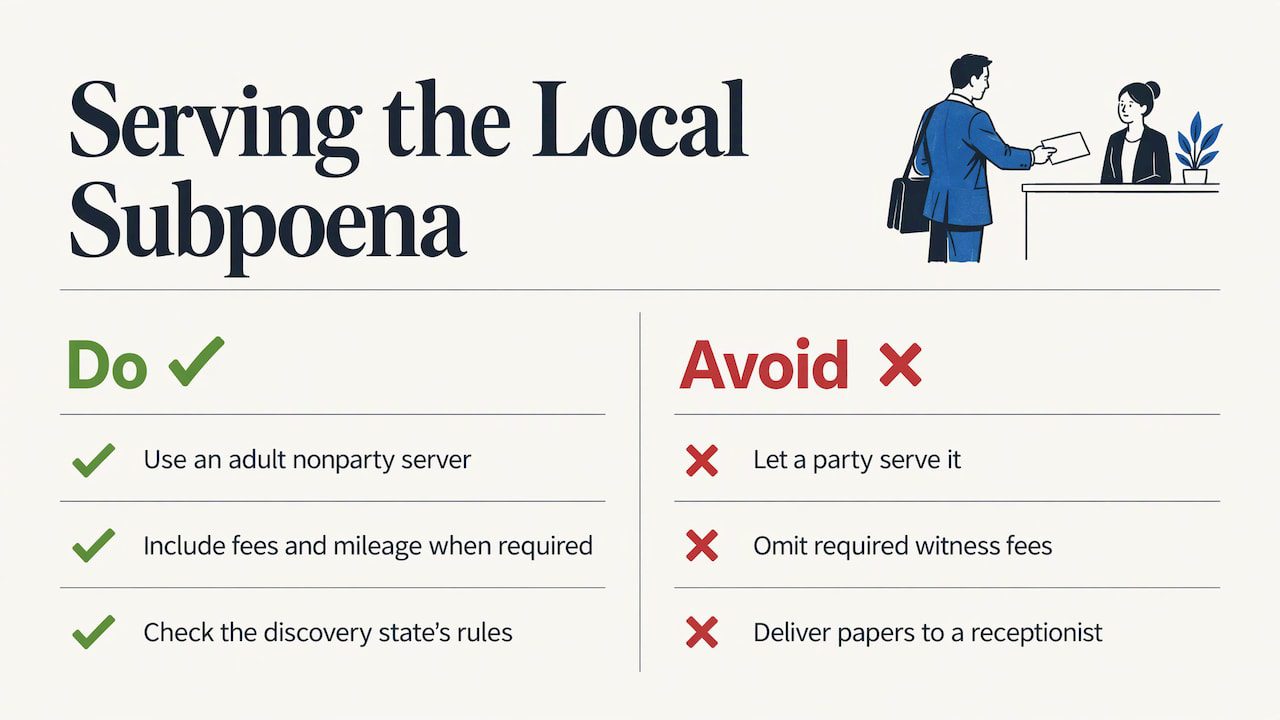
The local subpoena has to be served on the witness following the discovery state’s rules. That usually means personal delivery by an adult who is not a party to the case, often with a witness fee and mileage payment when the rules call for it. Some states also require specific wording, advance notice to the other parties, or a minimum number of days before the deposition date.
Where it goes wrong: this is the step that sinks the most subpoenas. Someone who is a party, or who works for one, serves it. The witness fee is missing. The papers go to a receptionist rather than the person named. Or the witness dodges and the deadline slips. If the witness ignores a subpoena that was served incorrectly, you have nothing to enforce.
A professional process server who knows the local rules avoids most of these problems. We serve subpoenas, and our service of process runs from the Los Angeles area to nationwide. When you hand us the local subpoena, we handle the delivery and the proof of service the court will want.
4. Handle objections in the discovery state
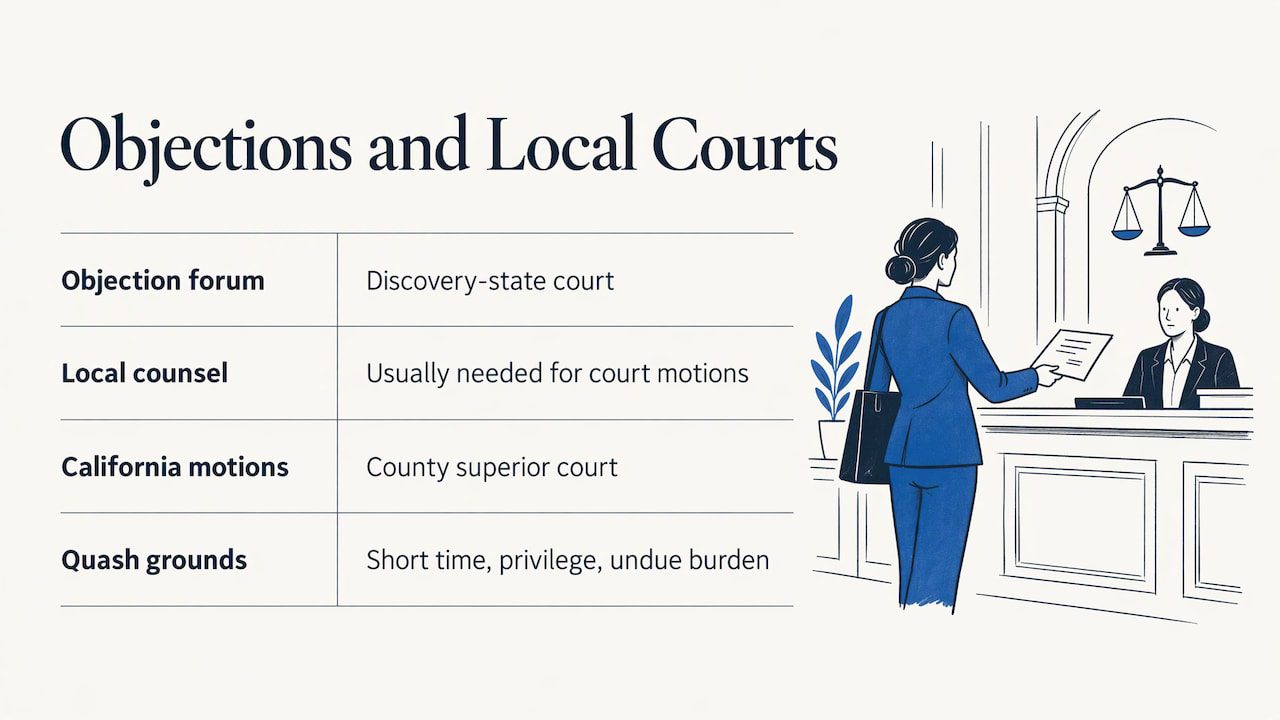
If the witness objects, the fight happens in the discovery state’s court, under that state’s rules. That is by design. The New Jersey Appellate Division reasoned in a 2019 case that the discovery state has a real interest in protecting its own residents who get pulled into someone else’s lawsuit, and that motions to quash or modify belong in its courts. The trial state still decides disputes between the parties themselves.
This is where a local lawyer becomes necessary. Filing, answering or appearing on a motion to enforce, quash, modify or for a protective order is normally treated as an appearance in the discovery state’s court. If you are the one issuing the subpoena, you will likely need counsel licensed there for that part. California’s code, for example, directs those requests to the superior court in the county where discovery is happening, under California’s own procedures.
Typical grounds for a motion to quash include too little time to comply, privileged material, and undue burden. Delaware’s court guidance on out-of-state subpoenas lists these, and similar grounds appear in most states.
What a UIDDA subpoena is, and whether the witness can ignore it
A UIDDA subpoena is the local subpoena that the discovery-state clerk issues after you present your trial-state subpoena. It looks and works like any other subpoena in that state.
Can the witness just ignore it? Not safely. Once it is issued and properly served, it carries the weight of that state’s court. A person who fails to obey without an adequate excuse can face sanctions, and the usual way to resist is to file a motion in the discovery state, not to stay silent. If you are the witness reading this, talk to a lawyer licensed in your state about your options and deadlines.
If you are the party trying to compel testimony, the key is clean service. A witness can point to defective service as a reason the subpoena is not enforceable. Serving it correctly the first time removes that argument.
Subpoenas, summonses and the difference that trips people up
People sometimes mix up a subpoena and a summons. A summons tells a defendant that a case has been filed against them. A subpoena orders a person, usually a non-party, to testify or hand over records. The UIDDA deals only with subpoenas for discovery. If you also need to serve a defendant in another state, that is a separate task with its own rules. Our guide on the difference between a summons and a subpoena walks through it.
If the witness or the documents are outside the United States, the UIDDA does not apply. You are in international territory, where treaties like the Hague conventions or local law decide the method. See our overview of serving legal documents abroad and the page on taking evidence abroad.
A worked example
Say your firm is litigating a contract case in Illinois. A former vendor, not a party, lives in Sacramento County, California, and you need a deposition and the vendor’s invoices.
- You issue a subpoena from the Illinois court for the deposition and the documents, with a Sacramento-area location and a reasonable date.
- You present it to the Sacramento County court clerk, following California’s out-of-state subpoena procedure. The clerk issues a California subpoena with the same terms.
- A process server serves the California subpoena on the vendor personally, tenders any required witness fee and signs a proof of service.
- The vendor’s lawyer objects to the document request as too broad. The motion is heard in the California court under California rules, so you retain a California attorney to respond.
- After the ruling, the deposition goes ahead, or the scope is narrowed.
At step 3, our California service of process rate is $135, and our Los Angeles area rate is $95. If a deposition date is close, our rush service starts from $95. Notary work is $25 per notarization. These are the published rates on our services page. Nationwide service is quoted for the job, so you get the price before we start.
Planning around timing
The UIDDA speeds up issuance, but the full process still takes planning. A few habits keep a deposition from slipping.
- Start the discovery-state steps early. Clerk processing times differ by county, and some counties are slower than others.
- Give the witness reasonable notice. Check the discovery state’s minimum notice and compliance periods before you set a date.
- Confirm the fee rules. Witness fees and mileage differ by state, and a missing payment can be used against you.
- Serve the other parties too. Most states require notice to all parties in the underlying case, as they would for any deposition.
- Keep proof of service. A signed, dated proof of service is what you will need if the witness does not show.
If a witness is hard to find, the service itself becomes the bottleneck. We also offer skip tracing and diligence searches for locating people before a subpoena goes out, which can save the cost of failed attempts.
Who needs what
Law firms use the UIDDA most. The practical benefit is skipping local counsel for issuance, but you still need local counsel for contested motions. Plan the budget with that in mind.
Individuals who are self-represented can use the process too, though clerks differ on how they handle pro se filers. Ask the clerk what they require, and note that a subpoena must be served by someone other than you.
Businesses are often the recipients, as non-party witnesses holding records. If you run a business and receive an out-of-state subpoena, check that it came through the local clerk and was served properly, then speak to a lawyer licensed in your state about any response.
Getting your subpoena served
Once the clerk issues the local subpoena, the job is delivery that holds up if challenged. We serve subpoenas and court papers across California and nationwide, with upfront pricing and no hidden fees. For a California witness, you can see the rates above and order on our services page. For witnesses in other states, our US process service page explains how nationwide service works.
If you also need to serve a company rather than an individual, see our guide to serving papers on a business, which covers who can accept papers on the company’s behalf.
FAQ
Did Texas adopt the UIDDA?
Texas has its own rules for out-of-state subpoenas, and recent reports describe a Texas Supreme Court rule bringing it closer to the UIDDA approach. Because the details have been changing, read the current Texas Rules of Civil Procedure or ask the clerk in the county where the witness is.
What is a UIDDA subpoena?
It is the subpoena the clerk in the discovery state issues after you present your trial-state subpoena. It carries the same terms as the original but is issued under the local state’s authority. It is served on the witness like any local subpoena.
Can I ignore a subpoena from another state?
Not safely. A subpoena issued locally through the UIDDA can be enforced by that state’s courts, and failing to obey without a good excuse can bring sanctions. A witness who wants to object should file a motion in the discovery state, and should talk to a lawyer licensed there.
Do I need a local lawyer to use the UIDDA?
Usually not to get the subpoena issued, since presenting it to the clerk is generally not a court appearance. You will typically need one licensed in the discovery state if someone moves to quash, enforce or modify the subpoena. Check that state’s rule to be sure.
Does the UIDDA work for witnesses outside the United States?
No. It covers subpoenas between U.S. states and territories. For witnesses or evidence abroad, the method depends on treaties and the other country’s law. We handle international service and taking evidence abroad.
Sources
- Summons vs Subpoena Explained
- Serving Legal Documents Abroad
- Taking Evidence Abroad
- Service of Process pricing
- US Process Service Anywhere
- Serving Papers on a Business
