
Skip Tracing Cost: What You Will Pay in 2026
Skip tracing costs anywhere from a few cents per record for automated bulk data to several hundred dollars for a legal-grade locate, and into the thousands for sustained fieldwork or a search abroad. The gap is not random. You are paying for different products: a raw data match, a verified current address you can build a court filing on, or a defendant found in another country. This guide breaks down each tier, what moves the price, and how to budget when the goal is serving legal papers.
TL;DR
- Automated database tools price by the record, usually in cents, and return unverified data. They suit marketing lists, not court filings.
- A basic investigator database search runs about $100 to $600, with many nationwide traces at $150 to $350. Complex fieldwork starts near $1,000.
- Locating a defendant before service typically adds $50 to $150 to a serving job. Stakeouts are commonly billed hourly.
- The more you know (full name, date of birth, last address), the less the search costs. Searches abroad cost more.
- If the skip trace exists to complete service, price the whole job, locate plus service plus any publication or translation, not the trace alone.
Table of Contents
- What you are actually buying when you buy a skip trace
- Skip tracing cost by tier
- What makes a skip trace cost more
- A worked budget: locating and serving one defendant
- Where skip tracing meets service of process
- Skip tracing when the defendant is abroad
- Is skip tracing legal?
- How to compare skip tracing quotes
- Our perspective
- Get the locate and the service handled together
- FAQ
- Sources
What you are actually buying when you buy a skip trace
Skip tracing means finding where a person or business is now. The phrase covers very different work, and that is why quotes look so far apart.
Automated data lookups. Software matches a name or property address against commercial databases and returns phone numbers, emails and mailing addresses. You pay per record or per match, and the output is a list of leads. Nobody has checked that the person at the address is your defendant.
Investigator database searches. A licensed investigator or legal support professional runs the name through several databases, cross-checks the results and reports a current address with identifiers that match. This is the tier most litigators mean by “legal skip tracing”.
Fieldwork. When the databases are stale, someone calls neighbors, checks employers, visits the address, or watches it. This is billed by time.
International locates. Finding a person overseas may require foreign databases, local agents and translation, which is why it sits in its own price band.
The practical difference for a litigator is accountability. Data you intend to rely on for a service attempt, or for a sworn statement of diligent search, has to come from a process that can be documented and explained to a judge.
Skip tracing cost by tier
| Tier | What it returns | Typical price pattern |
|---|---|---|
| Automated bulk data | Unverified phones, emails, addresses | Cents per record, often with monthly plans |
| Investigator database search | Verified current address, cross-checked | $100 to $600, many nationwide traces $150 to $350 |
| Locate added to a service job | Address for the serving attempt | Typically $50 to $150 extra |
| Stakeout or surveillance | Confirmation the person lives or works there | Commonly $50 to $100 per hour |
| Complex fieldwork | Located subject after sustained effort | From about $1,000, up to $5,000 to $7,500 for sustained nationwide work |
| International service with locate | Located and served abroad | Commonly $500 to $2,000 or more |
Treat these as ranges reported for the United States, not tariffs. Every provider sets its own rates, and a quote for your file is the only number that counts.
Automated tools: cheap per record, narrow in purpose
The top search results for this keyword are mostly about software built for real estate investors and call centers. Their pricing is by the record, subscription tier or volume bracket, and the numbers look tiny: cents per match, with bulk discounts as volume climbs. Those figures are real for what they sell, which is a batch of leads you will call or mail.
For a lawsuit, the arithmetic changes. You are not buying a thousand records. You are buying one reliable answer about one person. A low per-record rate says nothing about whether the address is current, whether it belongs to your defendant rather than a relative with the same surname, or whether you can explain how you got it. Data vendors themselves commonly state that results may be incomplete or out of date and should be reviewed before anyone relies on them. That is fine for marketing and risky as the sole basis for a service attempt.
Investigator searches: the legal-grade middle
The investigator tier is where most litigation locates land. A basic database search by a private investigator is reported at $100 to $600, and many nationwide traces fall between $150 and $350. What you get for the premium over automated data is judgment: someone reads the results, rules out false matches and tells you which address is most likely current.
Fieldwork: priced by effort
When the database trail goes cold, cost follows hours. Surveillance and stakeouts are commonly billed per hour, so a defendant who keeps irregular hours or works nights can double the bill. Complex cases begin around $1,000 in reported figures and can climb much higher when the search is sustained and nationwide.
What makes a skip trace cost more
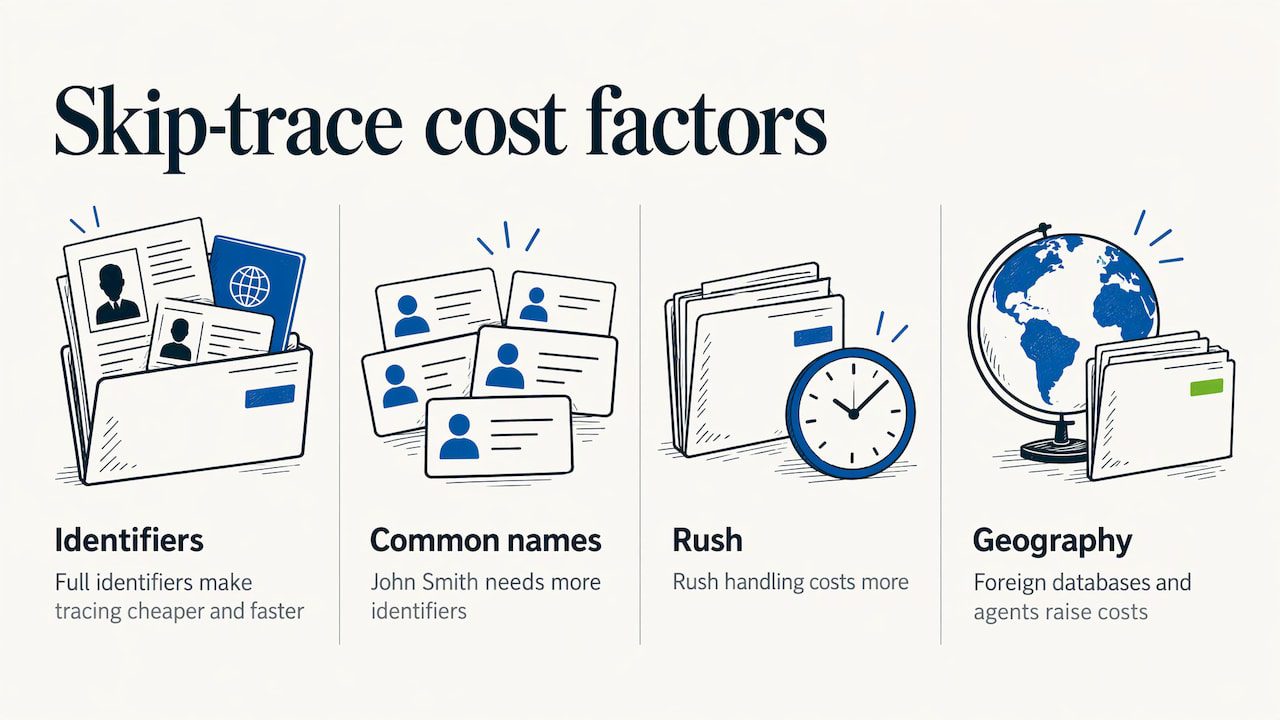
Four things move the price more than anything else.
1. How much you already know. A full name plus a Social Security number, date of birth or last known address is usually cheaper and faster to trace than a first name and a city. Sparse or old information means more manual work.
2. How common the name is. A person called John Smith needs more identifiers to separate from the dozens of matches. This is a reason to gather every identifier in your file before ordering: contracts, loan applications, accident reports, prior court filings.
3. Speed. Rush handling costs more at nearly every provider, because it pulls a person off other work. If your deadline is the statute of limitations or a court-ordered service date, build the lead time in rather than paying for a rush.
4. Geography. International searches cost more because foreign databases, languages, legal systems and overseas investigators may be involved. Data-protection rules abroad can also limit what is available and how it can be moved across borders. The ICCA-IBA roadmap notes that GDPR-style regimes can require a lawful basis and safeguards for cross-border processing and transfers of personal data.
A worked budget: locating and serving one defendant
Suppose you are a small firm with a defendant whose last known address bounced. You have a name, a date of birth and the old address. Here is how a realistic budget builds, using the reported ranges above.
- Database locate. Plan on the investigator-search band of $150 to $350 for a nationwide trace.
- First service attempt at the new address. A locate added to a service job is typically $50 to $150 on top of the serving fee.
- If the address proves stale. Add stakeout hours, commonly $50 to $100 each, or a second trace.
- If you still cannot find the person. Documented diligence supports a motion for alternative service, such as service by publication, which carries its own cost.
Our own published serving fees give you the anchor for the service step: $95 for the Los Angeles area, $135 across California, and a $25 notary fee. Nationwide service is quoted per job.
Where skip tracing meets service of process
For a litigator, a skip trace is not the end product. It is a step toward getting the defendant validly served. That changes how you should shop.
Locate and serve with one provider. When the person who finds the address is the person who serves it, there is no handoff, no second invoice and no gap in the record of what was tried. Our guide to serving someone you cannot locate walks through the sequence of attempts courts expect to see.
Keep the paper trail. Courts that allow alternative service usually require a showing of reasonable diligence. Record what was searched, when and with what result. A search you cannot describe is worth little in a declaration.
Know the fallback. If a defendant truly cannot be found, service by publication may be the court-approved route. Our affiliate runs an online legal notice publication system, and our piece on service by publication today explains how it fits when the whereabouts are unknown.
Skip tracing when the defendant is abroad
Once the person is outside the United States, cost is driven less by the trace itself and more by the service rules that follow it. Reported international service costs commonly run $500 to $2,000 or more, with translation, local agents or judicial officers and international shipping as add-ons. Hague Convention Central Authorities generally do not charge for their own handling, but the ancillary expenses remain.
The EU shows how this works in practice. Under Regulation 2020/1784, the applicant may have to pay or reimburse fees for a judicial officer or a particular method of service, and bears translation costs before transmission.
For budgeting, our international service starts from $395, and translations are $0.29 per word. We prepare the required Hague forms at no additional charge. These guides cover the rest of the picture:
- International service costs, for building a budget before you file
- Hague Convention process service, for how the treaty route works
- Certified translation for service, for the translation step
Is skip tracing legal?
Locating a person is lawful when it is done for a legitimate purpose and through lawful sources. Service of process is a textbook legitimate purpose. The risks come from how information is gathered: deceptive pretexts, unauthorized access, or data that is out of date and wrongly attributed to someone. Laws on access to personal data differ by state and by country, and rules abroad can be stricter than at home.
Three habits keep a locate defensible:
- Define the purpose up front, for example locating a named defendant for service in a specific case.
- Use authorized sources and cross-check at least two of them before treating an address as current.
- Keep a record of what was searched, when, and what it returned.
If your matter involves a regulated type of data or a particular jurisdiction’s privacy law, ask the litigator of record or a privacy attorney in that jurisdiction before ordering.
How to compare skip tracing quotes
Two quotes that look the same can cover very different work. Ask these questions before you compare numbers.
- What does the price include? A single database, several, or a human review of the results?
- What counts as a result? Some providers charge only when a usable record comes back, others charge per search regardless.
- What is the accuracy position? Data providers often disclaim accuracy in their terms. Ask what you receive in writing and whether it can support a declaration.
- Is service included or separate? A trace that ends with an address leaves you to find a server. Compare the total to the cost of locate plus service from one provider.
- What happens if nothing is found? Know whether you pay in full, partly or not at all, and what documentation you get for a diligence showing.
- How fast is standard turnaround and what is the rush premium?
Our perspective
Most of the skip tracing conversation online is about price per record, and for a law firm that is the wrong number. The number that matters is cost per served defendant, because that is what a case needs to move forward.
We have served papers since 1978, and the hard cases teach the same lesson every time: a cheap, unverified address that leads to a failed attempt costs more than a properly documented locate that leads to one successful service. Failed attempts burn filing deadlines, serving fees and attorney time.
That is why we treat locating, serving and, when necessary, publishing as one connected job. We work in every country, we prepare the required Hague forms at no additional charge, and our pricing is upfront, so you know what each step costs before you commit. For defendants whose whereabouts are unknown, our affiliate’s online legal notice system gives you a route to actual notice that holds up.
If your file has a name, a last address and a deadline, start there. We will tell you the path and the price.
Matthew
Get the locate and the service handled together
If a skip trace is standing between you and a served defendant, you can hand us the whole problem. We handle hard-to-serve cases, rush service from $95, international service from $395 and service by publication, with upfront pricing and no hidden fees.
See our service of process pricing for local and California rates, or visit processnet1.com to start a job. For defendants abroad, our international service rates show where costs begin.
FAQ
How much does skip tracing cost?
It depends on the product. Automated data is priced by the record, in cents. A basic investigator database search is reported at $100 to $600, with many nationwide traces at $150 to $350. Complex fieldwork starts around $1,000 and can go far higher.
What is a legal skip tracing service?
It is a locate done for a legal purpose, most often to find a defendant or witness for service of process. Unlike a bulk data match, the result is cross-checked, documented and meant to hold up when you describe your diligence to a court. It usually connects directly to the serving step.
Can I skip trace someone myself to save money?
Public records and the information in your file can give you a starting point, and the more identifiers you hold, the cheaper any professional trace becomes. For service of process, though, the address has to be right and your steps documented, so many firms hand the locate to the same team that serves the papers.
Does the skip trace cost include serving the papers?
Usually not. Locating a defendant before service typically adds $50 to $150 to a serving job, and the serving fee is separate. Ask any provider whether the quote covers locate only or locate plus service.
Why does an international skip trace cost more?
Foreign databases, languages, legal systems and overseas investigators may all be involved, which raises the price. Translation, local agents and shipping then add to the cost of service itself.
Sources
- How Much Does a Private Investigator Cost to Find Someone?
- Cost to Serve Someone: Process Server and Sheriff Fees
- How Much Does Skip Tracing Cost and What Affects the Price?
- Regulation (EU) 2020/1784 introduction
- ICCA-IBA Roadmap to Data Protection in International Arbitration
