

Fast International Process Service: Strategic Tactics for Global Litigation
Waiting six months for a Hague Convention response isn’t a legal necessity; it’s a strategic failure. You’re staring down a rapidly approaching court deadline while your documents sit in a bureaucratic black hole. It’s frustrating to feel like your litigation is at the mercy of a foreign Central Authority that doesn’t share your sense of urgency. You need more than just a delivery person. You need a tactical advantage!
Securing fast international process service requires a blend of veteran expertise and aggressive execution. We understand the fear of jurisdictional challenges and the exhaustion that comes from a lack of transparency. You deserve proof of service that withstands the toughest judicial scrutiny and no-nonsense status updates that keep you in control. Learn how to bypass traditional delays and execute service with maximum speed and legal precision. We’ll examine the critical impact of the December 2025 Smart Study ruling on email service and how to leverage Switzerland’s new January 2026 cross-border evidence rules to your advantage. Stop waiting and start moving!
Key Takeaways
- Master the strategic selection between the Hague Convention, service by agent, and letters rogatory to ensure your documents arrive on time.
- Secure fast international process service by choosing delivery methods tailored to the specific jurisdictional rules of your target country.
- Avoid the primary cause of service rejection by prioritizing professional Hague form preparation and certified legal document translation.
- Navigate the procedural nuances of serving corporate entities versus private individuals to maintain your litigation’s momentum.
- Leverage a veteran global network to execute service on even the most evasive defendants without missing a single court deadline.
The Reality of Fast International Process Service in 2026
In 2026, international process service is no longer a back-office administrative task. It’s a high-stakes strategic move. If your documents don’t reach the defendant with absolute precision, your entire litigation strategy collapses. Standard methods often crumble under the pressure of court-ordered deadlines because they lack tactical foresight. You need a partner who understands that speed is a product of intelligence, not just effort. Process Service Network, LLC has operated as a global authority since 1978. We’ve navigated every complication imaginable on every continent. We don’t just “try” to serve; we execute with a relentless focus on your deadline. Strategic method selection is the only way to bypass the queues that trap less experienced firms.
Why Traditional International Service is Slow
Most legal teams default to standard channels without realizing the inherent risks of bureaucratic stagnation. Central Authorities often act as massive bottlenecks, processing requests at a glacial pace. Diplomatic channels can stretch timelines into years, leaving your case in limbo. Even a minor administrative typo or a slight mistranslation on a form can reset your service clock to zero! The Hague Service Convention provides the legal framework, but navigating its complexities requires expert precision. Relying on “Service by Mail” is even more dangerous in the current legal climate. Many foreign jurisdictions simply don’t recognize it, which leads to immediate jurisdictional challenges or a total dismissal of your case. Don’t let a procedural technicality kill your litigation’s momentum before it even starts.
The Speed Advantage: What Sets Elite Servers Apart
Achieving fast international process service requires more than just high hopes. It demands direct access to a global network of vetted professional agents who understand the ground-level reality of local laws. You shouldn’t have to guess where your documents are or if the defendant has been found. Elite service providers offer real-time status tracking and transparent, proactive communication. This ensures you’re never in the dark about your case’s progress. We eliminate the “hidden variables” that cause delays by using modern methodology and a seasoned infrastructure. Fast service is the intersection of legal compliance and local operational agility! Demand a higher standard of performance. Our approach ensures that your documents are delivered swiftly while remaining bulletproof under judicial scrutiny.
Method Comparison: Hague vs. Agent vs. Letters Rogatory
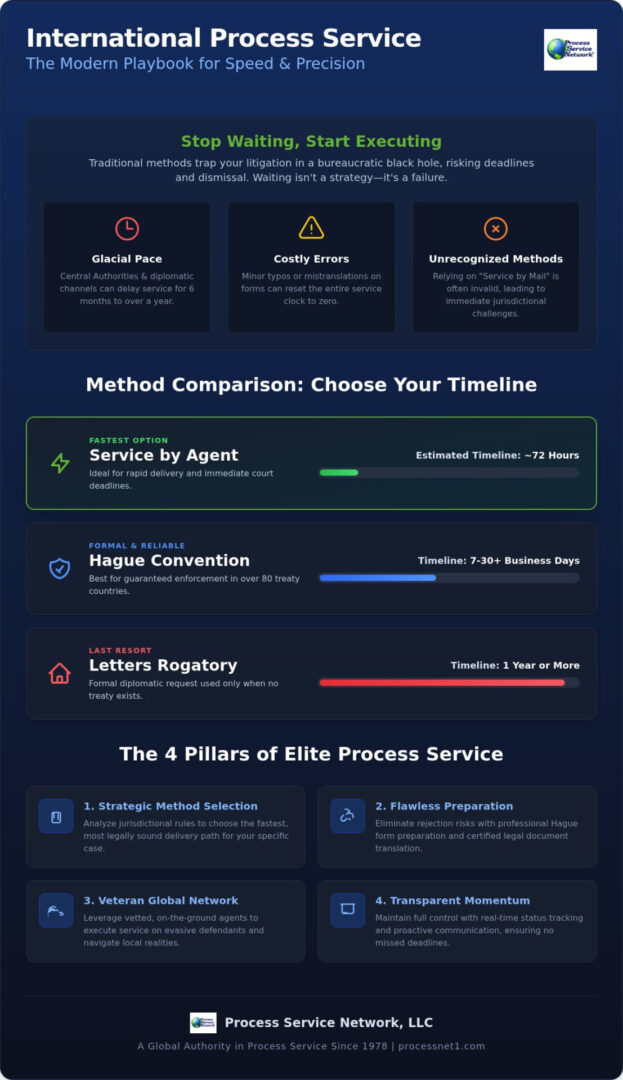
Choosing the wrong delivery method can freeze your case for a year. You have three primary options: the Hague Convention, Service by Agent, or Letters Rogatory. Each has its own speed profile and legal weight. Many practitioners assume the Hague Convention is the only valid path, but that’s a narrow view that ignores tactical speed. If you need fast international process service, you must evaluate the destination’s specific legal climate before sending a single page. Don’t get stuck in a diplomatic queue when a faster alternative exists. For a comprehensive breakdown of every available method and jurisdiction-specific requirements, our definitive guide to international process service and global legal delivery provides the strategic depth your case demands.
Letters Rogatory are the slowest evil in the legal world. The U.S. Department of Justice explicitly warns that this method can take a year or more. It involves diplomatic channels and multiple government layers; it’s essentially a formal request from one court to another. We only recommend this when no treaty exists and no other method will satisfy the local court. For everything else, there are smarter ways to move your case forward.
- Hague Convention: Best for guaranteed enforcement in treaty countries.
- Service by Agent: Ideal for rapid delivery and immediate court deadlines.
- Letters Rogatory: The last resort for non-treaty jurisdictions.
The Hague Convention: When Formal is Fastest
The Hague Convention isn’t always a bottleneck. In jurisdictions like the United States, the process is surprisingly streamlined. The U.S. Central Authority is required to complete service within 30 business days, and you can even request expedited service within 7 business days! The key is leveraging Article 10 for direct service where the destination country hasn’t objected. This bypasses the Central Authority entirely. Expert Hague form preparation is your best defense against rejection delays. One misplaced checkmark or a minor administrative error can derail your timeline for months. Precision in the paperwork is just as important as the delivery itself.
Service by Agent: The 72-Hour Solution
Service by Agent is our preferred 72-hour solution for high-stakes litigation. By using a local professional agent, you bypass government queues and achieve personal service immediately. The legal validity of this method varies. It’s often perfect for U.S. courts, but it may face challenges if you need to enforce a judgment later in a restrictive jurisdiction like China, especially following the December 2025 Smart Study ruling that tightened rules on alternative service methods. We ensure every Affidavit of Service meets strict U.S. standards to protect your case from dismissal. If your deadline is next week, you don’t have time for a treaty request. You can consult with our experts to determine if an agent-led approach is the right strategic fit for your specific jurisdiction.
Eliminating Delays: The Role of Translation and Form Prep
Documentation errors are the silent killers of speed in global litigation. You can’t achieve fast international process service if your paperwork is rejected at the border! The number one cause of international service failure isn’t a lack of effort; it’s poor documentation. When a foreign Central Authority finds a single discrepancy in your request, they don’t call you to clarify. They simply return the package. This resets your timeline by three to six months. We eliminate this risk by ensuring total synergy between our form preparation and translation teams. While some firms treat these as separate administrative tasks, we view them as a single, unified tactical operation.
Hague Form Preparation: Getting it Right the First Time
The USM-94 form is deceptively complex. Every country has specific requirements that aren’t always listed in the standard instructions. For example, some jurisdictions require specific boxes to be checked only if certain conditions are met, while others demand exact linguistic phrasing for the summary of the document. A “good enough” approach leads to catastrophic administrative delays. At Process Service Network, we utilize a zero-error methodology refined since 1978. We don’t guess. We know exactly what each Central Authority expects. This precision is what allows us to bypass the bureaucratic traps that ensnare less experienced firms. Don’t let a clerical error derail your high-stakes case.
Certified Legal Translation as a Speed Multiplier
Certified legal translation is a non-negotiable standard for international success. If your translation isn’t court-admissible, your final judgment is at risk! Don’t fall into the “lost in translation” trap by using general translation services that don’t understand specialized legal terminology. We keep translation and service under one roof to maximize efficiency. This streamlines the entire process and prevents the communication gaps that occur when you juggle multiple vendors. Unlike generalist process servers like ProVest, who may lack specialized in-house translation for complex international cases, our infrastructure is built specifically for global precision. We provide:
- Expert translation of summons, complaints, and evidence.
- Certified affidavits that withstand judicial scrutiny.
- Direct coordination between linguists and process servers.
This integrated approach ensures that your documents move through foreign courts with zero friction. Speed is about more than just fast delivery; it’s about getting the legal foundation right the first time. We handle the heavy lifting so you can focus on the litigation!
Strategic Selection: Navigating Global Jurisdictions
You can’t treat every border the same. Achieving fast international process service depends on knowing where you can cut corners and where you must follow the letter of the law. Strategic selection isn’t just about geography; it’s about the nature of the defendant. Corporations often have registered offices that make them easier to locate, but serving them correctly requires strict adherence to local corporate statutes. Private individuals are a different battle entirely. If you’re dealing with an evasive defendant, we deploy a Diligence Search to pinpoint their location before the clock runs out on your filing. When every other method fails, Service by Publication stands as your final strategic move to satisfy the court and move your litigation forward.
Serving Papers in the UK, Canada, and Western Europe
These regions are the gold standard for speed. In the UK and Canada, we often bypass the Central Authority by utilizing direct service through local professional agents. This cuts months off your timeline! Even in mainland Europe, the landscape is shifting toward greater efficiency. For example, effective January 1, 2026, Switzerland implemented new rules that simplify mutual assistance and broaden the use of videoconference testimony. These reforms provide a much faster alternative to the traditional letters rogatory process. If your case involves ICC arbitration, keep in mind that as of June 1, 2026, the monetary threshold for expedited procedures has increased to $4 million. We help you navigate these shifting thresholds to ensure your service matches the pace of your legal strategy.
Complex Jurisdictions: China, Mexico, and Beyond
Some regions demand absolute adherence to mandatory Hague protocols. China and Mexico are notoriously strict about sovereignty. You must manage your expectations here; these aren’t 72-hour turnarounds. Recent legal shifts have made these regions even more challenging for those seeking shortcuts. The December 18, 2025, Smart Study ruling established that the Hague Service Convention doesn’t permit service by email in countries that object to postal channels, such as China. This decision has been strictly followed throughout 2026. You can’t rely on digital workarounds anymore. You need a partner who understands that formal Central Authority channels are now the only bulletproof option in these jurisdictions. Understanding how to serve someone internationally in these non-cooperative regions requires mastering the strict procedural requirements that govern each jurisdiction. Don’t risk a dismissal by trying to bypass these rigid requirements. Instead, initiate your international service request with experts who know how to navigate these non-cooperative regions with precision.
Why Process Service Network is the Definitive Speed Leader
When your litigation crosses borders, you can’t afford a partner who guesses. You need a definitive leader who executes. Process Service Network isn’t just another agency; we’re the strategic engine behind high-stakes global cases. While others promise “effortless” results, we deliver through transparency and professional assertiveness. We understand that fast international process service is a non-negotiable requirement for your success. Our global operations are built on a foundation of absolute reliability. We don’t hide behind vague timelines or complex legal jargon. We provide a “no hidden variables” approach that gives you total clarity from day one!
We thrive on the cases that deter others. If you’re dealing with an “unfindable” or evasive defendant, our infrastructure is designed to handle it. We utilize advanced Diligence Search techniques and a network of local experts to locate parties across every continent. We’ve spent decades refining our methodology to ensure zero-friction delivery. We don’t just find people; we serve them with a level of legal precision that withstands the most aggressive judicial scrutiny. Your court deadlines are our priority!
A Seasoned Veteran in a Global Market
Leveraging over 45 years of procedural expertise isn’t just a claim; it’s our reality. Since 1978, we’ve navigated every possible complication in international law. We’ve seen treaties change and sovereignty rules tighten. This veteran status allows us to anticipate bottlenecks before they happen. Elite law firms trust our no-nonsense results because we’ve proven our capability on every continent. We possess the global reach and the technical depth to handle Hague form preparation and legal document translation in-house. This eliminates the risk of communication gaps and ensures your case stays on track. We’re the straight-shooting partner you need for complex landscapes.
Ready to Serve: Your Next Strategic Move
Operational precision begins the moment you contact us. We’ve streamlined our submission process to be as direct as possible. Simply submit your documents for review, and our team will immediately analyze the jurisdictional requirements. We provide a clear, logical path from the initial problem to a successful service of process. Don’t let bureaucratic delays or improper service jeopardize your litigation. Take control of your case now. Dominate your legal deadlines with our global network. We’re ready to act as your relentless problem-solver in the complex international landscape. Initiate your service today for immediate results!
Secure Your Global Litigation Advantage Today
Success in international litigation requires more than just luck. It demands a tactical approach that prioritizes speed and legal accuracy. You’ve learned that bypassing bureaucratic bottlenecks is a matter of expert Hague form preparation and the strategic selection of service methods. Whether you’re navigating the rigid protocols of non-cooperative regions or the streamlined reforms in Western Europe, precision is your greatest asset. Don’t let your case stall because of a clerical error or a slow Central Authority!
Process Service Network has been the definitive choice for high-stakes cases since 1978. We possess a global network spanning over 100 countries and a proven track record with even the most evasive defendants. Our “no hidden variables” approach ensures you have the transparency and results your litigation deserves. It’s time to stop waiting and start winning! Secure fast international process service that stands up to judicial scrutiny and keeps your case on track. We’re ready to be your relentless partner on the global stage. Initiate Your Fast International Service Now and take control of your court deadlines today!
Frequently Asked Questions
How long does fast international process service typically take?
Turnaround times vary based on the destination and the chosen method. For example, the U.S. Central Authority typically completes Hague requests within 30 business days, with expedited options available in just 7 business days. In contrast, letters rogatory can stretch beyond a year. If you need fast international process service, utilizing a professional agent in permissive jurisdictions like the UK or Canada can often result in successful delivery within 72 hours.
Is service by a private agent legally valid in Hague Convention countries?
Yes, service by a private agent is valid if the destination country hasn’t specifically objected to Article 10 of the Convention. Many Western European nations allow this direct approach, which bypasses slow government channels. However, you must be cautious. If your goal is to enforce a future judgment in a restrictive jurisdiction like China, formal Central Authority channels are the only way to ensure your service remains bulletproof under local laws.
Why is translation mandatory for international service of process?
Translation is a fundamental requirement to protect the defendant’s due process rights in their home country. Most foreign Central Authorities will flatly reject any documents that aren’t provided in their official language. We utilize certified legal translation to ensure every summons and complaint is court-admissible. This prevents administrative errors that could reset your service clock by months. Don’t let a language barrier derail your entire litigation strategy!
What happens if a defendant is evading service in a foreign country?
We solve this by deploying a comprehensive Diligence Search to pinpoint the defendant’s current location. Our global network has tracked down evasive parties since 1978. If the defendant remains unfindable after exhaustive efforts, we move to Service by Publication. This strategic path satisfies the court’s requirement for due diligence and allows your case to proceed. We don’t stop until your legal obligations are met and the court is satisfied.
Can I serve a foreign corporation through their US-based subsidiary?
Generally, you cannot serve a parent company through a subsidiary unless that subsidiary is the formally designated agent for service. Attempting this shortcut often leads to jurisdictional challenges. To maintain the integrity of your case and ensure fast international process service, it’s safer to serve the parent entity at its registered foreign headquarters. This prevents the defendant from arguing improper service later in the proceedings. Precision always beats shortcuts.
What proof of service will I receive for an international case?
You’ll receive a formal Certificate of Service or a notarized Affidavit of Service that meets strict U.S. court standards. For formal Hague Convention requests, the certificate is issued directly by the foreign Central Authority. For agent-led service, we provide a detailed affidavit documenting exactly when and where the documents were delivered. This evidence is crucial for withstanding judicial scrutiny and moving your litigation toward a final judgment without procedural delays.
How do I know which method (Hague vs. Agent) is right for my case?
The right choice depends on your specific court deadline and your long-term enforcement goals. Use the Hague Convention when you need the highest level of international legal certainty for judgment enforcement. Choose an agent when speed is your primary driver and the target country permits direct service under Article 10. We help you evaluate these variables to select the most aggressive and legally sound path for your specific jurisdiction.
What are the risks of using an inexperienced international process server?
Inexperience leads to administrative rejections, wasted fees, and jurisdictional dismissals. A novice server might miss a specific country’s translation nuances or attempt a service method that the destination country explicitly forbids. These mistakes don’t just cause delays; they can permanently jeopardize your ability to enforce a judgment abroad. Trust a seasoned veteran who understands the complex intersection of international treaties and local operational logistics. Reliability is the foundation of speed.
