

International Process Service Cost: A 2026 Strategic Budgeting Guide
The cheapest quote for international process service is often the most expensive mistake your firm will ever make! It’s a hard truth that many legal professionals learn only after a case is dismissed due to improper service. You’ve likely dealt with the frustration of unpredictable foreign agent fees or the “black box” of your total international process service cost. It’s exhausting to manage a litigation budget when hidden translation and legalization costs keep piling up without warning.
We’re here to end that uncertainty right now. This 2026 strategic guide empowers you to master the complexities of global legal delivery while securing court-admissible results every time. You’ll gain a transparent breakdown of the fee landscape, including the latest 2026 updates for new Hague Convention members like Algeria and Vietnam. We’ll show you exactly how to eliminate hidden variables and establish a predictable timeline for your litigation. Let’s move past the guesswork and get your documents served with absolute precision!
Key Takeaways
- Recognize that global legal delivery is a complex operation involving logistics and strict legal compliance, not a simple flat-rate task.
- Identify the four critical pillars that dictate your international process service cost, from foreign agent coordination to mandatory certified translations.
- Master the strategic differences between Hague Convention efficiency and the expensive, high-stakes diplomatic requirements of Letters Rogatory.
- Protect your litigation budget by avoiding “budget” service traps that result in hidden fees and costly motions to dismiss.
- Secure court-admissible proof of service through transparent financial reporting and the seasoned expertise of a veteran global partner.
The Reality of International Process Service Cost in 2026
Stop treating your international process service cost as a simple line item for a courier. In 2026, global legal delivery is a high-stakes logistics operation wrapped in complex layers of international law. It isn’t just about getting a packet from point A to point B. It’s about ensuring that the delivery survives the scrutiny of a judge months after the fact. We don’t just deliver papers; we secure your right to litigate.
Domestic flat-rate models are useless in a global context. In the United States, you pay a server a set fee and they hit the pavement. Internationally, every border adds a new layer of bureaucracy and expense. Your total investment is driven by increasing regulatory requirements from foreign central authorities who have tightened their protocols this year. We focus on the “Total Cost of Admissibility.” If your proof of service isn’t bulletproof, your initial fee was a complete waste of capital. We provide the transparency you need to avoid those expensive pitfalls.
Why Global Service Differs from Domestic Delivery
Jurisdictional hurdles create massive operational overhead that domestic servers never face. You aren’t just paying for a person to knock on a door; you’re paying for a navigator who understands the specific demands of a foreign judiciary. Many nations strictly enforce the Hague Service Convention, which mandates specific forms and channels for service to be recognized as valid. Missing a single stamp can stall your case for months.
Foreign central authorities often act as gatekeepers. They don’t care about your court deadlines; they care about their own sovereign procedures. This is why expert international process service management is non-negotiable. You need a partner who knows exactly which official wants which seal on which document to keep your case moving. We possess the infrastructure to handle these complexities without breaking your stride.
The Risk of Underestimating Your Litigation Budget
The financial fallout of a “cheap” service is catastrophic. If a judge quashes your service because of a technicality in a foreign jurisdiction, your budget just doubled. You’ll pay for the initial failed attempt, the legal fees to fight the motion to dismiss, and the full cost of re-serving under an even tighter deadline. It’s a nightmare scenario that’s entirely avoidable with the right expertise.
Don’t let a low-ball estimate wreck your strategy. High-stakes international cases typically demand a time-to-cost ratio where every additional month of delay exponentially increases the overall legal spend of the litigation. We give you the straight-shooting facts so you can budget for success from the very beginning!
The Four Pillars of Global Legal Delivery Expenses
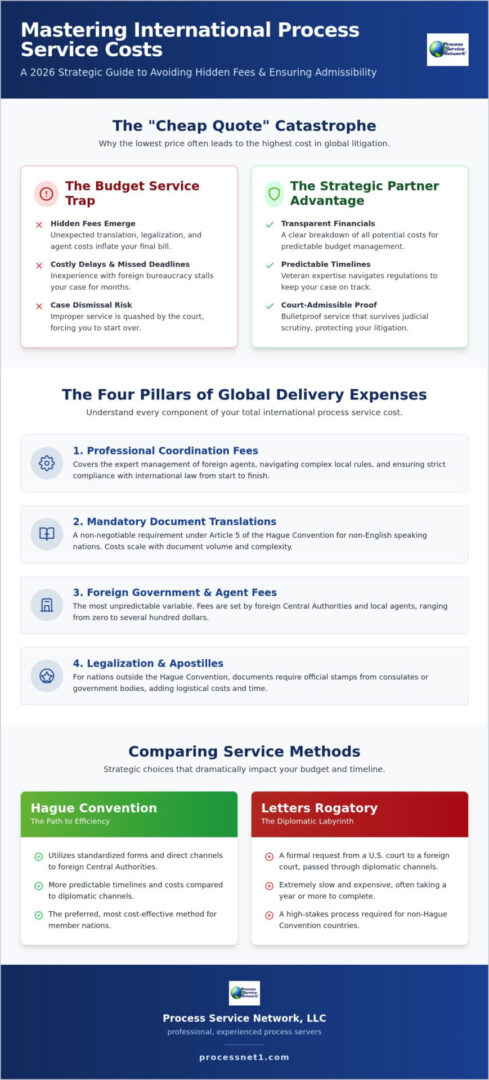
Understanding your total international process service cost requires a look under the hood. We don’t hide behind vague estimates! To build a bulletproof budget, you must account for the four foundational pillars of global delivery. These are professional coordination fees, mandatory document translations, foreign government filing fees, and the logistics of legalization or apostilles. Each pillar represents a critical step in ensuring your service is recognized by both the domestic court and the foreign jurisdiction. Stop guessing and start budgeting with precision!
Foreign government fees are often the most unpredictable variable in the equation. While the U.S. Central Authority utilizes a $95 fee for formal requests, other nations may charge several hundred dollars or nothing at all. Logistics and legalization also add weight to your budget. If you’re operating outside the Hague Convention, your documents may require an apostille or a chain of legalizations through various consulates. These administrative hurdles require physical couriers and specific government stamps that “budget” firms simply ignore until the bill arrives. We’ve navigated these waters since 1978 and know exactly how to avoid the hidden fees that sink other firms’ budgets!
The Translation Variable in International Costs
Certified translations aren’t just a suggestion; they’re a requirement for compliance with Article 5 of the Hague Convention. If you’re serving in a non-English speaking nation, your international process service cost will fluctuate based on document volume. A 100-page complaint costs significantly more to translate than a five-page summons. Utilizing legal document translation for service ensures your papers aren’t rejected by a foreign Central Authority on a technicality. We handle these certified translations with expert precision to keep your case on track and your budget intact.
Foreign Agent Fees and Local Protocols
In countries where the Hague Convention isn’t the primary method, we rely on a network of trusted foreign agents. These local experts navigate specific process server cost factors that vary wildly by region. Serving a defendant in a major European city is straightforward, but serving one in a remote or high-risk region requires specialized logistics and higher professional fees. You must also distinguish between “drop-off” service and “personal” service. Many civil law jurisdictions demand personal delivery to the individual, which requires more time and coordination than a standard domestic drop-off. If you need a clear picture of these variables, request a transparent quote from our veteran team today.
Comparing Methods: Hague Convention vs. Letters Rogatory Costs
Choosing the wrong method of delivery will blow your international process service cost out of the water. You need to understand the financial fork in the road between the Hague Convention and Letters Rogatory. One is a streamlined treaty designed for speed; the other is a diplomatic marathon that drains resources. We help you pick the winning path by weighing court admissibility against your firm’s bottom line. Don’t let a procedural error turn into a financial catastrophe!
The Hague Service Convention is the gold standard for cost-efficiency. With 130 contracting parties as of September 2026, it covers the vast majority of your litigation needs. Recent additions like Algeria (July 9, 2026) and Vietnam (September 11, 2026) have expanded this network, providing more predictable fee structures for US litigants. While it isn’t a flat-rate service, it is significantly more manageable than the alternative. You pay for expertise in preparation to ensure your documents aren’t rejected at the border.
Hague Convention Cost Advantages
Standardized procedures are your best friend when budgeting. The Hague Convention process service framework allows for a clearer projection of expenses. You avoid the “black hole” of diplomatic channels. Central Authority fees are not uniform across the globe. Some nations charge zero fees for formal requests, while others demand specific government payments upfront. We handle the complex form preparation that prevents expensive re-filing fees and administrative delays.
Precision in the initial filing is the only way to protect your budget. A single error on a Hague request form can lead to a rejection months later. This forces you to pay for the entire process all over again. We eliminate this risk by getting it right the first time. Our veteran team knows the specific quirks of each Central Authority, from the UK to Germany, ensuring your international process service cost stays within the original quote.
Letters Rogatory: The Premium Path
Treat Letters Rogatory as your absolute last resort. This method is required only for countries that aren’t treaty members. It involves a grueling trek through the Department of State and foreign embassies. The man-hours required for this coordination are extensive. You’re paying for a specialized legal escort through the highest levels of international diplomacy. It is slow, expensive, and often takes a year or more to complete.
Budget-conscious firms should pivot to Service via Agent where legally permissible. In some jurisdictions, you can bypass the Central Authority by using a local agent for direct personal service. This acts as a middle-ground option. It provides faster results than the Hague method without the diplomatic price tag of Letters Rogatory. We analyze your specific jurisdiction to see if this tactical shortcut can save you thousands in unnecessary expenses!
How to Avoid the Cheap Service Trap and Hidden Fees
Low-ball quotes are the single greatest threat to your litigation budget. When a server offers a suspiciously low price, they’re usually cutting corners on legal compliance or hiding the true international process service cost behind a wave of “add-on” fees that appear only after you’ve committed. You can’t afford to risk your entire case on an amateur who doesn’t understand the nuances of foreign law. Demand an “all-in” quote that includes estimated foreign agent fees and translation costs upfront. Absolute transparency is the only way to protect your firm from the sticker shock of a botched delivery.
The “service by mail” myth is another expensive trap that many firms fall into. While it looks cheaper on paper, US judges frequently quash mail service if it doesn’t strictly adhere to both the forum court’s rules and the specific treaty objections of the destination country. Defending a motion to dismiss because you tried to save a few hundred dollars on postage is a financial disaster. Instead of gambling, invest in a diligence search. This ensures your defendant is actually at the target address before you spend a dime on formal service attempts. It’s a proactive move that eliminates wasted capital on bad addresses.
The High Cost of Rejection
Technical errors on Hague forms are budget killers. A single typo or an incorrect box checked can lead to a summary rejection by a foreign Central Authority months after you filed. With new 2026 members like Algeria and Vietnam now enforcing strict Hague protocols, the margin for error has vanished. You’ll face re-filing fees and the loss of precious time that can never be recovered. Professional preparation is always cheaper than litigation delays! We utilize a synergy between skip tracing and process service to ensure we’re targeting the right person at the right location the first time. This “no-nonsense” approach is the only way to keep your budget under control.
Hidden Variables: Apostilles and Legalization
Many firms forget to budget for the final proof of service. In non-Hague countries, your proof may require an apostille or a chain of legalizations to be recognized by a US court. These aren’t just administrative fees; they require physical couriers and government interaction. You must also budget for multiple service attempts in difficult jurisdictions where defendants are known to be evasive. A “flat fee” that doesn’t account for these variables is just a fairy tale told by inexperienced servers. Stop playing games with your case’s admissibility. If you want a straight-shooting partner who delivers results without the sticker shock, get a transparent quote from Process Service Network today.
Choosing Process Service Network for Transparent Global Delivery
Experience matters when your litigation is on the line! Since 1978, Process Service Network has served as the definitive global expert for law firms that demand results. We don’t hide behind bureaucratic jargon or rely solely on government contracts to prove our worth. We provide a straight-shooting, veteran approach that eliminates the “black box” of your international process service cost. Our infrastructure is designed for absolute transparency. You get clear financial reporting and a partner who treats your deadlines with the urgency they deserve!
We are your comprehensive one-stop shop for international litigation support. Why juggle three different vendors when you can secure everything in one place? We handle your legal document translation, Hague form preparation, and global delivery with seamless coordination. This integrated methodology doesn’t just save time; it protects your budget from the hidden variables that arise when communication breaks down between separate providers. We’ve navigated every possible complication over the last 45 years. We know how to get the job done right!
The PSN Advantage: Expert Hague Form Preparation
Rejection is the most expensive outcome in international service. When a foreign Central Authority sends your documents back because of a technical error, your budget takes a massive hit. Our internal expertise drastically reduces the risk of these costly setbacks. We understand the local fee nuances and procedural quirks of over 130 nations. This global network allows us to provide accurate projections rather than vague guesses. Don’t leave your case to chance. Contact PSN today for a comprehensive international quote that reflects the reality of the 2026 legal landscape.
Elite Diligence and Difficult Cases
We thrive on the challenges that deter other agencies! If you’re dealing with an evasive defendant or a high-risk jurisdiction, you need a relentless problem-solver. Our elite diligence searches locate defendants where others fail, ensuring your service attempts are targeted and effective. This is the definition of cost-effectiveness in complex international litigation. You aren’t just paying for a delivery; you’re paying for a successful outcome. We possess the infrastructure to handle the most difficult cases with ease and professional assertiveness.
Stop settling for uncertainty and hidden fees. Position your firm for success by partnering with a seasoned veteran who values transparency as much as you do. Initiate your global service request now and experience the speed and accuracy that only 45 years of expertise can provide!
Secure Your Global Litigation Strategy with Precision
Mastering your international process service cost isn’t about finding the lowest bidder; it’s about securing a “Total Cost of Admissibility.” You’ve learned that expert Hague Convention form preparation and certified translations are the only way to eliminate the technical errors that lead to expensive rejections. Don’t let hidden logistics fees or botched mail service attempts sink your litigation budget. Every decision you make now determines whether your case moves forward or stalls in a foreign bureaucracy.
Since 1978, we’ve provided the infrastructure to handle the most complex and high-stakes cases across the globe. We offer a no-nonsense approach that delivers the transparency you need to manage your firm’s resources effectively. Our veteran team specializes in difficult serves that others simply can’t handle. It’s time to stop guessing and start executing with absolute confidence!
Get a Transparent Quote for International Process Service and take control of your global legal delivery today. Your case deserves the reliability of a seasoned veteran. Let’s get to work!
Frequently Asked Questions
Is there a flat fee for international process service?
No flat-rate model exists for global delivery because every jurisdiction operates under different legal frameworks. Your international process service cost depends on the destination country, the method of service required, and specific local agent protocols. We provide transparent, case by case quotes to ensure you don’t face hidden variables halfway through the process. This approach eliminates the “black box” pricing typical of less experienced servers and ensures your budget remains predictable.
How much do foreign government fees usually add to the cost?
Foreign government fees vary significantly by nation and are often outside the control of the process server. For example, formal requests to the United States Central Authority carry a $95 fee, while other countries may charge nothing or several hundred dollars. We include these estimates in our strategic budgeting guides so your firm isn’t blindsided. We track these fee trends daily to provide the most accurate financial projections possible for your litigation.
Does the cost of international service include legal translation?
Legal translation is typically a separate variable because the cost depends entirely on document volume and the target language. Most civil law jurisdictions mandate that documents be served in their official language to be valid. We offer comprehensive translation services as part of our “one stop shop” model. This ensures that your translated documents meet the strict certified standards required by foreign Central Authorities and US courts alike without requiring a secondary vendor.
Can I save money by serving documents via international mail?
Serving documents via international mail is a risky gamble that often leads to expensive motions to dismiss. While some countries technically allow it under Article 10 of the Hague Convention, many have filed specific objections that make mail service legally insufficient. If a judge quashes your service, the cost of re-litigating the issue far exceeds the initial investment in professional personal service. Don’t risk your case on a postage stamp when admissibility is on the line!
Why is Hague Convention service generally more cost-effective than Letters Rogatory?
Hague Convention service is more cost-effective because it utilizes a streamlined treaty framework with 130 member nations. It bypasses the grueling diplomatic channels required for Letters Rogatory, which often involve the Department of State and foreign embassies. Letters Rogatory demand extensive man-hours and carry high administrative costs. By choosing the Hague path where applicable, you secure a faster timeline and a much more predictable budget for your litigation while ensuring strict legal compliance.
What happens to my payment if the defendant cannot be located?
Professional fees cover the labor and logistics of the service attempts, regardless of the final outcome. However, we mitigate this risk by offering diligence searches before you initiate formal service. This proactive step verifies the defendant’s location, preventing you from wasting your budget on bad addresses. If a defendant is truly evasive, we utilize advanced skip tracing to ensure your service attempts are targeted and effective, protecting your firm’s capital from unnecessary loss.
Are there rush fees for international process service?
Rush options are available for many jurisdictions, but they depend on the availability of foreign agents and local judicial hours. Speeding up the process often requires dedicated couriers and prioritized handling by our international team. We’ll tell you upfront if a rush request is feasible for your specific target country. Our goal is to move your documents from problem to solution with the maximum possible operational speed while maintaining absolute procedural accuracy.
Do I need to pay for an apostille or legalization separately?
Apostilles and legalizations are separate administrative requirements that depend on whether the destination country is a member of the Apostille Convention. These steps involve physical interaction with government agencies and carry their own filing fees. We don’t hide these costs in a general international process service cost estimate. We identify these needs during the initial consultation so you can budget for the necessary stamps and certifications from the start, ensuring total financial transparency.
