

Service by Mail under the Hague Convention in Canada: The 2026 Guide
Saving a few dollars on international postage could be the most expensive mistake you make in your litigation. While Canada technically permits service by mail hague convention canada under Article 10(a), relying on a stamp to secure jurisdiction is a high-stakes gamble. You want a method that’s fast, cost-effective, and legally sound. We understand the fear of seeing your service vacated due to a minor technicality or a missed translation requirement in Quebec. It’s a frustrating hurdle that can stall your case for months while the clock ticks on your deadline.
This 2026 guide will help you master the complexities of Article 10(a) to ensure your legal service in Canada is ironclad and court-admissible. You’ll learn exactly when the postal channel is valid, how to navigate the decentralized provincial Central Authorities, and when it’s time to bypass the mail for a professional private process server. We’ll examine the specific civil law requirements in Quebec and the essential steps for obtaining a bulletproof Affidavit of Service. Let’s eliminate the uncertainty and get your documents served right the first time.
Key Takeaways
- Canada permits service by mail under Article 10(a), but don’t mistake legality for reliability in a high-stakes case.
- Learn the exact mechanics of service by mail hague convention canada to ensure your documents reach the defendant without a technical hitch.
- Understand why American judges often view international mail with skepticism and how to avoid “Due Process” objections that can sink your case.
- Contrast the multi-month wait times of the Canadian Central Authority with the speed of using a private process server under Article 10(b).
- Get the facts on provincial translation requirements, especially the strict French language rules in Quebec, to keep your service court-admissible.
Understanding Article 10(a): Can You Serve Legal Papers by Mail in Canada?
You need to know if dropping a summons in a mailbox actually counts as service. The answer is yes, but there’s a massive catch. Under the Hague Service Convention, Article 10(a) allows for the use of “postal channels” to send judicial documents directly to persons abroad. Canada is one of the few countries that hasn’t officially objected to this method. However, being “legal” under an international treaty isn’t the same as being “sufficient” for your local court’s due process standards.
The distinction between treaty legality and court admissibility is where most attorneys trip up. While Article 10(a) is a valid channel under the convention, US courts often demand more rigorous proof than a simple signature on a green card. If your defendant refuses to sign the acknowledgment or claims the envelope was empty, your case enters a procedural nightmare. This is why service by mail hague convention canada is often reserved for specific scenarios like:
- Uncontested matrimonial matters where both parties are in communication.
- Subpoenas for documents from cooperative third-party witnesses.
- Small claims actions where the cost of a private server is prohibitive.
The Legal Framework of the Hague Service Convention
The treaty was designed to create a predictable, standardized path for cross-border litigation. Before its inception, serving someone in another country was a chaotic mess of diplomatic channels and local roadblocks. By following the Hague Convention process service guidelines, you ensure your case rests on a foundation of international law. Canada is a signatory to simplify these North American legal exchanges, ensuring that international litigants have clear rules of engagement that bypass the slow gears of traditional diplomacy. For defendants located in non-treaty jurisdictions, however, the only viable path is service of process via letters rogatory, a more complex diplomatic channel that demands its own specialized expertise.
Canada’s Official Stance on Postal Channels
Canada’s declaration regarding Article 10(a) is straightforward. They don’t object to service through the post. But don’t just use a standard envelope and a few stamps. To make it stick, you must use registered mail with an acknowledgment of receipt. This requirement is non-negotiable across all provinces. Even in Quebec, where civil law rules are notoriously strict, service by mail hague convention canada is technically permitted. You’ll still need to handle Hague service request forms correctly to ensure the paperwork is recognized by the receiving authority if the mail service is later challenged. We’ve seen too many cases stall because a lawyer assumed “mail” meant “regular mail.” Don’t make that mistake.
The Practical Mechanics of Serving Canada via International Mail
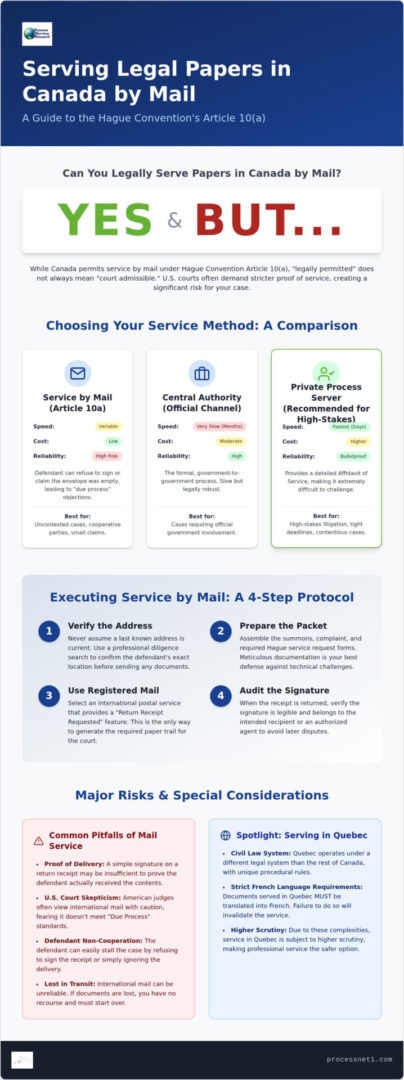
Executing service across the 49th parallel requires more than just a stamp. While the treaty provides the framework, your success depends on the meticulous preparation of the service packet and the verification of the defendant’s current location. If you skip a step, you’re not just wasting time; you’re handing the opposing counsel a reason to quash your service. Don’t leave your case to chance. Follow this rigorous protocol to ensure your service by mail hague convention canada meets the highest legal standards.
- Step 1: Verify the physical address. Never assume a last known address is current. If you’re unsure, utilize a professional diligence search to confirm the defendant’s exact location before mailing.
- Step 2: Prepare the packet. Assemble the summons, complaint, and the necessary Hague service request forms. Precision in documentation is your best defense against technical challenges.
- Step 3: Select the right channel. Use an international postal service that provides a “Return Receipt Requested” feature. This is the only way to generate the paper trail required by the court.
- Step 4: Audit the signature. Once the receipt returns, verify that the signature is legible and belongs to the intended recipient or an authorized agent.
Required Documentation and Mailing Standards
Your service package must be comprehensive. Include the original summons and complaint along with a “Notice and Acknowledgment of Receipt” form. Even when you’re opting for the postal channel, adopting a Hague Convention Article 5 service approach adds a layer of security. This means including a formal request that mimics the standards used by Central Authorities. It signals to the Canadian recipient and the US judge that you’re treating the matter with professional gravity. If you’re serving in Quebec, remember that French translations aren’t just a courtesy; they’re often a requirement for the service to be considered valid under local civil rules.
The Critical Role of Registered and Certified Mail
Standard first-class mail won’t cut it. To satisfy the requirements of service by mail hague convention canada, you must use international registered mail. This provides the “acknowledgment of receipt” that Canada specifically demands in its declarations. Be extremely careful with private couriers like FedEx or UPS. While they’re fast, many legal experts argue they don’t qualify as “postal channels” under Article 10(a). To stay compliant with the guidelines set by Canada’s Central Authority for the Hague Convention, stick to the government postal system. It’s the only way to ensure your proof of service withstands a aggressive motion to dismiss. We’ve seen cases fall apart because an attorney favored speed over the strict definitions of the treaty. Stick to the proven path.
Risks and Realities: Why Service by Mail Might Fail Your Case
Don’t mistake a delivery confirmation for a legal victory. While service by mail hague convention canada is technically permissible, it’s often the flimsiest foundation for a high-stakes lawsuit. The biggest threat isn’t the mailing itself; it’s the moment your opponent’s counsel realizes they can exploit a technicality to vacate your hard-won progress. If a defendant refuses to sign the acknowledgment of receipt, your service hasn’t actually happened. You’re left with an expensive envelope and a stalled case.
US judges are notoriously skeptical of international mail service. Even if you follow the treaty to the letter, a domestic court may find that the method didn’t provide sufficient “Due Process.” This skepticism stems from the lack of a neutral third party to verify the delivery. Unlike a process server who can testify to the events, a mail carrier is simply a delivery agent. This lack of certainty creates a massive opening for defendants to claim they never received the documents, or that the envelope contained unrelated paperwork. This can lead to the nightmare scenario: a default judgment being overturned months later, forcing you to restart the entire process from scratch. In cases where the Hague Convention does not apply at all, attorneys must instead pursue service of process via letters rogatory through diplomatic channels, a path that demands even greater procedural precision.
The Proof of Service and Scrutiny Trap
A standard USPS green card or a digital tracking printout is a poor substitute for a professional affidavit of service. In international litigation, the burden of proof is on the plaintiff to show that service was executed perfectly. If the signature on your return receipt is a messy scrawl or an illegible set of initials, your service is effectively void. A judge won’t take your word for it that the person who signed was actually the defendant or their authorized agent. Without a sworn affidavit detailing the time, date, and identity of the recipient, you’re walking into a trap that can sink your case before it even reaches discovery.
The Quebec Exception and Language Nuances
Quebec operates under a civil law system, making it the most complex jurisdiction for service by mail hague convention canada. While the treaty doesn’t strictly mandate French translations for mail service, the reality on the ground is different. Quebec defendants are statistically much more likely to challenge English-only service. They can argue that they didn’t understand the nature of the proceedings, a claim that resonates strongly with Quebec’s local judicial standards. If you don’t provide a translation, you’re practically inviting a motion to quash. Relying on mail in Quebec is a gamble that rarely pays off when the validity of your service is on the line.
Strategic Alternatives: Central Authority vs. Private Process Servers
Speed and certainty are the two variables that define your litigation strategy. While service by mail hague convention canada might seem like a shortcut, it’s often a detour into procedural purgatory. If you want to move your case forward, you need to choose between the formal weight of the Central Authority and the aggressive speed of a private process server. Each has its place, but for high-stakes litigation, one is clearly superior. The standard processing window for the Canadian Central Authority is 90 to 180 days. If your trial calendar can’t wait four months for a certificate, you need a different tactic.
Articles 10(b) and 10(c) of the Convention provide that elite alternative. Canada does not object to service by judicial officers, officials, or other competent persons. This means you can bypass the government queue entirely. A private process server can typically execute service within 7 to 14 days. This isn’t just about speed; it’s about control. You get real-time updates and a professional who understands the gravity of your deadline. For complex cases, the cost-benefit analysis favors private service every time.
Utilizing Canada’s Decentralized Central Authorities
Canada doesn’t have a single, monolithic Central Authority. Instead, the system is decentralized across provinces and territories. If you send your request to the federal authority in Ottawa, you’re adding weeks of administrative lag to your timeline. You must send your documents directly to the appropriate provincial authority in Ontario, British Columbia, or Alberta. Each province has its own quirks and a mandatory service fee of CAD $100 per party. To navigate this bureaucratic maze without a hitch, utilize our Hague form preparation services to ensure your submission is perfect on the first try. One clerical error can reset your four-month wait to zero.
Direct Service: The Elite Path to Admissibility
Hiring a Canadian process server directly is the most “aggressive” and effective move you can make. This method relies on Article 10(b), treating the server as a “competent person” under international law. Unlike service by mail hague convention canada, this path provides you with a court-ready Affidavit of Service. This document is the gold standard for US judges. It proves exactly who was served, where they were served, and when it happened. You don’t have to worry about illegible signatures or defendants claiming they received an empty envelope. We handle these difficult serves with a relentless, no-nonsense approach that ensures your jurisdiction is ironclad. If you’re ready to secure your case, initiate your international service with a partner who knows the Canadian landscape inside and out.
Professional Execution: How Process Service Network, LLC Guarantees Compliance
Litigation is a battle of details. While a DIY approach to service by mail hague convention canada might save a few dollars upfront, the long-term cost of a vacated judgment is astronomical. Process Service Network, LLC has been the definitive choice for international legal delivery since 1978. We don’t just “send mail.” We provide a comprehensive compliance shield that protects your case from the procedural pitfalls that derail less experienced firms. Our “no-nonsense” methodology ensures that every document we handle meets the exact requirements of both the Hague Convention and the specific Canadian province involved.
Our global reach isn’t just a marketing claim; it’s an operational reality. Process Service Network, LLC maintains an active network of professionals in every Canadian province, from the bustling courts of Toronto to the remote regions of the Northwest Territories. This infrastructure allows us to act as a relentless problem-solver for your most difficult cases. Whether you’re dealing with an evasive corporate entity or a private individual who has gone “off the grid,” we possess the resources to find the unfindable and secure a valid service that will stand up under intense judicial scrutiny.
Expert Hague Form Preparation for Canada
The most common reason for service rejection isn’t the method; it’s the paperwork. A single clerical error on a Hague request form can result in months of delay. Process Service Network, LLC eliminates this risk through a rigorous “double-check” system for provincial jurisdiction accuracy. We know exactly which provincial authority requires specific wording and which ones are likely to kick back a request for minor formatting issues. We bridge the gap between simple mail and professional execution by ensuring your filing is perfect before it ever leaves our office. Don’t leave your timeline to chance. Start your Canadian service with the experts today!
Seamless Translation and Diligence Searches
Quebec’s civil law environment requires a specialized touch that standard mail simply can’t provide. Process Service Network, LLC handles certified French translations with the precision an international case demands, ensuring that your documents are legally recognized in Montreal or Quebec City. Beyond translation, our elite diligence searches are designed to locate defendants who are actively avoiding service. We don’t just wait for a return receipt to come back in the mail; we proactively confirm the recipient’s location and status. This commitment to professional assertiveness and global leadership is why top-tier law firms trust us with their high-stakes Canadian serves. We handle the complexity so you can focus on the law.
Secure Your Jurisdiction with Expert Canadian Service
You’ve seen the risks. Relying on service by mail hague convention canada is a gamble that can leave your case vulnerable to motions to quash and months of unnecessary delay. While the post is technically legal, it often lacks the evidentiary weight required for high-stakes litigation. You need a solution that combines speed with absolute compliance. Whether you’re navigating the civil law requirements of Quebec or the decentralized authorities in Ontario and Alberta, precision is your only safeguard.
Process Service Network, LLC has been serving the legal community since 1978. We are the definitive Hague Convention experts with full provincial coverage across Canada. We don’t just deliver papers; we deliver certainty. Our team handles everything from complex form preparation to certified translations, ensuring your service is court-admissible the first time. Don’t let technicalities derail your progress. Get a Quote for Elite Process Service in Canada today! Let’s get your case moving with the confidence it deserves.
Frequently Asked Questions
Is service by mail under the Hague Convention legally binding in Canada?
Yes, Canada does not object to service by postal channels under Article 10(a). This makes service by mail hague convention canada a legally recognized method under international law. However, you must use registered mail with an acknowledgment of receipt to comply with Canada’s specific declarations. Don’t assume legality equals reliability. US judges often scrutinize mail service more heavily than personal service, especially if the defendant challenges the delivery’s integrity.
Do I need to translate my legal documents into French for service in Canada?
Translation requirements depend entirely on the destination province. Documents served in Alberta or British Columbia must be in English. However, for any service in Quebec, documents must be translated into French. Even if the Central Authority waives this because the recipient understands English, a Quebec defendant can still challenge the service in local courts. We recommend providing certified translations for all Quebec cases to eliminate any risk of a successful challenge.
How long does it take to serve a defendant in Canada via the Central Authority?
Plan for a timeline of approximately three to six months when utilizing the Canadian Central Authority. While the standard processing window is 90 to 180 days, decentralized provincial authorities can vary in their efficiency. If your trial date is approaching, this method is likely too slow for your needs. For high-stakes cases requiring a faster turnaround, we recommend bypassing the Central Authority and using a private process server to execute service within 14 days.
Can I use FedEx or UPS to serve legal papers in Canada?
Using private couriers like FedEx or UPS is risky and often inadmissible in court. Article 10(a) specifically refers to “postal channels,” which most legal experts interpret as government-run postal services. While these couriers provide tracking, they don’t always satisfy the “registered mail” requirements established by Canada’s treaty declarations. Stick to international registered mail through the government post or hire a professional server to avoid a successful challenge to your service’s validity.
What is the best way to serve a subpoena in Canada?
The most effective method for serving a subpoena is through a private process server under Article 10(b). This approach is significantly faster than the Central Authority and provides a court-admissible Affidavit of Service. While service by mail hague convention canada is an option for subpoenas, it lacks the third-party verification that US judges demand. A professional server ensures the witness is properly identified and served in person, securing your evidence for the upcoming trial.
What happens if a Canadian defendant refuses to sign for registered mail?
If a defendant refuses to sign, your service is effectively dead in the water. Without a signature on the acknowledgment of receipt, you have no proof of delivery that will satisfy a US court. This is the primary weakness of the postal channel. You’ll be forced to restart the process using a more reliable method, such as personal service by a professional. Don’t let a recalcitrant defendant stall your litigation for months while your deadline approaches.
Is a private process server allowed under the Hague Convention in Canada?
Absolutely. Canada has no objection to service through judicial officers, officials, or other competent persons under Articles 10(b) and 10(c). This allows you to hire a private process server directly to execute personal service. This method is the gold standard for international litigation because it’s fast, reliable, and results in a sworn affidavit. It bypasses the bureaucracy of the Central Authority while remaining fully compliant with all Hague Convention standards.
How do I prove service to a US court after serving someone in Canada?
Your proof of service depends on the method used. If you used the Central Authority, you’ll receive a formal certificate of service. For private process service, you’ll get a sworn Affidavit of Service detailing the time, date, and manner of delivery. If you relied on mail, you only have the return receipt. Because mail receipts are easily challenged, we always provide our clients with a comprehensive affidavit that meets or exceeds US court standards.
