

Service of Process via Letters Rogatory: The 2026 Authority Guide
In the high-stakes world of international litigation, a single procedural misstep in a non-treaty jurisdiction can render your entire case worthless! You cannot afford to leave your legal delivery to chance when dealing with sovereign nations. While the Hague Service Convention has expanded to 130 contracting parties as of 2026, many jurisdictions still require the traditional, more complex path. Mastering service of process via letters rogatory is the only way to ensure your international service is legally unassailable.
It’s frustrating to face unpredictable timelines and the constant risk of judicial rejection by foreign courts. We understand that the lack of transparency in diplomatic channels often feels like a black hole for your documents. This guide provides a clear roadmap of the diplomatic path and strategic ways to minimize delays. You’ll gain the assurance that your service will lead to an enforceable judgment. We are diving into the technical procedures and diplomatic requirements that turn a “last resort” into a strategic win for your firm.
Key Takeaways
- Identify exactly when to deploy letters rogatory as your definitive method of last resort for jurisdictions outside international treaties.
- Navigate the rigorous six-step diplomatic channel to guarantee your service of process via letters rogatory meets every international legal standard.
- Prepare for the long game by understanding the specific timelines and diplomatic fees associated with non-Hague service requests.
- Eliminate the risk of foreign court rejection by adhering to strict document authentication, apostille, and certified translation protocols.
- Discover how strategic formatting and authoritative presentation can significantly reduce delays in the world’s most difficult legal landscapes.
What is Service of Process via Letters Rogatory?
International legal delivery is a minefield for the unprepared. When you move beyond U.S. borders, you’re entering the complex territory of sovereign power. Letters rogatory represent a formal request for judicial assistance from a court in the United States to a court in a foreign country. This isn’t just an administrative letter; it’s a high-level diplomatic appeal for cooperation! It remains the definitive method of last resort when no international treaty governs the relationship between the two nations. If you’re dealing with a country that hasn’t signed the Hague Service Convention, you must use this channel. Without this formal bridge, your litigation stops at the water’s edge. Using service of process via letters rogatory ensures that the foreign court recognizes your legal action, which is the only way to make a U.S. judgment enforceable on their soil.
The Concept of Judicial Comity
Foreign courts don’t owe you anything. Unlike the Hague Convention, which creates a legal obligation to assist, letters rogatory rely on the principle of judicial comity. This is the mutual respect and recognition that sovereign nations grant to each other’s legislative, executive, and judicial acts. It’s built on the expectation of reciprocity! If a U.S. court honors requests from a foreign jurisdiction, that nation is far more likely to return the favor. This isn’t a mandatory treaty requirement; it’s a diplomatic handshake between two legal systems. You’re asking for help, and you must follow their specific rules to get it. If you fail to respect their local procedures, they’ll simply ignore your request, and your case will stall indefinitely.
When Letters Rogatory are Mandatory
You’ll encounter jurisdictions where there’s simply no other choice. If your defendant is in a non-Hague nation like Ethiopia or Saudi Arabia, service of process via letters rogatory is your primary path. Some countries belong to the Hague Convention but have opted out of specific service methods like international mail or private process servers. In these cases, the diplomatic channel is the only legally unassailable route! Don’t get cute with email or informal delivery. Foreign courts view these shortcuts as a violation of their sovereignty. One wrong move here can result in a total judicial rejection, rendering your hard-won judgment impossible to collect abroad. Stick to the formal path to protect your client’s interests. We’ve seen cases fall apart because a firm tried to save time with a method the foreign judge didn’t recognize. Avoid that disaster by following the rules of the destination country exactly!
The 6-Step Path: How the Diplomatic Channel Works
Tracking a request through the diplomatic channel requires a seasoned veteran’s eye. This isn’t a simple mailing process; it’s a multi-stage mission involving three separate government branches. If you miss a single hand-off point, your documents will vanish into a bureaucratic void! Understanding Cornell Law’s definition of letters rogatory is just the start. You must master the physical path these documents take to ensure your service of process via letters rogatory actually reaches the defendant.
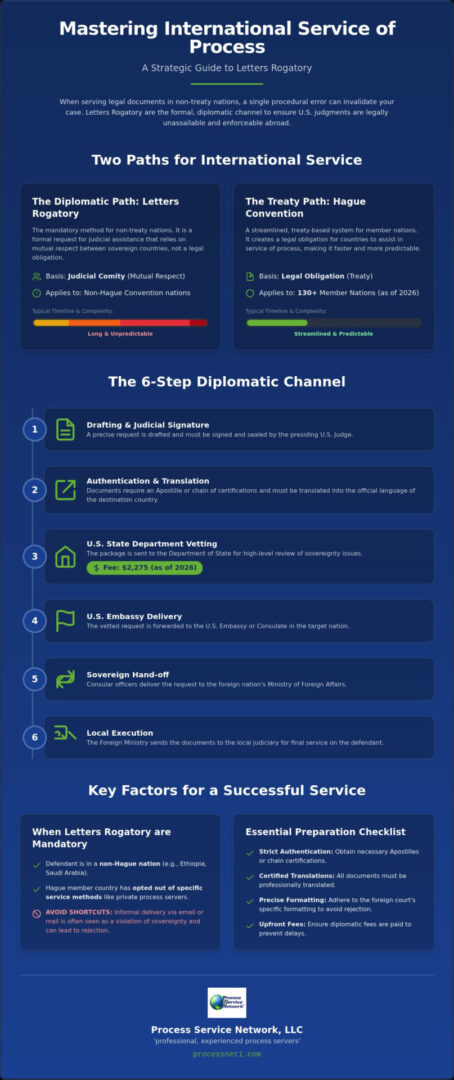
- Step 1: Drafting and Signature. You must draft a precise request and obtain a formal signature and seal from the presiding U.S. Judge.
- Step 2: Authentication. Documents require specific authentication, often involving an Apostille or a chain of certifications from the Secretary of State and the Department of Justice.
- Step 3: State Department Vetting. The package is transmitted to the U.S. Department of State for high-level diplomatic review.
- Step 4: Embassy Delivery. The State Department forwards the vetted request to the U.S. Embassy in the target nation.
- Step 5: Sovereign Hand-off. Consular officers deliver the request to the foreign nation’s Ministry of Foreign Affairs.
- Step 6: Local Execution. The Foreign Ministry transmits the documents to the local judiciary for final service on the defendant.
The Role of the U.S. Department of State
The State Department acts as the ultimate gatekeeper. They review every request for “sovereignty” issues to ensure the U.S. court isn’t overstepping its bounds. As of 2026, the fee for processing letters rogatory and Foreign Sovereign Immunities Act judicial assistance cases is $2,275. You must provide these fees upfront, or your request will sit on a desk indefinitely! Every document must be court-sealed before it reaches the federal level. If the seal is missing or the formatting is slightly off, the State Department will reject the entire package. For expert management of the diplomatic channel, you need a partner who knows these federal requirements inside and out.
Navigating the Foreign Judiciary
Once your documents reach the target country, the local Ministry of Foreign Affairs takes over. In non-Hague nations, this ministry serves as the “Central Authority” equivalent. Local service protocols are often rigid and strictly enforced. Private process servers are frequently banned, meaning a foreign court official or police officer must deliver the papers. Once documents enter a foreign court’s jurisdiction, U.S. rules of procedure no longer apply. You are now operating entirely under the host country’s laws. This is why the process can take a year or more to complete. You need a “no-nonsense” approach to keep the pressure on and ensure local officials actually move the case forward.
Letters Rogatory vs. Hague Convention: Strategic Differences
Choosing between the Hague Convention and the diplomatic channel isn’t just about checking a box. It’s a high-stakes strategic decision that dictates the future of your litigation! While the Hague Service Convention provides a streamlined framework for its 130 members, service of process via letters rogatory remains the essential “heavy hitter” for everywhere else. You need to understand the fundamental trade-offs in speed, cost, and legal weight to protect your client’s interests.
- Speed: Hague service typically wraps up in 3 to 6 months. In contrast, the diplomatic path is a marathon, often requiring 6 to 18 months or longer due to multiple layers of government vetting.
- Cost: Hague requests usually involve modest administrative fees. Letters rogatory are expensive, requiring significant diplomatic fees, mandatory certified translations, and local foreign court costs.
- Compliance: The Hague Convention is treaty-based, meaning member nations have a legal obligation to assist. Letters rogatory are purely discretionary, relying on the goodwill and “comity” of the foreign court.
- Enforceability: Because a foreign judge is personally involved in executing a letter rogatory, the service is virtually unassailable during later asset seizure or judgment enforcement.
The ‘Enforcement Gap’ Explained
Winning your case in a U.S. court is only half the battle. If you want to collect money from a bank account in a non-treaty jurisdiction, that nation’s judges must believe their sovereignty was respected. Improper service is the number one defense used to block the enforcement of foreign judgments! If you cut corners now, your final judgment is just an expensive piece of paper. While treaty service is faster, the diplomatic channel often creates a more “ironclad” record in the eyes of local authorities. You can compare these requirements in detail by reviewing our Hague Convention Process Service: 2026 Definitive Guide.
Choosing the Right Method for Your Jurisdiction
For nations like Ethiopia or Saudi Arabia, you have no choice; the diplomatic path is the only route. However, “grey areas” exist in 2026. For example, while Algeria and Vietnam joined the Hague Service Convention earlier this year, local officials in remote provinces may still defer to traditional diplomatic requests. Using the wrong method in these transition zones can lead to catastrophic delays. Don’t gamble with your case’s foundation. Consulting with international process service experts is the only way to ensure your method matches the current reality on the ground.
Preparation Checklist for Success
Success in international litigation is never an accident. It requires a level of precision that most domestic firms simply aren’t prepared for! If your paperwork contains even a minor clerical error, a foreign judge will reject it without hesitation. To master service of process via letters rogatory, you must treat every document as a high-stakes diplomatic instrument. Our decades of experience since 1978 have taught us that the difference between success and a total judicial rejection lies in the smallest details. Use this checklist to ensure your request is unassailable.
- Precise Formatting: Foreign courts demand specific “Heading” and “Salutation” styles. Addressing the request “To the Appropriate Judicial Authority in [Country]” is non-negotiable.
- Mandatory Translation: You must provide a certified translation for every single page. “Close enough” is a recipe for failure in diplomatic channels.
- Fee Management: You must handle multiple layers of costs upfront. As of August 2026, the U.S. Department of State requires a $2,275 fee for processing letters rogatory.
- The Essential Summary: Every request needs a clear, concise explanation of the suit. This summary helps the foreign judge understand why their assistance is necessary for justice.
Translation and Legal Accuracy
A standard translation isn’t enough for a sovereign court. You need certified, court-admissible translations that respect the legal terminology of the destination country. Many agencies fail because they translate words rather than legal concepts. A literal translation can create cultural misunderstandings that offend a foreign judge’s sensibilities! At Process Service Network, we insist on dual-vetted translations to ensure every nuance is preserved. You can order certified legal translations from our veteran team to ensure your documents are ready for high-level scrutiny.
Managing the Timeline
Be realistic about the diplomatic clock. You’re entering a process that typically takes a year or more to complete. While you can request “Expedited Treatment,” these pleas rarely move the needle with foreign bureaucracies. We manage the timeline through strategic follow-ups. We know exactly when to contact the Department of State to ensure your request hasn’t stalled on a desk in Washington. Setting client expectations for a 12-month journey is essential. It’s a marathon, not a sprint, and trying to rush a sovereign power often backfires. We maintain a no-nonsense approach to these delays, providing you with the transparency you need to keep your case on track while the diplomatic wheels turn.
Why Process Service Network is the Diplomatic Authority
Navigating the world’s most difficult legal landscapes requires more than just a map. It requires a veteran who has walked the path thousands of times! Process Service Network, LLC has been operational since 1978, specializing in high-stakes international delivery that other agencies simply avoid. We don’t just process paperwork; we manage a strategic diplomatic mission to ensure your service of process via letters rogatory is legally unassailable. Our no-nonsense approach eliminates the uncertainty that typically plagues international litigation. We provide comprehensive support across the board, from Hague form preparation services to the most complex non-treaty requests. You need a partner with the infrastructure to handle sovereign-to-sovereign hand-offs without flinching!
Our commitment to judgment-proof service is unwavering. We understand that your entire case hinges on the integrity of the initial delivery. By leveraging our global network of agents and decades of procedural expertise, we ensure that every step of the diplomatic channel is executed with operational precision. We don’t settle for “good enough” when the stakes involve international asset seizure and judgment enforcement. Process Service Network, LLC acts as your relentless guide through the most complex legal environments on the planet.
Handling the ‘Un-Servable’ Cases
We thrive on the challenges that deter others. Our team has a proven history of success in non-treaty jurisdictions across Asia and Africa. We understand the local customs and judicial temperaments that dictate success in these regions. You don’t have to worry about your documents disappearing into a “diplomatic black hole.” We track every hand-off with precision and provide absolute transparency throughout the process. We’ll tell you the truth about timelines and potential hurdles, not just what you want to hear. This commitment to honesty ensures you can manage your client’s expectations with confidence while we handle the heavy lifting in foreign courts.
Get Started with the Experts
The margin for error in diplomatic legal delivery is zero. A single formatting mistake or a missing seal can set your case back by an entire year! You cannot afford to guess when it comes to the Hague service request form or a formal letter rogatory. We’ve navigated every possible complication and possess the infrastructure to handle even the most difficult cases with ease. Protect your litigation and ensure your future judgment is enforceable by partnering with a seasoned veteran. Contact Process Service Network, LLC to initiate your international service today! We are the definitive choice for legal professionals who demand results, speed, and accuracy in the global marketplace.
Master Your International Legal Delivery
Success in global litigation depends entirely on the integrity of your initial steps. You’ve seen the complexities of the diplomatic path and the rigorous formatting required to satisfy foreign judiciaries. By mastering service of process via letters rogatory, you eliminate the procedural loopholes that defendants use to evade justice. It’s about ensuring your U.S. judgment has real teeth in a foreign jurisdiction. Don’t let your case stall because of a bureaucratic technicality you could’ve avoided!
Since 1978, Process Service Network, LLC has served as the definitive guide for legal professionals navigating these treacherous waters. Our specialized expertise in non-treaty jurisdictions ensures that your documents move through the diplomatic channel with operational precision. We handle the “impossible” cases so you can focus on winning your suit. Secure Your International Service with Process Service Network, LLC now and ensure your international litigation remains unassailable! We’re ready to help you move forward with absolute confidence.
Frequently Asked Questions
How long does service of process via letters rogatory actually take?
You should expect the execution of letters rogatory to take a year or more. This isn’t a fast process because it moves through multiple layers of the U.S. State Department and foreign diplomatic channels. While some jurisdictions might move faster, most non-treaty nations operate on their own bureaucratic timelines. We track every hand-off to minimize delays, but you must plan for a long-term diplomatic journey.
Can a foreign court deny a request made via letters rogatory?
Yes, a foreign court has the absolute right to deny a request based on their own laws or public policy. Unlike treaty-mandated service, letters rogatory rely on judicial comity, which is discretionary. If the request violates their sovereignty or doesn’t follow local formatting, they’ll reject it instantly. This is why precise drafting and expert vetting are essential to avoid a total judicial rejection of your international service.
Are translations always required for service via letters rogatory?
You must provide certified translations if the destination country’s official language isn’t English. Foreign courts view untranslated documents as a violation of their procedural rules and sovereignty! Don’t rely on automated tools for this. Accurate, court-admissible translations ensure the foreign judge understands the request and the nature of the suit. We insist on dual-vetted translations to prevent any cultural or legal misunderstandings that could stall your case.
What happens if the defendant cannot be located in the foreign country?
If the defendant isn’t found, the foreign court will return the documents to the U.S. court as “unserved” through the same diplomatic channels. This can waste months of effort and thousands in fees. We recommend performing a comprehensive diligence search before initiating the process. If the defendant remains elusive, you might need to pursue service by publication or alternative methods, provided the U.S. court approves them under Federal Rule 4(f)(3).
How much does the U.S. Department of State charge for letters rogatory?
The U.S. Department of State charges a flat fee of $2,275 for processing letters rogatory and Foreign Sovereign Immunities Act judicial assistance cases. This fee is mandatory and covers the diplomatic vetting and transmission to the foreign embassy. Keep in mind that this doesn’t include local foreign court fees or translation costs. You must pay this amount upfront to ensure your request moves through the federal bureaucracy without unnecessary delays.
Is service via letters rogatory the same as service under the Hague Convention?
No, they are fundamentally different. Service of process via letters rogatory is a discretionary diplomatic request used primarily in non-treaty nations. The Hague Convention is a multilateral treaty that streamlines the process among 130 contracting parties. Hague service is generally faster and carries a treaty-mandated obligation for the foreign country to assist. Rogatory is the method of last resort when no such legal agreement exists between nations.
Can I serve a foreign corporation using letters rogatory?
You can absolutely serve a foreign corporation using the diplomatic channel. The process remains the same as serving an individual, requiring a formal request from a U.S. court to the foreign judiciary. You must identify the corporation’s registered office or a high-level officer within the target country. Ensuring your service of process via letters rogatory is properly executed against a corporation is vital for the future enforcement of any corporate judgment.
What is the difference between a Letter Rogatory and a Letter of Request?
The main difference lies in the legal framework and terminology. A “Letter Rogatory” is the traditional term for a court-to-court request based on comity in non-treaty jurisdictions. A “Letter of Request” is the specific terminology used under the Hague Evidence Convention. While both seek judicial assistance, a Letter of Request operates under a streamlined treaty protocol. Using the correct term for your specific jurisdiction prevents confusion and demonstrates your firm’s technical expertise.
