

Serving Legal Documents in China: The 2026 Authoritative Guide
In international litigation, a single translation error or an unapproved delivery method is enough to kill your case before it even starts! Procedural perfection is your only path to a victory that sticks. You’re likely exhausted by the prospect of 6 to 18-month timelines and the constant fear that a Chinese court will quash your service over a minor technicality. It’s a high-stakes environment where any shortcut outside the Hague Convention guarantees a dead-end judgment. We understand the pressure to get this right the first time. Mastering the complexities of serving legal documents in China is the only way to protect your client’s interests and secure a judgment that is actually enforceable.
This authoritative 2026 guide provides the exact roadmap to navigate Ministry of Justice requirements with absolute confidence! We’ll show you how to leverage the new ILCC online portal and meet strict Simplified Chinese translation standards without the typical headaches. You’ll also learn how the 2026 Mainland-Hong Kong arrangement is streamlining service for specific cases. From Hague form preparation to obtaining a valid affidavit of service, we’re laying out the professional strategy you need to move fast and stay compliant. Let’s get your documents served correctly!
Key Takeaways
- Understand why the Hague Service Convention is the exclusive legal channel for serving legal documents in China to ensure your judgment is enforceable.
- Learn the strict Simplified Chinese translation standards required by the Ministry of Justice to prevent the immediate rejection of your service request.
- Navigate the International Legal Cooperation Center (ILCC) online portal and set realistic expectations for the 6 to 18-month service timeline.
- Avoid fatal procedural errors like attempting service by mail or using private process servers, both of which are strictly prohibited in Mainland China.
- Discover how professional Hague form preparation can eliminate administrative delays and streamline your international litigation strategy.
Navigating the Hague Service Convention in China
If you want to succeed in a Chinese court, you must follow the rules exactly. China is a signatory to the Hague Service Convention. This isn’t just a suggestion; it is the mandatory legal framework for serving legal documents in China. The Ministry of Justice (MOJ) acts as the Central Authority, specifically through the International Legal Cooperation Center (ILCC). If you bypass this channel, your foreign judgment won’t be worth the paper it’s printed on! Chinese courts will simply refuse to recognize or enforce it. Stick to the protocol to protect your litigation.
The Exclusive Nature of the Hague Treaty in China
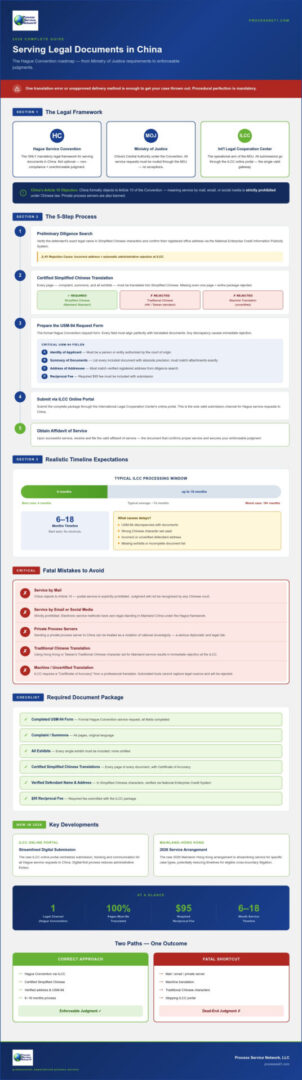
Many litigants think they can save time by using informal methods. They’re wrong. China has made formal objections to Article 10 of the Convention. This means service by mail, email, or social media is strictly prohibited. While jurisdictions like the UK or Canada might allow more flexibility, China demands procedural perfection. Sending a private process server to a Chinese office isn’t just ineffective; it’s a high-risk gamble that can lead to quashed judgments. Attempting private service in China can even be treated as a violation of sovereignty. Legal precedent is clear: if service doesn’t go through the ILCC, the case is dead on arrival. Don’t gamble with your client’s future. Use the only path that leads to an enforceable judgment.
Preliminary Diligence: Finding the Registered Address
You can’t serve a defendant if you don’t know exactly where they are. This is why an elite diligence search for legal proceedings is your first tactical move. You must verify the defendant’s exact legal name in Simplified Chinese characters. Don’t rely on English translations from a business contract. You also need to confirm the registered office address via the National Enterprise Credit Information Publicity System. An incorrect address is the leading cause of administrative rejection at the ILCC. We handle this investigative work upfront to ensure your request moves through the system without friction. We find the unfindable so your case stays on track! Starting with the right data saves you months of frustration and prevents costly re-submissions.
Mandatory Translation and Documentation Standards
Don’t let your case collapse because of a typo! When serving legal documents in China, the Ministry of Justice (MOJ) demands absolute linguistic and clerical precision. Every single page of your complaint, summons, and exhibits must be translated into Simplified Chinese. If you miss even a one-page exhibit, the entire package will be rejected. This isn’t just about language; it’s about strict adherence to sovereign standards that leave no room for interpretation. Precision is your only protection against administrative failure.
Simplified Chinese vs. Traditional Chinese
Mainland China uses Simplified characters. This is a critical distinction. Using Traditional Chinese, which is standard in Hong Kong or Taiwan, is a fatal error for mainland service. It’s a common trap that results in immediate rejection by the ILCC. You also can’t rely on automated tools or uncertified translators. Machine translation lacks the legal nuance required for court-admissible documents and often fails to capture technical legal terminology correctly. The ILCC requires a “Certificate of Accuracy” signed by a professional translator to verify the filing. Process Service Network, LLC provides expert legal document translation for service to eliminate these risks. Our in-house team ensures every character meets the MOJ’s rigid expectations!
Preparing the USM-94 Request Form
The USM-94 is your formal request under the Hague Convention. It must be perfect. Any clerical discrepancy between the USM-94 and the translated documents will cause months of unnecessary delays. Chinese authorities scrutinize the “Summary of Documents” section with extreme care. If the summary doesn’t perfectly align with the actual attachments, the ILCC will quash the request immediately. Precision here is non-negotiable.
Pay close attention to these critical areas:
- Identity of the Applicant: This must be a person or entity specifically authorized by the court of origin.
- Summary of Documents: You must list every document included in the package with absolute clarity.
- Address of the Addressee: This must match the verified registered address found during your preliminary diligence search.
- Reciprocal Fee: Ensure the required $95 reciprocal fee for U.S. requests is properly accounted for in your submission.
Common clerical errors, like misspelling a corporate officer’s name or failing to match the Chinese character name exactly, lead to months of frustration. This level of detail is why Process Service Network, LLC handles Hague form preparation as a core competency. It creates a single, streamlined execution that leaves no room for administrative error. If you want to move forward without the fear of rejection, you can start your consultation with our experts today. We get it right the first time!
The ILCC Submission Process and Realistic Timelines
The submission process is no longer a black box! In 2026, the International Legal Cooperation Center (ILCC) has moved to a digital-first approach through its online portal. This shift aims to eliminate the clerical friction that historically plagued international litigation. However, clicking “submit” is just the first step in a complex bureaucratic relay. When serving legal documents in China, your request moves through a rigid hierarchy that requires expert monitoring. We track every milestone to ensure your case doesn’t vanish into a provincial backlog.
The Workflow of a Hague Service Request
Your documents follow a precise, top-down path. For U.S. litigants, the process starts with the U.S. Central Authority, which transmits the package to the Chinese Ministry of Justice (MOJ). The MOJ then delegates the task to the appropriate High People’s Court. Finally, the request reaches the local People’s Court where the defendant is located. It’s the local judges and clerks who physically execute the service. Once finished, proof moves back up the chain. You will receive an official “Certificate of Service” stamped with the court’s red seal. This is the gold standard for international compliance. It carries far more weight than a standard private affidavit and is the only document Chinese courts will recognize to prove you followed the law.
Managing Expectations for High-Stakes Litigation
Timing is everything. In 2026, you should budget 4 to 9 months for a completed certificate of service. While major cities like Shenzhen or Shanghai may process requests faster, rural areas often face resource constraints that cause delays. If a defendant attempts to dodge service, the local court can utilize “service by leaving.” This involves leaving the documents at the verified address in front of witnesses or local officials. It is a powerful tool to prevent defendants from stalling your case. We recommend initiating the process of serving legal documents in China as early as possible to accommodate these regional variables. Our team acts as your veteran guide, navigating these timelines with operational precision and absolute transparency!
Critical Prohibitions: Avoiding Fatal Mistakes
Shortcuts are the fastest way to lose your case in China! While other jurisdictions might allow for creative delivery methods, the Chinese judiciary maintains an exclusive, sovereign right to serve process within its borders. Any attempt to bypass the Central Authority isn’t just a procedural error; it’s a direct violation of international law that Chinese courts take very seriously. If you try to skirt the rules, you won’t just face a quashed service. You might permanently destroy your ability to ever enforce a judgment against the defendant. Don’t gamble with your litigation strategy when the stakes are this high.
Why Mail Service is a Non-Starter
Many U.S. attorneys assume that if a defendant signs for a FedEx package, service is complete. In China, this is a dangerous delusion! China has made a specific, formal reservation against Article 10(a) of the Hague Convention, which covers service by postal channels. Article 10 is the most common pitfall for US attorneys who are used to more flexible domestic rules. Even if the defendant “accepts” the documents and your local court considers it valid, a Chinese court will never recognize that service. Without a certificate from the Ministry of Justice, your foreign judgment is legally invisible in Mainland China. We ensure you avoid these “convenient” traps that lead to total case failure.
The Legal Risks of Unauthorized Process Servers
Sending a private investigator or a local agent to hand-deliver papers in China is a recipe for disaster. In fact, it’s often treated as a felony! Unauthorized individuals attempting to perform judicial acts on Chinese soil can face severe criminal penalties, including detention or deportation. Beyond the personal risk to the server, this unauthorized action leads to a permanent “lack of jurisdiction” ruling. You cannot fix this mistake with a simple re-service; the taint of the initial illegal act often lingers.
When serving legal documents in China, you must respect the local legal landscape. This is why it is critical to work with a global process service network that understands the nuances of local sovereignty and criminal statutes. We operate within the strict confines of the law to ensure your service is bulletproof. If you’ve reached a dead end where the defendant is truly unfindable, we can guide you through “Service by Publication.” However, this is strictly a last resort. It requires a specific court order and definitive proof that all other Hague-compliant methods have failed.
Don’t risk your reputation or your client’s case on unauthorized methods. If you need to ensure your service is 100% compliant and enforceable, contact our international experts today for a professional consultation. We handle the hard cases with absolute precision!
Secure Your Litigation with Process Service Network, LLC
Don’t leave your case to chance! serving legal documents in China requires a partner who has seen it all and knows how to win. Process Service Network, LLC brings over 45 years of specialized expertise in Hague Convention process service to your legal team. We don’t just fill out forms; we engineer success for high-stakes litigation. Our team provides a comprehensive, end-to-end solution that integrates legal document translation, elite Hague form preparation, and strategic submission. We are the relentless problem-solvers you need when international bureaucracy threatens your timeline! We get it right the first time to eliminate the risk of costly rejections and administrative delays.
Why Leadership Matters in International Service
We thrive on cases that others call “impossible.” Whether you’re dealing with a shell company in a remote province or a high-profile corporate entity, our infrastructure is built for high-volume, complex international process service. Process Service Network, LLC maintains a “can-do” attitude that transforms procedural hurdles into manageable steps. We provide absolute transparency in everything we do. There are no hidden variables or surprise fees in our financial structure! You get a clear, straightforward partner who understands the high-pressure nature of your court-ordered deadlines. Our team monitors the Ministry of Justice and the ILCC with aggressive, persistent follow-ups. We don’t wait for updates; we demand them to ensure your certificate of service returns with operational speed and precision.
Initiate Your Service in China Today
Stop worrying about administrative rejections or quashed service! Contact Process Service Network, LLC today to begin your preliminary diligence search. As established earlier in this guide, verifying the correct registered address is the single most important step for a successful Hague request. We handle this investigative work with surgical precision so your filing is bulletproof from the start. We find the unfindable so you can secure your judgment! Experience the total peace of mind that comes with professional Hague compliance and a partner who never backs down from a challenge. We have the global reach and modern methodology to handle your most difficult international cases with ease!
Ready to move forward with serving legal documents in China? Get a Quote for Service in China now and secure your path to a valid, enforceable judgment! Our experts are standing by to execute your request with the accuracy and speed you deserve!
Secure Your Global Legal Victory
Procedural perfection is the only shield against a quashed case in China. You now have the authoritative strategy to navigate the Ministry of Justice and the ILCC portal with absolute confidence! Remember that serving legal documents in China leaves no room for clerical errors or informal shortcuts. Every Simplified Chinese character must be precise, and every Hague form must be flawless. Bypassing these mandatory channels doesn’t just delay your case; it renders your final judgment legally invisible within the Chinese judiciary.
Don’t let your litigation stall in a provincial backlog or fall into the dangerous “Article 10” trap. Process Service Network, LLC has been the definitive choice for high-stakes international service since 1978. Our infrastructure is built to handle the most difficult defendants with relentless efficiency. Leverage our veteran expertise for your professional Hague form preparation and certified Simplified Chinese translation needs. We handle the technical complexity so you can focus on the core of your case! We’ve navigated these challenges for decades and possess the global reach to deliver results where others fail.
Dominating No Borders: Start Your International Service with Process Service Network, LLC. Your path to an enforceable judgment starts right here!
Frequently Asked Questions
Is service of process by mail allowed in China?
No, service by mail is strictly prohibited in Mainland China. China has made a formal objection to Article 10(a) of the Hague Convention. This means any document sent via FedEx, DHL, or standard post will not be recognized by Chinese courts. Even if the defendant signs for the package, your service is legally invalid. Stick to the formal Hague channel to ensure your judgment is enforceable.
How long does it take to serve legal documents in China under the Hague Convention?
You should expect the process of serving legal documents in China to take between 6 and 18 months. While the new ILCC online portal aims to improve efficiency, the request must still pass through the Ministry of Justice and multiple levels of the Chinese court system. Factors like the defendant’s location and the specific province’s caseload can impact this timeline. We recommend starting as early as possible to meet deadlines.
Do documents served in China need to be translated?
Yes, every document in your service package must be translated into Simplified Chinese. This includes the summons, complaint, and all attached exhibits. The Ministry of Justice will reject any request that is incomplete or uses Traditional Chinese characters. We provide certified legal translations that meet the ILCC’s strict standards. Professional translation is non-negotiable to prevent administrative rejections that can set your case back by several months.
Can I use a private process server to deliver papers in China?
No, using a private process server in China is illegal and can be treated as a violation of sovereignty. China does not recognize private service of process. Attempting this can lead to criminal penalties for the server and a permanent lack of jurisdiction ruling for your case. All service must be executed by the Chinese judiciary through the formal Hague Convention process. Don’t risk your litigation on unauthorized delivery methods.
What happens if a Chinese defendant refuses to accept service?
If a defendant refuses to accept service, the local People’s Court can utilize “service by leaving.” The court official leaves the documents at the defendant’s verified address, often in the presence of witnesses or local representatives. This act is documented and considered legally complete under Chinese law. This prevents defendants from stalling your case by simply refusing to open the door. We monitor these developments to ensure you receive a valid certificate.
What is the ILCC and what is its role in process service?
The International Legal Cooperation Center (ILCC) is the operational arm of China’s Ministry of Justice. It acts as the designated Central Authority for receiving and processing all Hague Service Convention requests. The ILCC reviews your documentation, manages the online portal, and coordinates with the High People’s Courts to execute service. It is the gatekeeper for all international legal documents entering the Chinese judicial system.
What documents are required for a Hague Service Request in China?
A complete request requires the USM-94 form, the original legal documents, and their full Simplified Chinese translations. You must also include the $95 reciprocal fee for requests originating from the United States. Ensure the “Summary of Documents” section on the USM-94 perfectly matches your translated attachments. Any discrepancy between these files will lead to an immediate rejection. Precision in your documentation is the only way to ensure a successful filing.
Can I serve a Chinese company via email or LinkedIn?
No, electronic service via email or social media is not permitted for Mainland Chinese defendants. While the 2026 Mainland-Hong Kong Arrangement introduced some electronic options for cases between those specific regions, it does not apply to foreign litigants serving legal documents in China. China’s objection to Article 10 remains absolute. You must use the formal Hague channel to ensure your service is recognized and your judgment remains enforceable.
