
New York Service of Process: Rules, Methods and Proof
Service of process in New York means getting the summons and complaint to the defendant in a way the CPLR (the Civil Practice Law and Rules, the state’s main court procedure code) allows, then filing proof that you did it. Get either part wrong and a judge can toss the service, which costs you time and sometimes a missed deadline. We run process service for law firms, businesses and individuals, including hard-to-serve and international cases, and this guide walks through the New York rules in plain terms and shows where service usually breaks down.
TL;DR
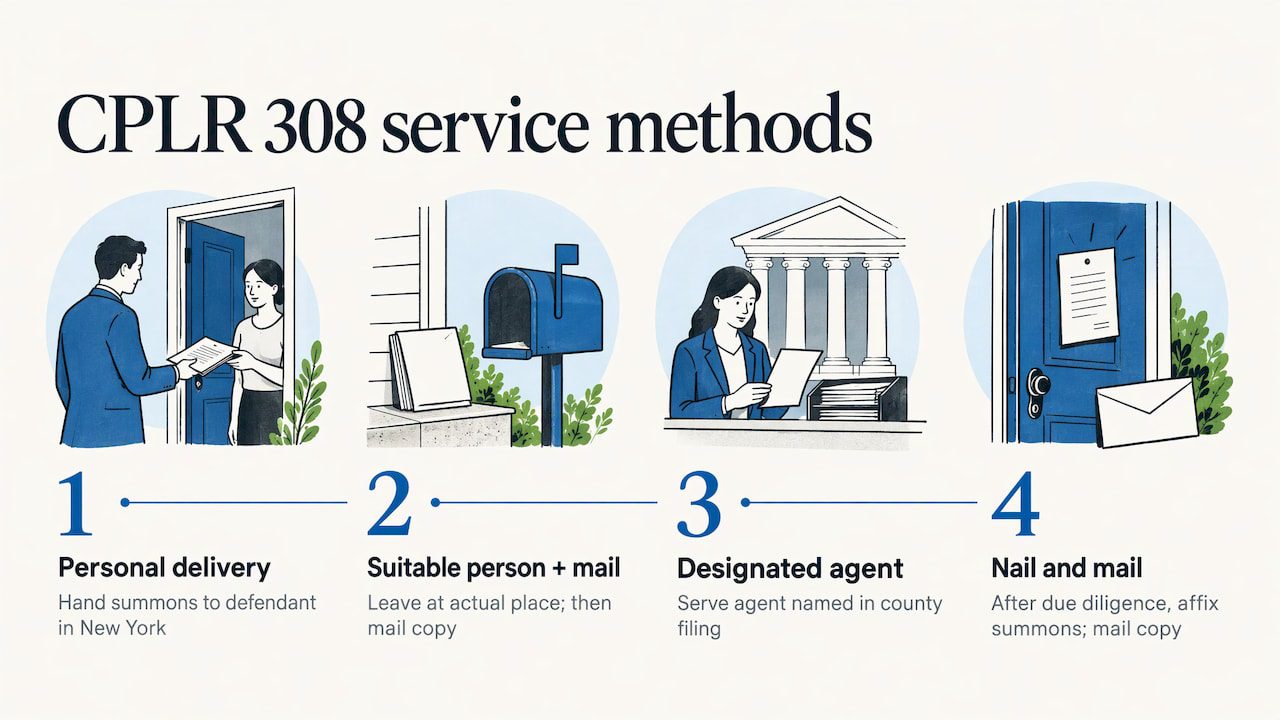
- Under CPLR 308, an individual is served by personal delivery, by delivery to someone of suitable age and discretion plus a mailing, through a designated agent, or by “nail and mail” after due diligence.
- Businesses are served under CPLR 311, usually through an officer, a managing agent, or the Secretary of State as statutory agent.
- Proof of service has to carry specific details (date, time, address, manner, a description of the person) and the clock on the defendant’s response often depends on when you file it.
- Defendants who hide, move or live abroad need extra steps: documented diligence, publication, or Hague Convention service.
- We handle New York-bound jobs nationwide, with upfront pricing and Hague forms prepared at no additional charge.
Table of Contents
- Who can serve papers in New York
- Serving an individual: the four CPLR 308 methods
- Serving a business, a registered agent or the state
- Proof of service: what the affidavit must say
- Timing: when the defendant’s clock starts
- When the defendant is hard to find
- If the defendant is outside the United States
- What it costs
- A note on Florida Statutes § 48.031
- How we handle New York jobs
- FAQ
- Sources
Who can serve papers in New York
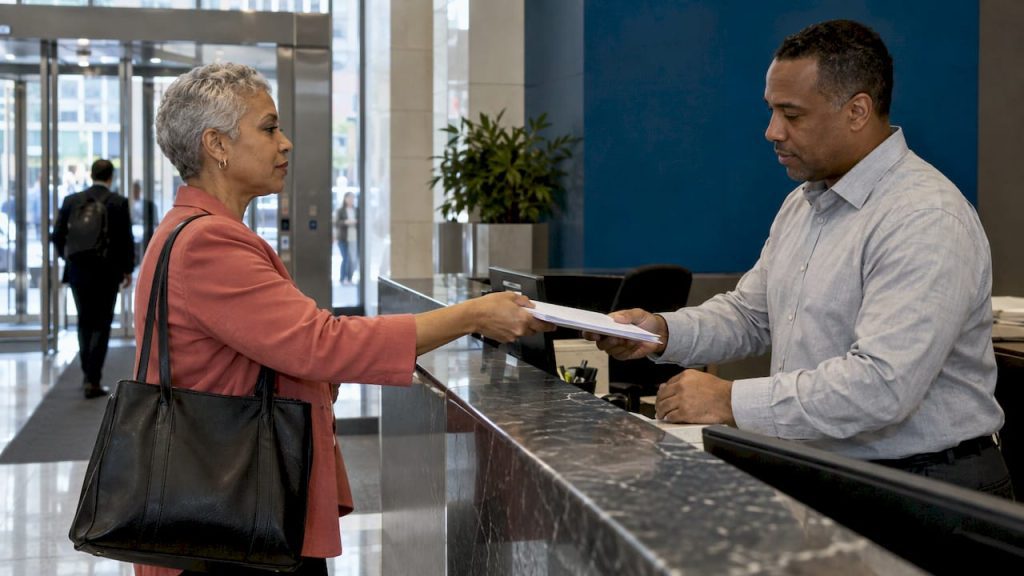
The person who hands over the papers must be an adult who is not a party to the case. You, as the plaintiff, can’t serve your own summons. A friend who is not a party can technically do it, but the server will later need to swear to every detail of the delivery in an affidavit, and a defendant who contests service will cross-examine that person. That is why most law firms use a professional who serves papers every day and knows what the affidavit must say.
One point trips up a lot of people: in New York, a process server in New York City generally needs to be licensed by the city’s Department of Consumer and Worker Protection. When you choose a server for a NYC job, confirm the license before the papers go out.
If your case is in another state but the defendant is in New York, or the other way around, the rules of the court hearing the case and the rules of the place of service can both matter. Our guide to out-of-state process servers covers that situation.
Serving an individual: the four CPLR 308 methods
CPLR 308 is the section most New York cases run through. It lists the ways to serve a natural person, in order of preference.
1. Personal delivery. You hand the summons to the defendant inside New York. This is the cleanest method, and the defendant’s response clock starts right away. It is also the hardest when the person avoids contact.
2. Delivery to a person of suitable age and discretion, plus mailing. The server leaves the papers with a suitable person at the defendant’s actual place of business, dwelling or usual place of abode. Then the server mails a copy to the defendant’s last known residence or actual place of business. The delivery and the mailing must happen within 20 days of each other. Proof of service must be filed within 20 days of whichever of the two came later, and service is complete 10 days after that filing.
Where this goes wrong: “suitable age and discretion” is a judgment call, and the “usual place of abode” has to actually be where the defendant lives. Leaving papers with a doorman or a coworker at a place the defendant no longer uses is a common reason for a later challenge. For an individual, CPLR 308 treats a location held out as a place of business through regular solicitation or advertising as an actual place of business, which helps with self-employed defendants.
3. Delivery to a designated agent. Under CPLR 318, a person can name an agent to accept service by filing a written designation with the county clerk. It lasts three years unless revoked earlier. This is rare, but it is worth checking in contracts and county records.
4. Nail and mail. If the first two methods can’t be done with due diligence, the server can affix the summons to the door of the actual place of business, dwelling or usual place of abode and mail a copy. The same 20-day mailing and filing rules apply, and service is complete 10 days after filing.
The key phrase is due diligence. Courts expect a record of real attempts at different times of day, including evenings and weekends, at the right addresses. Our overview of serving court papers on a person goes deeper on how those attempts are made and logged.
Serving a business, a registered agent or the state
CPLR 311 covers corporations, domestic or foreign. You can serve an officer, a director, a managing or general agent, a cashier or assistant cashier, or another agent authorized by appointment or by law. The receptionist at the front desk is not automatically one of these, so the server has to ask who is authorized and note the name and title.
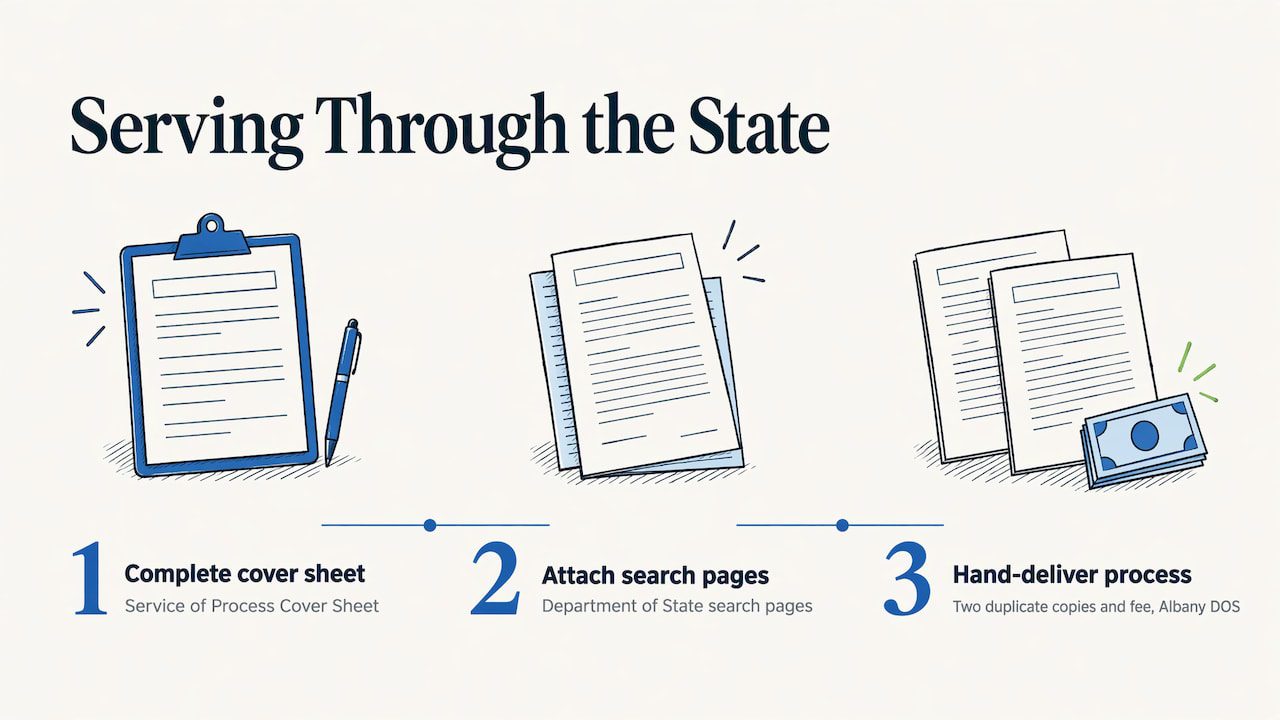
For most New York business entities, the Secretary of State is also the statutory agent for service. Business Corporation Law § 306 and the Department of State’s own instructions set out how: the server completes a Service of Process Cover Sheet, attaches the Department of State search pages, and hand-delivers two duplicate copies of the process with the fee to the Department of State at One Commerce Plaza, 99 Washington Avenue in Albany. The Department of State’s fee schedule lists $40 for corporations, LLCs, limited partnerships and LLPs, and $25 for a certificate as to service of process. These are government fees, separate from any process-server charge.
A practical note: serving the Secretary of State is complete service on the entity, but the entity only learns about the case if its address on file is current. If you can find a working address for an officer or registered agent, serving there as well can shorten the path to a response. Our guide on serving papers on a business shows how we approach both routes.
Government defendants have their own recipients under CPLR 311. New York City, for example, is served through the corporation counsel or a designated recipient, and counties, towns, villages and school districts each have designated officials. Check the rule for the specific entity before the papers go out.
Proof of service: what the affidavit must say
Service isn’t finished until it is proven. CPLR 306 says proof must identify the papers served and the person served, and state the date, time, address (or the place, if there is no address) and the manner of service, plus facts showing the service was authorized. For an individual, the server also describes the person: approximate age, height, weight, hair color and sex are the usual items. For nail-and-mail under CPLR 308(4), the affidavit adds the dates, addresses and times of the earlier attempts.
Proof can also take the form of a public officer’s certificate, another server’s affidavit, or the signed acknowledgment described in CPLR 312-a. A written admission by the person served counts as proof too.
The usual mistakes are small, and they matter:
- A missing time of day or a vague address.
- A person description copied from a template instead of what the server saw.
- Attempt logs for nail-and-mail that skip times or use one address for several tries.
- Filing late, which pushes back the date service becomes complete.
We write the affidavit from the server’s field notes, so the details on the page match what happened at the door.
Timing: when the defendant’s clock starts
New York currently has a patchwork. After personal delivery, the defendant generally has 20 days to respond. After substituted service (suitable person plus mailing, or nail-and-mail), the period doesn’t begin until service is complete, which is 10 days after proof is filed, and then the defendant has 30 days, so the total runs past 40 days. The New York State Bar Association’s Committee on the CPLR proposed in April 2025 to require filing proof of service in every case, set a single 30-day response period, and remove the 10-day wait. Those were proposals, not law, as of that report, so check the current CPLR text before you calendar a deadline.
Separately, New York signed a change in November 2025 for Surrogate’s Court citations (S8175, chapter 563). It allows service by registered or certified mail and lets the court order electronic service, and it sets minimum notice before the return day: 10 days for personal delivery within New York, 20 days for other delivery within the United States, and 30 days in all other cases and where the Attorney General is a party. That matters if your matter is an estate, not a regular civil action.
When the defendant is hard to find
Hard-to-serve defendants are the cases where New York’s diligence requirement bites hardest. A workable order of operations:
- Verify the address. Skip tracing and diligence searches confirm where the person lives and works before anyone drives out. We offer skip tracing and diligence searches as part of our work.
- Try personal delivery first, at different times of day, and keep a log.
- Move to substituted service once you have a real record of effort and a reliable place of abode or business.
- Consider nail and mail only after documented diligence, since a judge can ask to see it.
- Ask the court about alternatives (for example publication) if you truly can’t locate the person.
On that last point, publication in New York needs a court order, and the court expects proof that you searched. We run the online legal notice publication system through our affiliate, Global Legal Notices, LLC, for clients who need actual notice to a defendant whose whereabouts are unknown. Our article on how online legal notice publication works explains the steps, and why traditional publication has become obsolete covers the reasoning.
It’s also worth reading about what a process server can and cannot do. Knowing the limits keeps expectations realistic, for example around entering buildings or dealing with mail.
If the defendant is outside the United States
When the person or company you need to serve is in another country, New York’s rules lead you to the Hague Service Convention if both countries are parties to it. The Convention routes documents through a Central Authority in the destination country, and each country sets its own conditions, such as translation into the local language. Some countries object to certain methods, so the route that works in one place may be invalid in another.
Three things tend to decide whether foreign service holds up: correct forms, accurate translation, and a clear record of delivery. We prepare the required Hague forms at no additional charge, translate documents in 88 languages (at $0.29 per word), and publish pricing for international service starting from $395. For the details, see our explainer on the Hague Service Convention, our international service rules guide and the page on due diligence for service abroad. If you need testimony or documents from overseas, we also handle taking evidence abroad.
What it costs
New York process service has two kinds of cost. The first is the server’s fee, which depends on the location, the number of attempts and how fast you need it. The second is any government fee, like the Department of State charges above.
Our published pricing is $95 for Los Angeles-area service and $135 for California, with rush service available from $95. Nationwide service, which is how we handle New York jobs, doesn’t have a published price, so we quote it up front before work starts, with no hidden fees. A notary fee is $25. Having the quote in hand before the papers move lets you budget for the whole matter, including any Secretary of State fees and translation.
A note on Florida Statutes § 48.031
If your matter involves a Florida defendant, a different statute applies. Florida Statutes § 48.031 says original process is served by delivering it to the person, or by leaving copies at the person’s usual abode with a resident aged 15 or older and telling that person what the papers are. The 2025 version also requires an employer contacted by an authorized process server to allow service of an employee in a designated private area, with a noncriminal fine of up to $1,000 for noncompliance. Florida’s 2025 changes to § 48.091, effective October 1, 2025, also set weekday hours that registered agent offices must be open. The age rule is different from New York’s suitable-person standard, so don’t assume one state’s practice carries over to the other.
How we handle New York jobs
We have served process since 1978 and take on the cases that stall elsewhere: evasive defendants, tight deadlines, and defendants abroad. For New York service, we use our network of professional process servers, work nationwide, and quote the price before we start. If your case needs speed, ask about rush service. If the defendant can’t be found, we can run diligence searches and, where a court allows it, handle service by publication.
You can see the full list of services and pricing at our services page, or send us the papers and the defendant’s details and we’ll tell you the quote and the route.
For a United States job anywhere, our US process service page explains how nationwide coverage works.
FAQ
Can I serve the papers myself in New York?
No. A party to the case can’t serve their own papers. The server must be an adult who isn’t involved in the case, and they’ll sign the affidavit of service. Using a professional server also makes that affidavit easier to defend later.
What is nail and mail in New York?
It is the CPLR 308(4) method. After due diligence shows the first methods can’t be done, the server affixes the papers to the door of the defendant’s home or business and mails a copy. The mailing and filing deadlines are strict, and service is complete 10 days after proof is filed.
How do I serve a New York company?
Under CPLR 311 you serve an officer, director, managing or general agent, or another authorized agent. Most entities can also be served through the Secretary of State at the Department of State in Albany, with a cover sheet, two copies and the fee. For more, see our guide to ways legal documents can be served.
What proof of service does New York require?
An affidavit stating the date, time, address and manner of service, identifying the papers and the person, with a description of the individual served. For nail-and-mail, it must also list the earlier attempts. Our process server FAQs cover other common questions.
Does the Hague Convention apply to every foreign defendant?
Only when the destination country is a party to it and the papers must be sent abroad. Each country sets its own rules on translation and methods, so the route has to be matched to the country.
Sources
- Serving Court Papers on a Person
- Serving Papers on a Business
- Out-of-State Process Servers
- Ways Legal Documents Can Be Served
- Hague Service Convention Explained
- International Service Rules
- Service of Process Services and Pricing
