

Online Legal Notice Service: How Publication Works and How to Get It Done
An online legal notice service publishes your court notice on the web so a defendant you can’t find still receives formal notice of the case. It is the court-approved fallback when a process server can’t deliver papers in person. We run it through our affiliate, Global Legal Notices, LLC, and we handle it alongside the search work courts expect before they grant permission. This guide covers when you can use it, what the court will ask for, and how to keep the result from being challenged later.
TL;DR
- An online legal notice service is service by publication: the court lets you publish notice of the case instead of handing papers to the defendant, because you can’t locate them.
- Courts treat it as a last resort. You normally have to show a documented, diligent search first, and the rules differ by state and by court.
- Your search record is the part judges look at hardest. Dates, sources and results all need to be written down.
- Once the court approves, the notice has to run in the way the order says and be proven with the paperwork your court requires.
- We offer the only online legal notice publication system through Global Legal Notices, LLC, and we can also handle skip tracing and diligence searches for the same case.
Table of Contents
- What an online legal notice service actually is
- When a court will let you publish
- The search courts expect before they say yes
- What the notice says and how long it runs
- Why online publication changes the result
- Proving the notice ran
- What this costs, and what drives the price
- How we handle it
- When the defendant is outside the US
- A worked example
- FAQ
- Sources
What an online legal notice service actually is
In a normal lawsuit, someone hands the defendant the summons and complaint. That is personal service, and it is how a court knows the defendant has been told about the case.
Sometimes that can’t happen. The defendant moved, left no forwarding address, or is dodging the process server. Legal systems in the US have a workaround: with the court’s permission, you publish notice of the case where the defendant is likely to see it. Traditionally that meant an ad in a local newspaper. Cornell’s Legal Information Institute describes the method as substitute delivery by advertisement or newspaper of general circulation, and notes that courts are hesitant to allow it.
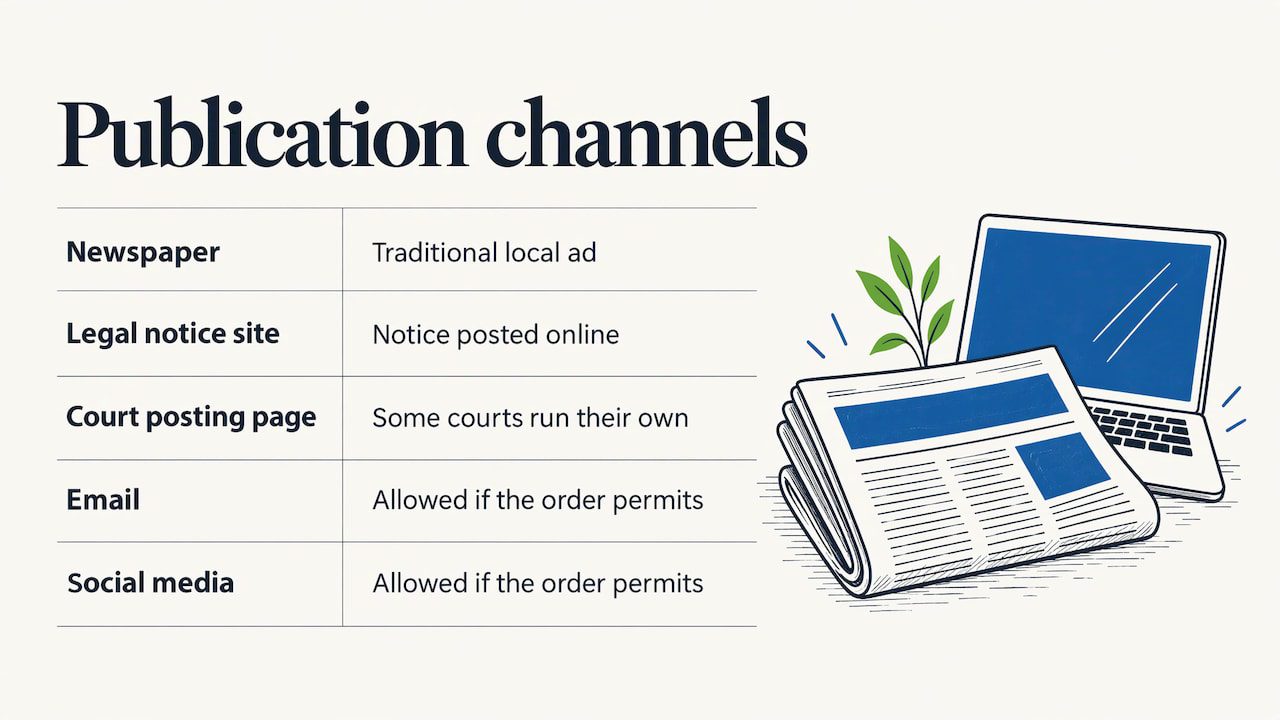
An online legal notice service does the same job on the web. Instead of a classified ad that few people read, the notice is posted on a legal notice website. Some courts also run their own posting pages, and some now allow email or social media delivery in addition to, or instead of, newspaper ads. What is allowed depends on your state and your judge, which is why the order matters more than the platform.
For more on how the older newspaper method compares, see our piece on service by publication today.
When a court will let you publish
Publication is for cases where regular service has failed or can’t be tried. Think of it as three situations:
- The defendant is hiding. You know roughly where they are, but they avoid the process server.
- The defendant has vanished. The last known address is stale and nobody can say where they went.
- The defendant’s identity or location is unknowable. This comes up in some property, estate and family matters.
In all three, judges want to see that you tried the regular methods first. Some courts spell this out in their own forms. A Georgia superior court’s family-law form, for example, calls publication a method of last resort and warns that the court may lack authority to order certain relief if the other side’s concealment and actual knowledge aren’t shown. Even if you’re not in Georgia, the lesson carries over: publication can be granted and still leave you with a weaker judgment than a defendant who was served in person.
That is why the question isn’t only “can I publish?” but “what will the judgment be worth afterward?” If the defendant has assets, a job or a business you can reach, a judgment built on published notice may get more scrutiny when you try to enforce it. A careful search at the start protects you at the end.
The search courts expect before they say yes
Every court that allows publication asks the same basic thing: show us you looked, and show us how. Self-help guides from several state courts describe the same pattern. You try the last known address, you contact people who might know where the person is, you check public records, and you write down every attempt with a date and a result.
In practice, a solid diligence record includes:
- Address checks. Confirm the person isn’t at any last known home or work address. Mail to those addresses and keep any returned envelope.
- People who would know. Relatives, friends, former employers, landlords and neighbors. Record who you contacted, when and what they said.
- Records searches. Phone and utility listings, property and court records, post office forwarding information, motor vehicle records where the law lets you use them, and jail or prison inmate lookups.
- Online searches. Social media and people-search sites. Courts that address this say that web searches and an email or two on their own aren’t enough.
- A failed attempt at personal service. In many places, a process server’s return showing the person wasn’t found is the foundation of the request.
Then you put this into a sworn statement, often called an affidavit of diligent search or diligent inquiry, and file it with a motion or application asking the judge for permission. Many states have a specific form for it. California, for instance, uses an application and a proposed order for publication, and the self-help guides ask petitioners to name the newspaper on the application before filing.
Where these searches go wrong
The most common reasons judges send people back:
- The affidavit says “I searched” but gives no dates, sources or results.
- The search relied on one database or one Google query.
- No one actually tried the last known address in person.
- The affidavit mixes up facts, such as a person’s age or former employer, that don’t match the case file.
If the court isn’t satisfied, it can refuse publication, delay the case, or have you redo service at your own expense. That is a lot of lost time for something a clean search record prevents.
This is where skip tracing and diligence searches earn their keep. We perform both for clients, and the output is written up so it can go into your affidavit. If you’re a law firm, that saves a paralegal’s afternoon. If you’re an individual, it saves you from guessing what the judge wants.
What the notice says and how long it runs
The court’s order controls the details. A published notice usually contains the case name and number, the court, the parties, a short summary of what the case is about and what relief is sought, and the deadline for the defendant to respond. Some states require the full summons to be published with a brief statement of the claim, and some orders also require mailing a copy to the last known address.
Run times and placement vary a great deal:
- Some courts require a set number of consecutive weeks of publication.
- Some require publication in the county where the defendant was last known to live, and in another county if there’s reason to think they moved.
- Some court systems operate their own legal notice website and allow posting there for a fixed period.
- Some states permit online publication, email or social media posting only when the judge orders it.
Because of this variation, we don’t recommend working from a generic checklist. Read your state’s rule and your judge’s order, and build the publication plan from those. When you order from us, we work from your order so the notice matches it.
Why online publication changes the result
The purpose of notice is that the defendant actually has a fair chance to learn about the case. A small ad in a paper that few people subscribe to satisfies a rule, but it rarely reaches a person who has moved across the country. Some courts have noticed this and now ask applicants to explain whether another method, such as an online posting, would be more likely to give actual notice.
That is the case for an online system. It makes the notice searchable and reachable from anywhere. We say our approach is built around actual notice for defendants whose whereabouts are unknown, and the Global Legal Notices, LLC platform is the only online legal notice publication system of its kind.
If the court’s order calls for a newspaper or a particular outlet, you follow the order. If your judge has discretion over the method, you can ask for what is most likely to reach the person. Talk to your attorney about how to frame that request, or call us and we can explain what the platform provides so you can address it in your motion.
Proving the notice ran
Publishing isn’t the finish line. You also have to prove it to the court, and the proof has its own deadlines.
Typically that means:
- An affidavit or certificate from the publisher stating what ran and on which dates. Courts that use newspapers usually want this from the newspaper itself.
- A printed copy of the notice showing the publication name and dates, where the rule asks for one.
- A filing deadline. Some courts require the notice to start running within a set time after the order and the proof to be filed within a set time after that. Miss those windows and you may need a new order.
- A waiting period for the defendant to answer, which usually starts only after the last publication is complete.
Put those dates on your calendar the day the order is signed. A lot of default judgments get delayed because the paperwork was filed late or incomplete, not because the search was weak.
What this costs, and what drives the price
Publication costs have a few moving parts, and they differ by state and court:
- Court filing fees for the motion or application, which the court sets.
- Publication fees, which depend on the method, the length of the notice and how long it runs. Some court-run postings cost little or nothing, while newspapers charge by length and run.
- Search costs, if you hire out the diligence work.
- Service attempts that come before publication.
Our own published prices for the pieces that surround publication are:
| Item | Price |
|---|---|
| Service of process, Los Angeles area | $95 |
| Service of process, California | $135 |
| Rush service | from $95 |
| Notary fee | $25 |
Service by publication itself has no published price, so ask us for a quote based on your court, your order and the length of your notice. We state the price upfront, with no hidden fees. See the services page for the current list.
The attempt at personal service that usually has to come first is a separate line. If you want to see how we approach it, read about serving court papers on a person or serving a business.
How we handle it
We have been serving process since 1978, and hard-to-serve cases are our focus. For a defendant who can’t be found, the work usually runs in this order:
- We attempt service through our network of professional process servers.
- If the person can’t be found, we can run skip tracing and diligence searches so your affidavit rests on a documented search.
- Once you have the court’s permission, the notice goes out through our online legal notice publication system, operated through our affiliate, Global Legal Notices, LLC.
If your case is time-sensitive, ask about rush service. If the papers are in another language or need to go abroad, we offer translations in 88 languages at $0.29 per word and international service from $395. We also prepare the required Hague forms at no additional charge.
To start an order, go to our service by publication page. For nationwide jobs, see our US process service page.
When the defendant is outside the US
Publication isn’t a fix for every missing defendant. If you know the defendant is in another country and you have an address, you normally have to follow the rules for international service, which often means the Hague Service Convention when both countries are members. Those procedures have their own forms, translation requirements and timelines, and a court can refuse to enter a judgment that skipped them.
If the address is unknown and the person may be abroad, the problem is two-layered: you need to find them, and you need to follow the international rules once you do. That is a case for diligent search first, then the correct service route. Our guides explain the pieces:
- Hague Service Convention explained
- International service rules
- Serving legal documents abroad
- Due diligence for service abroad
- Certified translation for service
Our international service page lists how we run these cases.
A worked example
Say a small business in Phoenix is suing a former contractor for unpaid materials. The contractor’s last known address is an apartment, and the lease has ended.
- The process server visits the apartment. The new tenant has never heard of the contractor. The server files a return saying the person wasn’t found.
- You mail the papers to that address anyway. They come back marked as undeliverable.
- You or a search provider check the contractor’s old employer, a couple of relatives, utility records, court records and social media. A cousin says the contractor moved out of state but won’t say where. Every step is dated and noted.
- You file a motion for service by publication with an affidavit describing all of this. The judge signs an order naming how and where the notice will run.
- The notice is published as the order says. The publisher provides proof, and you file it by the deadline.
- The response period runs. If the contractor doesn’t answer, you can ask for a default.
The step that fails most often is step 3. A thin record gets the motion denied, and you lose weeks. That is why we treat search and publication as one job.
FAQ
Is an online legal notice the same as a legal notice in a newspaper?
It serves the same legal purpose: giving formal notice of a case to someone who can’t be served in person. The difference is the medium. A court may require a newspaper, allow an online posting, or let you choose, so the order decides.
Can I publish notice without asking the court?
Generally no. Service by publication is a court-approved method, and you normally need a motion, a supporting affidavit and a signed order before the notice runs. Without that, a judgment can be attacked later.
How long does service by publication take?
It depends on your court. You have to complete the search, get the motion decided, run the notice for whatever period the order sets, and file proof. Then the defendant’s response period starts. Plan for weeks to a few months, and check your court’s local rules for the time limits.
What if the defendant lives in another country?
If you know where they live, international service rules, such as the Hague Service Convention where it applies, usually come first. If you don’t know where they are, you need a documented search before the court will consider other options. We handle both kinds of cases.
Do you publish notices for individuals as well as law firms?
Yes. Law firms, businesses and individuals order from us, usually as part of active litigation or court-ordered service. For individuals, we recommend you confirm the order details with the court clerk before the notice runs.
Sources
The guidance above draws on our own published guides and service pages:
- Service by Publication
- Service by Publication Today
- Services and published prices
- Hague Service Convention Explained
- International Service Rules
