

International Process Service: The Definitive Guide to Global Legal Delivery (2026)
What if your multi-million dollar litigation strategy collapses simply because a foreign defendant claims they were never served correctly? It’s a brutal reality in global law. One procedural slip or a mistranslated document can lead to an immediate case dismissal. You need more than just a delivery person; you need a strategic shield. Executing international process service requires an aggressive, expert approach that anticipates foreign judicial pushback before it happens.
We know the fear of stalling out at the Hague Convention or waiting years for Letters Rogatory. It’s confusing, slow, and incredibly risky. This guide allows you to master the complexities of cross-border litigation with total confidence. At Process Service Network, LLC, we’ve navigated these landscapes since 1978. We’ll show you exactly how to serve legal documents in any jurisdiction worldwide while avoiding common traps like the 2026 ICC rule changes or the specific service requirements for new Hague members. You’re about to learn the exact methodology for securing valid service that holds up in any court.
Key Takeaways
- Eliminate the risk of case dismissal by identifying the exact treaty or non-treaty method required for your destination country.
- Learn how to track down evasive “ghost” defendants through advanced diligence searches that go beyond standard skip tracing.
- Secure your jurisdictional standing with professional legal document translation designed to withstand the highest levels of judicial scrutiny.
- Master the technical nuances of international process service to ensure your global delivery is fast, accurate, and legally unassailable!
- Discover why matching your service method to specific enforcement rules is the ultimate strategic defense in cross-border litigation.
Navigating the High Stakes of International Process Service
International litigation isn’t a game of chance; it’s a high-stakes legal operation where the first step determines the final outcome. Your international process service is the most scrutinized phase of cross-border litigation because it establishes the court’s power over the defendant. If you cut corners here, you’re committing the “Deadly Sin” of improper service. This error leads directly to jurisdictional challenges and immediate case dismissals. A “one-size-fits-all” approach fails because every jurisdiction has its own rules for protecting its sovereignty. You need a partner who understands that global delivery is a strategic maneuver, not just a mailing task.
The Risks of Procedural Non-Compliance
A simple error in service can lead to a vacated judgment years after the fact. Imagine the horror of winning your case only to see the ruling evaporate because of a minor procedural slip. The financial impact is devastating. You won’t just lose the judgment; you’ll face the massive cost of restarting the entire service process from scratch while your opponent prepares for your next move. In the high-pressure world of global law, “good enough” service doesn’t exist internationally. We don’t accept “good enough” because we know your case depends on absolute compliance.
U.S. Courts vs. Foreign Jurisdictions
Rule 4 of the Federal Rules of Civil Procedure gives you the U.S. perspective, but it doesn’t grant you a free pass abroad. Many foreign governments view the service of legal documents as a sovereign act that only their officials can perform. This is why the Hague Service Convention is so critical for participating nations. It provides a standardized path, yet local laws in the destination country frequently override standard U.S. methods. You must balance the desire for speed with the absolute necessity of a valid Affidavit of Service that survives international scrutiny.
Process Service Network, LLC bridges this gap by ensuring every document meets the strict requirements of both the domestic court and the foreign jurisdiction. Dealing with foreign sovereignty requires a level of transparency and assertiveness that standard domestic servers simply don’t possess. Whether you’re serving a corporate entity in a Hague nation or a sovereign entity through diplomatic channels, the margin for error is zero. We provide the operational precision needed to move your case forward without fear of procedural pushback. We eliminate the uncertainty that plagues international process service and replace it with a relentless drive for results.
The Hague Convention vs. Letters Rogatory: Choosing Your Method
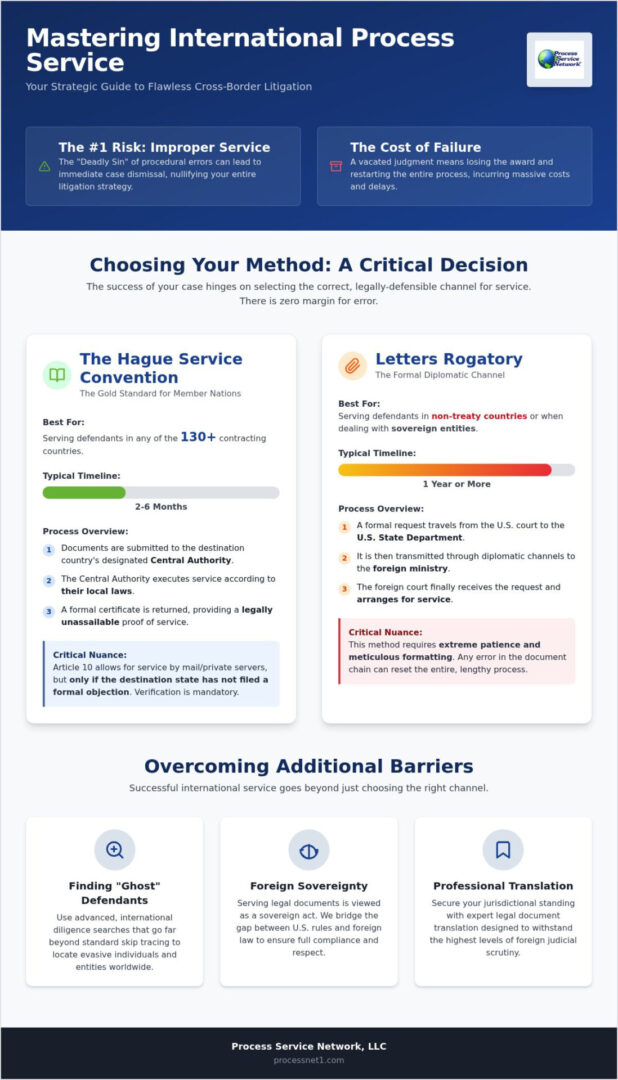
Choosing the correct delivery method is a strategic decision that determines whether your case moves forward or stalls indefinitely. The Hague Service Convention remains the gold standard for participating nations. By July 9, 2026, Algeria officially joins the convention, followed by Vietnam on September 11, 2026. If your defendant resides in one of these 130 contracting parties, you must follow the treaty’s specific protocols. Mastering international process service starts with matching the right method to the specific jurisdiction.
Mastering the Hague Service Convention
This treaty functions through a Central Authority in each destination country. They receive your request and execute service according to their local laws. You must understand the technical divide between Article 5 and Article 10. While Article 5 is the formal path, Article 10 allows for service by mail or private process servers, but only if the destination state hasn’t filed a formal reservation. One typo on your summary page can lead to an immediate rejection. We treat Hague form preparation as a technical discipline where precision is the only acceptable standard. For a comprehensive breakdown of every country-specific requirement and the latest 2026 member updates, our Hague Convention process service definitive guide provides the tactical intelligence you need to avoid costly rejections.
The Reality of Letters Rogatory
When you’re dealing with a non-treaty country or a sovereign entity, Letters Rogatory are your only option. This is the diplomatic channel. Your documents must travel from your local court to the U.S. State Department, then to the foreign ministry, and finally to the foreign court. It requires extreme patience and meticulous formatting. While the Hague method might take a few months, Letters Rogatory often stretch toward a year or more. There are even special circumstances where you might choose this method in a Hague country to obtain specific judicial assistance.
Success in international process service depends on matching the right method to the specific legal climate of the destination. Don’t let a bureaucratic technicality stall your litigation. If court deadlines are approaching and you cannot afford months of delays, understanding the tactical options for fast international process service can mean the difference between maintaining jurisdiction and losing your case entirely. Our team at Process Service Network, LLC handles the heavy lifting, ensuring your Hague form preparation is flawless from the start. We possess the infrastructure to navigate both treaty and non-treaty jurisdictions with operational precision. We don’t just deliver papers; we secure your standing in court.
Overcoming Barriers: Serving Evasive Defendants and Sovereign Entities
Litigation stops when the defendant disappears. Standard agencies often hit a wall when a target moves across borders or hides behind complex corporate layers. This is where international process service becomes an investigation rather than just a delivery. You can’t just hope for the best; you need a proactive strategy to flush out “ghost” defendants who think they’re beyond the reach of U.S. law. We specialize in cases that other firms find too difficult or too risky to handle.
International Diligence and Skip Tracing
Finding an unfindable defendant requires more than a standard database search. Our tactics for locating parties in Europe, Asia, and the Americas involve deep-level Diligence Search operations that track financial footprints, property records, and local registrations. U.S. courts demand a high threshold of “due diligence” before they’ll even consider alternative methods. You must prove you’ve exhausted every reasonable avenue to locate the party. Process Service Network, LLC thrives on these high-stakes challenges. We’ve been solving these puzzles since 1978, using a global network that refuses to take “not at home” for an answer.
Serving Foreign Entities and Corporations
Serving a foreign corporation or a government instrumentality adds layers of legal protection you must strip away. If you’re dealing with a state-owned enterprise, you must navigate the Foreign Sovereign Immunities Act (FSIA) with surgical precision. One wrong move violates international protocol and kills your case. We ensure service on corporate officers strictly complies with local business codes to prevent future challenges. In some jurisdictions, we may utilize substituted service, which is the legal delivery of documents to a court-approved third party or agent when personal service on the defendant is impossible.
When every investigative lead goes cold, Service by Publication remains your last resort. This isn’t just about placing an ad in a newspaper; it’s about meeting the specific legal standards of both the U.S. court and the foreign jurisdiction to ensure the judge accepts the effort as valid. We handle the entire process, from the initial search to the final publication. Our goal is simple: we eliminate the “unfindable” excuse and get your case back on track. We provide the transparency you need and the results your clients expect. We possess the infrastructure to handle the most evasive targets in the world.
Translation and Documentation: Ensuring Your Service Withstands Scrutiny
Translation isn’t a courtesy; it’s a jurisdictional mandate. If you treat it as an afterthought, you’re inviting the defense to dismantle your case before it even begins. Using “Google Translate” or an uncertified translator is a recipe for legal disaster. A single mistranslated legal term can be argued as a violation of the defendant’s “right to notice.” This isn’t just a minor technicality. It’s a fundamental due process failure that can lead to your service being quashed. In international process service, the quality of your documentation is just as important as the delivery itself.
The Legal Necessity of Certified Translation
Most jurisdictions require every page of your legal documents to be translated into their official language. Under Article 5 of the Hague Service Convention, the Central Authority of the destination country has the explicit right to require a translation before they will even attempt service. If you submit English documents to a non-English speaking nation without the proper translation, they’ll simply send them back. This causes massive delays and wastes your client’s budget. Process Service Network integrates our translation team directly with our service team. We don’t just translate words; we translate legal intent. We ensure every document meets the “court-admissible” standard required by both the foreign authority and the domestic judge.
Crafting the Proof of Service
Winning the “delivery” phase is only half the battle. You must prove it with an Affidavit of Service that is bulletproof. A perfect international Affidavit must detail the exact method of delivery, the identity of the person served, and the specific local laws that authorized the action. For non-Hague countries, this documentation often requires an apostille or formal legalization to be recognized by a U.S. court. You must maintain a strict chain of custody for every document from the moment it leaves your office until the proof is filed with the court clerk. We possess the infrastructure to manage this complex paperwork trail with absolute precision.
Don’t let a language barrier or a weak affidavit stall your litigation. Your case deserves a partner who understands the high stakes of procedural accuracy. Secure your jurisdictional standing today by utilizing our expert Legal Document Translation services. We eliminate the uncertainty of foreign language requirements and provide the transparent, authoritative results you need to move forward. We don’t just deliver papers; we deliver peace of mind through relentless attention to detail. Our team is ready to ensure your service stands up to the most aggressive scrutiny.
Why Process Service Network is the Global Authority
Process Service Network isn’t just another vendor in a crowded field; we’re the definitive authority in international process service. Founded in 1978, our firm has spent decades mastering the procedural minefields that cause others to stumble. While high-volume “factories” focus on automated systems and impersonal DOJ contracts, we focus on results. We understand that every case is a high-stakes battle for jurisdiction. You don’t need an impersonal corporation. You need a seasoned veteran who has seen every possible complication and knows exactly how to overcome it.
Our approach is simple: no borders and no excuses. We don’t just deliver papers; we secure your legal standing. Whether you’re navigating the 2026 ICC rule changes or serving a sovereign entity in a non-treaty nation, our methodology remains relentless. When pressing court deadlines demand fast international process service without sacrificing legal precision, our veteran team deploys the aggressive tactical execution your case requires. We possess the infrastructure to handle the cases that deter other firms. This “can-do” attitude is backed by a legacy of leadership and a commitment to absolute transparency in everything we do. We’re the straight-shooting partner you need in a complex, often opaque industry.
The Power of a Global Network
We provide immediate access to a vetted network of professional servers in every corner of the globe. These aren’t just names on a list. They’re proven experts who understand local judicial customs and specific document requirements. You’ll receive real-time updates and proactive communication on your case status. We eliminate the “black hole” of international delivery by keeping you informed at every stage. This level of reliability is why we’re the preferred choice for high-stakes international litigation involving complex corporate structures and evasive defendants.
Get Started with the Experts
Initiating your request is a direct and efficient process. Simply submit your documents for our expert review, and we’ll provide a clear, no-nonsense assessment of the best path forward. We don’t hide behind jargon or vague timelines. Our commitment to speed, accuracy, and absolute transparency ensures that your litigation moves forward without unnecessary delays. We operate with the same speed and precision that we promise to our clients every single day. We thrive on the challenges that others avoid.
Don’t let procedural errors or inexperienced servers jeopardize your case. Take control of your legal strategy with a partner that has the experience to win. Dominate your international litigation with Process Service Network! We’re ready to put our global infrastructure to work for you. Reach out today and experience the difference that true expertise makes in the world of global legal delivery. We possess the tools, the talent, and the tenacity to ensure your international process service is executed flawlessly.
Take Control of Your Global Litigation Strategy
Success in cross-border cases requires more than just luck. It demands a relentless commitment to procedural accuracy and a deep understanding of foreign sovereignty. You’ve learned that choosing between the Hague Convention and Letters Rogatory is a tactical decision that dictates your timeline. You also know that “good enough” translation is a direct path to a quashed service. Don’t let your case stall due to avoidable errors or evasive defendants. You need a partner that possesses the infrastructure to handle the most difficult international process service tasks with absolute precision!
Process Service Network has been serving the legal community since 1978. We’re specialists in Hague Convention protocols and Letters Rogatory, offering integrated legal translation and diligence searches to ensure your documents withstand judicial scrutiny. We eliminate the uncertainty that plagues global delivery. It’s time to move your case forward with a straight-shooting, veteran partner who knows how to get results. Secure your international service with the experts at Process Service Network! Your jurisdictional standing is too important to leave to chance. Let’s start winning your case today!
Frequently Asked Questions
What is the fastest way to serve legal documents internationally?
The fastest way is utilizing Article 10 of the Hague Convention for direct service by a private agent, provided the destination country hasn’t filed a reservation. If the country requires service through a Central Authority, timelines expand significantly. We prioritize the most efficient legal path to ensure your international process service moves at the speed of your litigation. Speed never excuses a lack of procedural compliance!
Does the Hague Convention apply to every country?
No, the treaty does not have universal coverage. As of 2026, there are 130 contracting parties to the Hague Service Convention. For nations that aren’t members, you must utilize the Letters Rogatory process. This involves a diplomatic channel that’s much slower and more formal. We maintain the infrastructure to handle both treaty and non-treaty jurisdictions with absolute transparency and precision. We possess the global reach you need.
Can I serve a foreign defendant by email or social media?
Alternative service via email or social media is only possible with a specific court order under Federal Rule of Civil Procedure 4(f)(3). You must prove that traditional methods are impractical or have failed despite your due diligence. Even then, the method must not be prohibited by international agreement. We help you establish the necessary diligence search records to support these motions when traditional delivery is blocked by an evasive defendant.
How much does international process service typically cost?
Costs vary widely based on the destination country, the required method, and whether translation is mandatory. Fees for international process service are quoted on a case-by-case basis because variables like local agent fees and government processing charges fluctuate. We provide clear, no-nonsense quotes that eliminate hidden variables. You’ll know exactly what’s required to secure a valid service without any financial surprises or detached legal jargon.
What happens if a defendant refuses to accept service abroad?
If a defendant refuses to accept documents, local laws in the destination country dictate the next steps. In many Hague nations, the Central Authority considers service complete if the documents were delivered according to their local procedures. We anticipate evasive behavior by using seasoned agents who understand how to execute valid drop service or substituted service where permitted. We don’t take “no” for an answer when the integrity of your case is on the line!
Why is a translation required if the defendant speaks English?
Translation is a jurisdictional requirement, not a language preference. Even if a defendant is fluent in English, the foreign Central Authority often refuses to execute service unless the documents are in the official language of their state. This protects the defendant’s right to notice under their own constitution. Skipping this step is a recipe for an immediate case dismissal. We provide integrated legal translation to ensure your documents are technically perfect.
How do I serve a subpoena on a witness located in another country?
Serving a subpoena abroad is a complex task that usually requires the Hague Evidence Convention rather than the Service Convention. You cannot simply send a process server to compel testimony or document production in a foreign sovereign state. You must request judicial assistance through a Letter of Request. We guide you through these specialized procedural requirements to ensure your discovery remains valid and enforceable in a U.S. court environment.
What is an Affidavit of Service and why is it critical for international cases?
An Affidavit of Service is the sworn testimony of the server confirming that delivery occurred. In international cases, this document is the primary evidence that the court has jurisdiction over the defendant. It must be meticulously formatted and often requires an apostille or legalization to be accepted. For attorneys who need a complete procedural roadmap, our guide on how to serve someone internationally covers every step required to secure court-admissible proof of service in 2026. We ensure your proof of service is bulletproof and survives the highest levels of scrutiny from both domestic judges and foreign officials. We guarantee absolute transparency.
