

Serving a Foreign Government Under FSIA: The Definitive 2026 Guide
In the high-stakes arena of international litigation, a single procedural misstep isn’t just a delay; it’s often a death sentence for your case! When it comes to serving a foreign government under fsia, the U.S. courts demand absolute, rigid perfection. We understand the anxiety of facing a jurisdictional challenge because of a minor clerical error. You’re navigating a minefield of diplomatic channels and strict statutory hierarchies where “close enough” simply doesn’t exist. One wrong move can lead to an immediate dismissal, wasting years of litigation and significant resources.
This guide is your definitive roadmap to total compliance and successful delivery. You’ll master the strict four-step sequence required for sovereign states and the distinct rules for agencies or instrumentalities under 28 U.S.C. § 1608. We provide the clarity you need on the $2,275 Department of State fee for diplomatic service and the mandatory 30-day waiting periods that catch many off guard. From Hague form preparation to professional translations, we’ll show you how to execute service that stands up to the toughest judicial scrutiny. Let’s eliminate the uncertainty and ensure your case stays on track!
Key Takeaways
- Understand why strict compliance with 28 U.S.C. § 1608 isn’t just a recommendation; it’s a jurisdictional prerequisite for your case to survive.
- Identify the legal distinctions between a foreign state and its agencies to apply the correct service methodology and avoid immediate dismissal.
- Master the mandatory four-step hierarchy that dictates exactly how and when you can move from special arrangements to diplomatic channels.
- Learn the precise document requirements for serving a foreign government under fsia, including the formal Notice of Suit and mandatory translations.
- Recognize why in-house Hague form preparation and elite international expertise are your best defenses against procedural gaps and extreme delays.
Understanding 28 U.S.C. § 1608: The Strict Hierarchy of FSIA Service
The Foreign Sovereign Immunities Act (FSIA) is your exclusive gateway to the courtroom when your defendant is a sovereign entity. This isn’t just about giving the other side a heads-up; it’s about establishing the court’s power. Under 28 U.S.C. § 1608, service of process is a non-negotiable jurisdictional prerequisite. If you don’t follow the statute to the letter, the court simply doesn’t have the legal authority to hear your case. We’ve seen countless plaintiffs lose their standing because they treated these rules as mere suggestions.
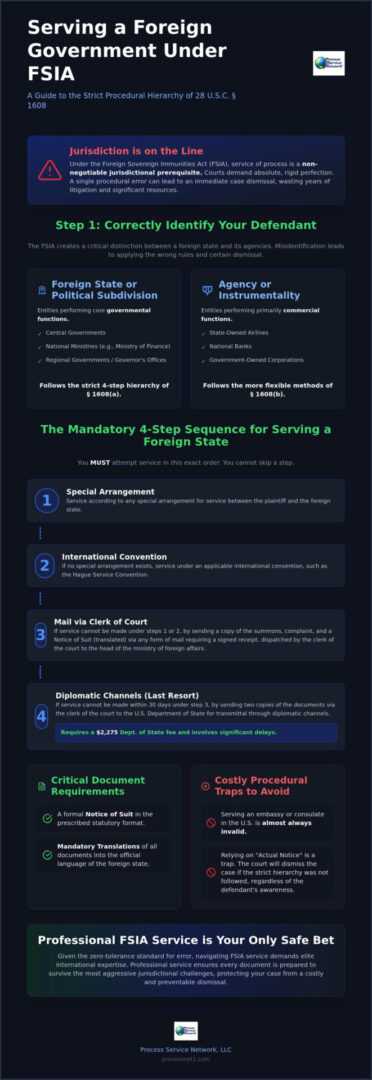
The law establishes a mandatory “Hierarchy of Service.” This means you must attempt methods in a specific, descending order. You can’t jump to Step 3 just because it’s faster or cheaper. A common and costly mistake is attempting service on a foreign embassy or consulate located within the United States. Don’t fall for this trap. Serving an embassy is almost always invalid because it violates international protocols and fails to meet the statutory requirements of § 1608. When serving a foreign government under fsia, you must look beyond U.S. borders to the foreign state’s actual territory.
Why Procedural Precision is Non-Negotiable
U.S. courts strictly enforce § 1608 requirements to protect international comity. This principle ensures that nations respect each other’s sovereignty and legal boundaries. FSIA service is a rigid, step-by-step statutory mandate. If you skip a level in the hierarchy, you face a “lack of personal jurisdiction” ruling. This results in an immediate dismissal of your complaint. There’s no room for “substantial compliance” here; only perfect execution will suffice to keep your case alive.
The Consequences of Bypassing the FSIA
Think you can rely on the fact that the foreign government already knows about the lawsuit? Think again. This is the “Actual Notice” trap. Even if the foreign ministry is fully aware of your claims, a judge will vacate any default judgment if the service didn’t follow the strict hierarchy. Botched service wastes years of litigation time and thousands in unnecessary fees. It’s a procedural nightmare that resets your progress to zero.
Successful litigation starts with an airtight delivery. When serving a foreign government under fsia, you’re dealing with a system that prioritizes technicality over common-sense delivery. A single missing translation or a skipped 30-day waiting period can derail your entire strategy. Our team handles the heavy lifting, ensuring every document is prepared to survive the most aggressive jurisdictional challenges.
Foreign State vs. Agency: Identifying Your Defendant Under the FSIA
Before you even draft your summons, you must answer one critical question: who is your defendant? The FSIA creates a sharp divide between “Foreign States” and “Agencies or Instrumentalities.” This isn’t just a semantic difference. It’s a procedural fork in the road. If you misidentify your target, you’ll likely apply the wrong service rules, leading to a swift dismissal. Successfully serving a foreign government under fsia requires you to analyze the entity’s “Core Functions” to determine which statutory path to follow.
The “Core Functions” test is the gold standard used by U.S. courts. Ask yourself if the entity performs governmental or commercial acts. A ministry of finance or a regional governor’s office clearly falls under the “Foreign State” umbrella. However, a state-owned airline or a national bank usually qualifies as an agency. Mistaking a state-owned enterprise for the state itself can invalidate your service entirely. You must be certain of the entity’s status before you proceed.
Serving a Foreign State or Political Subdivision (§ 1608(a))
When your defendant is the central government or a political subdivision, you are bound by 28 U.S.C. § 1608(a). This section applies to the highest levels of power, including national ministries and regional governments. It demands the most stringent adherence to the four-step hierarchy discussed earlier. You cannot bypass these steps. Additionally, you must include a mandatory “Notice of Suit” in a very specific format. This document must be translated into the official language of the foreign state to be valid. There is zero room for error here.
Serving an Agency or Instrumentality (§ 1608(b))
If you are targeting state-owned corporations, banks, or other commercial entities, § 1608(b) provides your roadmap. This section offers more flexibility than the rules for states. You might be able to use an international process server or even service by mail if the conditions are met. Special arrangements are very common here. Many commercial contracts with state-owned entities include specific service provisions that can save you months of effort. Leveraging these agreements is often the fastest way to achieve successful delivery.
Navigating these distinctions is where many legal teams stumble. Another crucial step when serving a foreign government under fsia is selecting the correct statutory subsection. The technical heavy lifting of identifying the correct defendant and preparing the right documents is what we do best. If you’re unsure which category your target falls into, our experts can help you determine the most effective path for international process service. Don’t risk your case on a guess. Get the veteran guidance you need to ensure your service stands up in court!
The 4-Step Mandatory Sequence for Serving a Foreign State
FSIA 1608(a) isn’t a “choose your own adventure” menu. It’s a strict, hierarchical ladder. You must climb every rung in order. If you try to jump to the top without proving the lower rungs are broken, your case will fall apart at the first jurisdictional challenge. Serving a foreign government under fsia requires tactical patience and a deep understanding of the exhaustion requirement. We’ve seen courts dismiss massive claims simply because a plaintiff tried to be “efficient” by skipping a step.
Exhausting Method One and Two
Check your contracts first. Step 1 is the “Special Arrangement.” If your agreement with the foreign state specifies a method of service, you must use it. Look for clauses naming a specific agent or a specific mailing address for legal notices. These are common in high-value sovereign debt or infrastructure contracts. If no such arrangement exists, or if the foreign state ignores it, you move to Step 2.
The Hague Convention process service is the primary tool for Step 2. If the foreign state is a signatory to the Hague Service Convention or another applicable treaty, you must follow those international protocols. You cannot move to Step 3 simply because the Hague process seems slow. You must demonstrate that no treaty applies or that service via the treaty has failed. We handle these complex filings every day, ensuring your Hague forms are perfect to avoid unnecessary rejection by foreign central authorities.
Moving to Step 3 and 4: The Harder Paths
If the first two methods are unavailable, Step 3 allows for service by mail. This isn’t a standard task. The Clerk of the Court must send a copy of the summons, the complaint, and a formal “Notice of Suit,” along with a certified translation, to the head of the ministry of foreign affairs in the foreign state. You must use a form of mail that requires a signed receipt. Don’t forget the 30-day rule; you must wait a full 30 days after the mail is sent before you can even consider the next step.
The final resort is Step 4: Diplomatic Channels. If service by mail isn’t successful within that 30-day window, you can request that the U.S. Secretary of State transmit the documents. This is the most complex phase of serving a foreign government under fsia. It involves sending two copies of the package to the Department of State for transmission. Be prepared for the cost. The State Department mandates a $2,275 fee for each instance of service. It’s slow and requires absolute procedural perfection. We manage the entire “Request for Service” package to ensure the State Department accepts your filing without delay.
Navigating Diplomatic Channels and Document Requirements
Step 4 is the ultimate test of your procedural patience. It’s the most complex and time-consuming phase of serving a foreign government under fsia. At this stage, you aren’t just dealing with a local clerk; you’re engaging the U.S. Department of State and the diplomatic apparatus of a foreign nation. This process demands a flawless document package. You must provide two sets of the summons, the complaint, and the formal Notice of Suit. Every single document must be translated into the official language of the foreign state. This isn’t optional. It’s a statutory requirement that determines whether your service is legally effective.
Preparing the FSIA Notice of Suit
The Notice of Suit is a mandatory document under 22 C.F.R. § 93.2. It carries a heavy burden. It must explain the nature of the suit and explicitly detail the defendant’s right to sovereign immunity. If you fail to include this specific document, or if it lacks the necessary legal language, the State Department will reject your request without hesitation. We’ve seen cases stalled for months because of a poorly drafted notice. We eliminate that risk by preparing your package to meet the highest diplomatic standards.
The Critical Role of Certified Translation
Inaccurate translations are a primary cause of service rejection. Foreign central authorities look for any reason to deny service on their government. Professional legal document translation for service ensures your documents are court-admissible and technically perfect. A “good enough” translation is a liability that invites jurisdictional challenges. Our in-house experts handle these translations to ensure no procedural gaps exist. This attention to detail is why our service survives the toughest judicial scrutiny.
Initiating diplomatic service is a high-stakes move. You need a partner who understands the nuances of the FSIA and the Department of State’s requirements. We’ve navigated these complex sovereign cases since 1978. If you’re ready to secure personal jurisdiction over a foreign state, reach out to us for elite international process service today!
Why Professional FSIA Service is Your Only Safe Bet
FSIA service is an unforgiving discipline. It’s not a project for a standard local process server who lacks international infrastructure. Serving a foreign government under fsia requires entering a landscape of international treaties and sovereign sensitivities. One small error in the hierarchy or a missing translation isn’t just an inconvenience; it’s a fatal blow to your jurisdictional standing. We’ve spent decades refining a methodology that survives the most aggressive court challenges.
The Process Service Network Advantage
Since 1978, we’ve established ourselves as the definitive authority in international process service. Our team doesn’t just “try” to deliver documents. We execute with a “can-do” attitude that turns bureaucratic roadblocks into successful outcomes. We know the specific, often opaque requirements of foreign central authorities. We understand exactly what the U.S. State Department demands for a Step 4 request to avoid immediate rejection.
Our expertise extends beyond simple delivery. We perform elite diligence searches to identify the correct ministry or head of agency for your specific defendant. This is vital. Serving the wrong official is a waste of time and money. We handle the technical heavy lifting by integrating Hague form preparation and certified translations into a single, seamless workflow. This eliminates the procedural gaps that typically occur when firms juggle multiple vendors.
Get Your FSIA Service Started Today
Don’t risk a dismissal on a technicality. Your high-stakes case demands the transparency and reliability that only a seasoned veteran can provide. We’ve navigated every possible complication in serving a foreign government under fsia over the last 48 years. We know the rules, we know the players, and we know how to get results. Our infrastructure is built to handle the most difficult sovereign cases with ease.
Hire the authority in global legal delivery. We transform months of potential bureaucratic delay into a successful, court-admissible service of process. Let’s ensure your documents stand up to any jurisdictional challenge. Contact Process Service Network for Expert FSIA Service Now! We’re ready to handle your most complex international tasks with speed and precision.
Take Command of Your International Litigation Strategy
Mastering the rigid requirements of 28 U.S.C. § 1608 is the only way to ensure your case survives a jurisdictional challenge. You now understand the critical distinction between a foreign state and its agencies, along with the unforgiving four-step hierarchy that dictates your every move. Success in serving a foreign government under fsia depends on technical precision, from certified legal translations to expert Hague form preparation. Don’t let a procedural technicality or a 30-day waiting period derail your litigation goals.
Since 1978, we’ve provided elite international delivery for the most complex sovereign cases. We handle the heavy lifting, ensuring your Notice of Suit and diplomatic packages are flawless before they ever reach the Department of State. You need a partner who turns bureaucratic delays into confirmed results! Secure Your FSIA Service with Process Service Network and move your case forward with absolute confidence. We possess the global reach and the seasoned expertise to handle your highest-stakes tasks today!
Frequently Asked Questions
Can I serve a foreign government by simply mailing the papers to their embassy?
No, you cannot. Embassies and consulates are considered inviolable under international law. Attempting to deliver legal papers to an embassy within the United States is almost always invalid and will result in a lack of personal jurisdiction. You must strictly follow the hierarchy of 28 U.S.C. § 1608. Serving a foreign government under fsia requires looking beyond U.S. borders to the foreign state’s actual territory or its ministry of foreign affairs.
What happens if a foreign state refuses to accept service under the Hague Convention?
If a foreign state refuses service or the Central Authority fails to return a certificate after a reasonable time, you must move to the next rung of the statutory ladder. You’ll need to demonstrate to the court that service via the international convention was unsuccessful before you can proceed to Step 3, which is service by mail. Documenting this failure is essential to prove you’ve exhausted the mandatory hierarchy required by law.
Is a contractual waiver of service valid under the FSIA?
Yes, it’s valid. The FSIA hierarchy actually prioritizes “Special Arrangements” as the very first step under § 1608(a)(1) and § 1608(b)(1). If your contract with the foreign entity specifies a particular method of service or waives formal requirements, the court will respect that agreement. Always check your commercial contracts first. Utilizing these pre-negotiated provisions is often the most efficient way to establish jurisdiction without navigating complex diplomatic channels.
How long does it typically take to serve a foreign government through diplomatic channels?
Diplomatic service is the slowest method available, often taking six months to a year or more to complete. You must wait a mandatory 30 days after attempting service by mail before the U.S. Department of State will even accept your request. Because it involves multiple government bureaucracies, any minor error in your document package can reset the clock. It’s a test of patience that requires absolute procedural perfection from the start.
What is a ‘Notice of Suit’ and when is it required for FSIA service?
A Notice of Suit is a mandatory document for serving a foreign state or its political subdivisions under § 1608(a). It must follow the exact format prescribed by 22 C.F.R. § 93.2. This document explains the nature of the lawsuit and the defendant’s right to sovereign immunity. If you’re serving a foreign government under fsia, failing to include this notice will lead the State Department to reject your entire service package immediately.
Do I need to translate my legal documents if the foreign government officials speak English?
Yes, you do. Translation isn’t a courtesy; it’s a strict statutory requirement under the FSIA. All documents, including the summons, complaint, and Notice of Suit, must be translated into the official language of the foreign state. Even if the officials are fluent in English, a lack of certified translation gives the defendant a perfect technicality to challenge the court’s jurisdiction. Don’t give them an easy way to dismiss your case.
Can I use an international process server for an agency or instrumentality under § 1608(b)?
Yes, you can. Section 1608(b) offers more flexibility than the rules for sovereign states. You can utilize an international process server if it’s part of a special arrangement or if the method is reasonably calculated to give notice and isn’t prohibited by the foreign country’s law. This is often the fastest way to handle service on state-owned corporations or banks, as it bypasses the more rigid diplomatic requirements of § 1608(a).
What is the difference between 28 U.S.C. § 1608(a) and § 1608(b)?
The difference lies in the nature of the defendant. Section 1608(a) governs service on a foreign state or political subdivision, like a ministry or regional government, and requires a strict four-step hierarchy. Section 1608(b) applies to “agencies or instrumentalities,” such as state-owned companies. The rules for agencies are more lenient, allowing for methods like personal delivery or mail without the exhaustive 30-day waiting periods required for sovereign states.
