

International Service of Process Rules: The Definitive 2026 Legal Guide
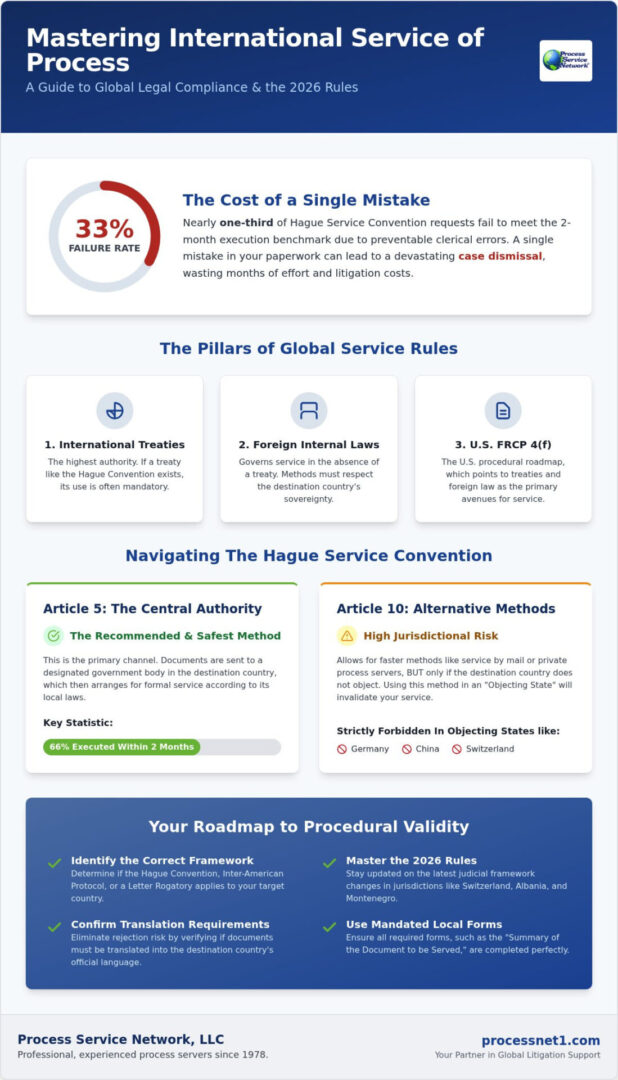
Did you know that nearly one-third of all Hague Service Convention requests fail to meet the standard two-month execution benchmark? This often happens because of preventable clerical errors. It’s a sobering reality for any legal professional. One mistake in your paperwork can lead to a devastating case dismissal. Mastering the international service of process rules isn’t just about following a checklist; it’s about protecting your litigation from jurisdictional challenges before they start. You deserve a process that moves as fast as your case does.
We understand the anxiety that comes with conflicting treaty requirements and the long wait times associated with Central Authorities. You need certainty, not guesswork. This guide provides a definitive roadmap for both Hague and non-Hague service, including the critical 2026 updates for jurisdictions like Switzerland, Albania, and Montenegro. You’ll learn how to verify translation requirements and choose the most effective service method for your specific needs. We’re here to eliminate the uncertainty and ensure your documents are served with absolute procedural validity.
Key Takeaways
- Identify the correct legal framework for your target country to avoid costly procedural delays, whether it’s the Hague Convention or Inter-American protocol.
- Master the specific international service of process rules for 2026, including the latest judicial framework changes in Switzerland and Albania.
- Eliminate the risk of case dismissal by confirming mandatory translation and local form requirements before you submit your documents.
- Accelerate your litigation timeline by using a proven roadmap that bypasses common Central Authority bottlenecks.
- Secure absolute procedural validity with a veteran approach that has successfully handled global delivery since 1978.
The Pillars of International Service of Process Rules
International service of process is the formal delivery of legal documents across national borders. It isn’t just a logistical hurdle; it’s a jurisdictional requirement. Your success depends on a strict adherence to a hierarchy of authorities. These include international treaties, foreign internal laws, and the US Federal Rules of Civil Procedure. If you fail to follow these international service of process rules, your hard-won judgment becomes unenforceable. You will waste litigation costs and months of effort! The rules have changed significantly for 2026, making precision more critical than ever. The primary goal is satisfying the US Due Process Clause while respecting foreign sovereignty. Don’t leave this to chance.
The Interplay Between FRCP 4(f) and Global Treaties
Rule 4(f) is your primary roadmap for serving individuals in foreign countries. It provides three main avenues. First, it points to internationally agreed means of service, such as the Hague Service Convention. If a treaty exists, you must determine if its use is mandatory. In many jurisdictions, the treaty is the exclusive path. When no treaty exists, Rule 4(f)(2) allows for service via the foreign country’s law or a letter rogatory. You cannot simply mail documents and hope for the best. “Actual notice” is never a substitute for legal validity. Even if the defendant admits they received the papers, a US court can and will dismiss your case if you ignored the treaty’s specific protocols.
Due Process vs. Foreign Sovereignty
Understanding the tension between US law and foreign sovereignty is vital. Many foreign nations view unauthorized service by a private citizen as a violation of their judicial power. They see it as an infringement on their sovereignty. If you ignore these local sensitivities, you invite a motion to quash in US courts. Your service must be “reasonably calculated” to provide notice under constitutional standards. This means the method must be reliable and legally recognized by both the sending and receiving countries. Shortcuts are the fastest way to lose a case. We ensure your service is bulletproof, satisfying both the US Constitution and the specific international service of process rules of the destination nation. Our veteran approach, refined since 1978, eliminates the risk of procedural collapse.
Navigating the Hague Service Convention Framework
The Hague Convention of 1965 remains the gold standard for legal document delivery in over 75 countries. It provides a centralized, uniform method for transmitting judicial documents across borders. You must understand that the official text of the Hague Service Convention establishes the primary legal framework you’ll encounter. For most signatories, this isn’t optional. It is a mandatory requirement. If you attempt to bypass these international service of process rules, your litigation is dead on arrival. We ensure every detail is handled correctly from the start. Our veteran team has been perfecting this process since 1978.
Article 5: The Central Authority Channel
Article 5 is the primary engine of the Convention. Each member state designates a Central Authority to receive and execute service requests. Once they receive your “Full Pack” of documents, they handle the actual delivery according to their local laws. Data shows that approximately 66% of requests are executed within two months. However, government agencies move at their own pace. You must include the mandatory “Summary of the Document to be Served” form. Errors here lead to immediate rejection. If you need help with Hague Convention process service forms, our team is ready to step in and handle the heavy lifting for you.
Article 10: Alternative Methods of Service
Article 10 offers faster alternatives like service by mail or private process servers. But there’s a catch. This only works if the destination country does not object. Many nations are “Objecting States.” They strictly forbid these methods to protect their sovereignty. If you use Article 10 in a country like Germany or China, your service is invalid. While Article 10 is often faster, it carries much higher jurisdictional risk. You must verify the current status of the destination country before choosing this path. For example, Vietnam joined with an effective date of September 2026, and Algeria followed in July 2026. Each new member brings specific declarations you cannot ignore.
We’ve navigated these complex waters for decades. We know exactly which countries allow direct service and which demand the Central Authority route. Don’t risk your case on a procedural shortcut. If you’re unsure about the best path forward, we can help you determine the most secure service method for your specific jurisdiction.
Alternative Rules: Letters Rogatory and Inter-American Protocols
Not every nation belongs to the Hague “club.” If you’re targeting a defendant in a country that hasn’t signed the Hague Convention, you must pivot immediately. These alternative international service of process rules are often slower and more demanding. They require a veteran hand to avoid total procedural stagnation. We’ve mastered these protocols since 1978. We don’t let gaps in treaty coverage stop your progress! Success in these regions depends on knowing which specific framework applies before you file your first motion.
Mastering the Inter-American Convention
The Inter-American Convention on Letters Rogatory is the primary framework for many Latin American nations. To succeed here, you must utilize the “Additional Protocol.” This protocol was designed to simplify service between the Americas, but it still requires precision. You’ll need to prepare the specific USM-94 form. Certified translations are not a suggestion; they are a mandatory legal requirement! Without them, the foreign Central Authority will reject your request without hesitation. While there is no fee for service requests submitted under this convention, the administrative burden is high. We handle the complex form preparation and certified translations to ensure your submission is flawless from day one.
Service via Letters Rogatory
Think of Letters Rogatory as the “method of last resort.” This is the only path for countries that have no treaty relationship with the United States. A Letter Rogatory is a formal request from a US court to a foreign court. It’s essentially a “judge-to-judge” communication asking for judicial assistance. Drafting these requests requires specific, highly respectful language and strict adherence to court-to-court protocols. Once the US court signs the request, it often travels through the Department of State via the diplomatic “pouch.” This is a notoriously slow process that can take a year or more. You need a partner who knows how to move these documents through the system with maximum efficiency. We track every step to keep your case on the radar of foreign officials and prevent it from disappearing into a bureaucratic void.
Whether you’re dealing with a signatory of the Inter-American Convention or a nation that requires a traditional Letter Rogatory, the stakes are high. One mistake in the drafting or the translation can reset your timeline by months. We provide the infrastructure and expertise to handle these difficult cases with ease. Our global process service network is designed to handle these high-stakes tasks with absolute transparency and reliability.
Essential Compliance: Translation and Local Jurisdiction Rules
Translation is not just a courtesy. It is a mandatory legal requirement in almost every jurisdiction worldwide. If you deliver documents in English to a non-English speaking nation, you are inviting a total procedural collapse. Don’t let a small translation error sink a multi-million dollar lawsuit! These international service of process rules exist to ensure the defendant has clear, unambiguous notice of the claims against them. We’ve seen cases dismissed simply because a translator used the wrong regional dialect. Accuracy is your only shield against a jurisdictional challenge.
Certified Legal Document Translation Requirements
Standard business translation won’t satisfy a foreign court or the US Due Process Clause. You need a certified translation for legal service that includes a formal affidavit of accuracy. This document must be executed by a professional who understands regional legal terminology. For instance, the Spanish used in Mexico differs significantly from the Spanish used in Spain or Argentina. If the defendant can argue they didn’t understand the summons due to poor translation, your service is invalid. We provide certified translations that meet the highest international standards, ensuring your documents are bulletproof.
Adhering to Local Service Protocols
Every nation has its own delivery preferences. Some countries allow substituted service, while others demand personal delivery. In France and many civil law jurisdictions, you must use a “Huissier.” This is a specialized judicial officer who holds the exclusive right to serve process. If you hire a private investigator instead, the service is worthless. You must also ensure the “Return of Service” is court-admissible. This document often needs to be translated back into English before it can be filed with a US court. We manage these local nuances to ensure your evidence of service is undeniable.
Don’t risk your litigation on a paperwork technicality. You need a partner who understands the granular details of foreign law. We have the infrastructure to handle your legal document translation and service needs with absolute precision. Let us handle the compliance so you can focus on the trial.
Executing Global Service with Process Service Network
Process Service Network, LLC has dominated the global legal delivery landscape since 1978. We aren’t just another agency; we are the definitive choice for high-stakes litigation. Our team possesses the infrastructure to handle the most difficult cases across every continent. We master the complex international service of process rules so you can focus on your legal strategy. We thrive where others fail, especially when dealing with evasive defendants who think they can hide behind national borders! Our veteran status means we’ve seen it all and solved it all.
The Process Service Network Advantage
We offer a no-nonsense approach that eliminates the administrative surprises typical of our competitors. You get flat-fee pricing with zero hidden variables. This transparency is the cornerstone of our partnership. You’ll have direct access to seasoned experts who have navigated every possible global complication, from shifting treaty declarations to local bureaucratic hurdles. Our global process service network operates with the speed and operational precision your case demands. We don’t just send papers; we ensure they’re delivered with absolute procedural validity.
How to Initiate Your International Service
Getting started is simple and efficient. We move you quickly from a logistical problem to a verified solution. First, submit your documents for our comprehensive internal review. We catch clerical errors and translation missteps before they ever reach a foreign Central Authority. This proactive step saves you months of potential delays! We handle the complex Hague form preparation from start to finish. Our team ensures every Summary of the Document and Request form is flawless. Once we verify your package, we deploy our local agents or utilize the appropriate treaty channel immediately.
Secure your litigation’s procedural foundation today. Don’t let an amateur mistake jeopardize your jurisdiction. We are the relentless problem-solvers you need for your international cases. Contact us now to initiate service and experience the reliability that only a veteran firm can provide. We’ve been the industry leader for nearly five decades. Let us handle the international service of process rules while you win your case.
Secure Your Global Litigation Strategy Today
Your success in cross-border litigation depends on absolute procedural precision. You’ve seen how easily a case can collapse due to a single translation error or a misunderstood treaty protocol. Mastering the international service of process rules is the only way to bulletproof your jurisdiction against aggressive challenges. Don’t let your case be the one that stalls at the Central Authority or gets dismissed in a US court for improper notice! Precision isn’t just a goal; it’s your primary defense.
We’ve been serving legal documents worldwide since 1978. Our team acts as a relentless problem-solver for every client, ensuring that no border stops your progress. We are recognized experts in Hague and Inter-American Convention protocols, providing the comprehensive translation and skip tracing support you need to find and serve even the most evasive defendants. You deserve a partner that handles the heavy lifting with absolute transparency and unwavering confidence. We’re ready to secure your litigation’s procedural foundation right now!
Get Your International Service Started with Process Service Network!
Frequently Asked Questions
What is the Hague Convention for service of process?
The Hague Convention is a 1965 treaty that standardizes document delivery between member nations. It eliminates the need for slow diplomatic channels by using a designated Central Authority in each country. As of 2026, it remains the primary mechanism for over 75 countries. Using it correctly ensures your service is recognized by both the foreign state and US courts. It is the essential framework for modern international service of process rules.
Can I serve legal papers internationally by mail?
You can only serve papers by mail if the destination country does not specifically object to Article 10 of the Hague Convention. While some nations allow it, many view service by mail as a violation of their sovereignty. Even if allowed, US courts often prefer more formal methods to survive a motion to quash. You must verify the specific declarations of the receiving state before dropping papers in a mailbox to avoid a total case dismissal.
How long does international service of process take?
Timelines vary significantly based on the method and destination country. Approximately 66% of Hague Convention requests are executed within two months. However, some Central Authorities can take six months or longer. Letters rogatory are notoriously slow, often exceeding one year. We move your documents as fast as the law allows by ensuring your paperwork is error-free before submission, preventing bureaucratic rejections that reset your litigation clock.
Are translations mandatory for international service?
Yes, translations are almost always required when serving documents in a non-English speaking country. Most Central Authorities will flatly reject requests that lack a certified translation in their official language. This isn’t just about the defendant understanding the claim; it’s a strict legal requirement for valid service. We provide certified legal translations to ensure your submission meets every local jurisdictional standard without delay.
What happens if a country is not a member of the Hague Convention?
You must use alternative international service of process rules, such as the Inter-American Convention or a Letter Rogatory. The Inter-American protocol is common in Latin America and requires the USM-94 form. Letters rogatory involve a formal request from a US judge to a foreign judge. These methods are more complex and require a veteran hand to navigate the diplomatic pouch and foreign court systems effectively.
What is a Central Authority in the context of international law?
A Central Authority is a government-designated agency responsible for receiving and executing service requests from other treaty members. Under the Hague Convention, this agency ensures documents are served according to local laws. Each country has one, and they act as the gatekeeper for legal validity. Errors in your summary forms or translations give these authorities a reason to return your documents unserved, costing you valuable time.
Can I serve an individual at a foreign embassy?
No, you generally cannot serve process at a foreign embassy located within the United States. Embassies are considered the sovereign territory of the sending state under the Vienna Convention on Diplomatic Relations. Attempting service there is legally ineffective and could create a diplomatic incident. You must follow the formal treaty or diplomatic channels to serve an individual associated with a foreign government or located in their home country.
What is an Affidavit of Service for international cases?
An Affidavit of Service is the formal proof that your legal documents were successfully delivered to the defendant. In international cases, this often takes the form of a Certificate from a Central Authority or an affidavit from a local process server. This document must be court-admissible in the United States. It frequently requires a certified English translation if the original was issued in a foreign language to satisfy US judicial requirements.
