

Certified Translation for Service of Process: Legal Guide
A single mistranslated phrase in your legal documents can derail a multi-million dollar international lawsuit before it even begins. It’s a brutal reality of cross-border litigation. If your paperwork fails to meet the exact linguistic standards of a foreign Central Authority, your entire case risks being quashed on a procedural technicality. You’ve worked too hard to let a clerical error jeopardize your jurisdiction!
We understand the pressure of high-stakes litigation and the confusion that often surrounds international requirements. This guide provides the definitive roadmap to mastering the procedural requirements for a certified translation for service of process. You’ll learn how to ensure your documents withstand every judicial challenge and avoid the nightmare of costly re-service. We’ll examine the critical distinctions between certified and notarized documents; explore Hague Convention compliance; and detail the steps necessary to achieve valid, unbreakable jurisdictional service across global borders. We’ve navigated these complex landscapes for decades. Let’s get your case moving forward with absolute precision and zero uncertainty!
Key Takeaways
- Define the high-stakes standard of word-for-word legal translation required for total courtroom validity.
- Protect your case from a “Motion to Quash” by ensuring every document respects the defendant’s due process rights.
- Navigate the technical differences between certified and notarized documents to satisfy the specific demands of foreign Central Authorities.
- Secure a certified translation for service of process that covers every exhibit and complaint to maintain total jurisdictional authority.
- Avoid the dangers of siloed services by using integrated litigation support to align your translation and international service strategy.
What is Certified Translation for Service of Process?
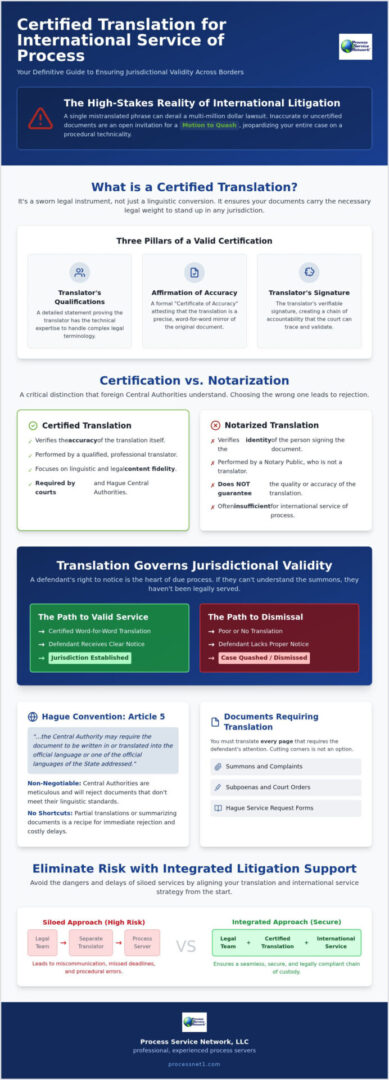
A certified translation for service of process isn’t just a linguistic conversion; it’s a sworn legal instrument. It consists of a precise, word-for-word translation of your legal papers paired with a formal, signed statement of accuracy from the translator. While a standard business translation might capture the general intent of a document, a court-certified legal translation must mirror the exact legal weight and terminology of every single clause. In international litigation, court-admissible translation is non-negotiable. If the translation is found lacking, your entire service of process can be declared invalid by a judge.
Every valid certification must include three primary components: a detailed statement of the translator’s qualifications, a formal affirmation of the document’s accuracy, and the translator’s signature. This creates a chain of accountability that the court can verify. We don’t just translate words; we translate authority. Our methodology ensures that every document we handle carries the necessary legal weight to stand up in any jurisdiction worldwide.
The Legal Standard for Certification
Courts and foreign Central Authorities rely on the “Certificate of Accuracy” to bridge the language gap. This certificate acts as the translator’s affidavit. It proves they possess the technical expertise to handle complex legal terminology. Don’t fall for the myth that anyone can certify a translation. While the U.S. doesn’t have a federal “sworn translator” system, foreign jurisdictions often demand verifiable credentials. Using an in-house staffer or an uncertified freelancer is a gamble you can’t afford. A receiving Central Authority will reject documents that don’t meet their specific professional standards, leading to months of expensive delays.
Common Documents Requiring Certified Translation
You must translate every page that requires the defendant’s attention. Cutting corners here is a recipe for disaster. Common documents include:
- Summons and Complaints: These are the bedrock of jurisdictional notice. If the defendant can’t read the allegations, they haven’t been served.
- Subpoenas and Court Orders: To ensure cross-border compliance, these mandates must be perfectly clear in the local language.
- Hague Service Request Forms: Many litigators forget that the request itself often requires translation. The Central Authority needs to understand exactly what you’re asking them to do.
Precision is your greatest asset in international law. We ensure every certified translation for service of process meets the exact specifications of the receiving jurisdiction, eliminating the risk of procedural failure and ensuring your case moves forward without hesitation.
The Legal Necessity: Why Translation Governs Jurisdictional Validity
A defendant’s right to notice is the heart of every legal proceeding. If they can’t understand the summons, they haven’t been served. It’s that simple. A botched or non-existent certified translation for service of process is an open invitation for a “Motion to Quash.” Opposing counsel will seize on any linguistic ambiguity to argue their client lacked proper notice under Due Process standards. Don’t give them that opening! Your jurisdictional authority depends entirely on the defendant receiving a document they can actually read and comprehend.
Translation must be treated as a secure link in the litigation chain. You need a seamless transition from the moment the clerk stamps the summons to the moment the foreign process server places it in the defendant’s hand. Any break in this chain or delay in the translation phase can cause you to miss critical court deadlines. We’ve seen cases stall for months because a firm treated translation as an afterthought rather than a jurisdictional requirement. Precision wins cases; errors lose them. To stay ahead of the clock, consider an integrated legal document translation strategy that moves as fast as your litigation team does.
Hague Convention Article 5 and Translation
Article 5 of the Hague Service Convention is explicit. It grants the destination state the power to require that the document be written in or translated into its official language. Central Authorities are meticulous. They don’t just check for a signature; they review the quality and completeness of the work. Partial translations are a recipe for immediate rejection. As noted in the academic analysis of Translated Documents and Hague Service Convention Requirements, failing to meet these specific linguistic standards can render the entire service request void. You must translate the full package, including all exhibits and secondary forms, to satisfy the Central Authority’s gatekeepers.
Consequences of Procedural Non-Compliance
Rejection by a Central Authority isn’t just a minor setback. It’s a logistical nightmare! You’ll lose your court date. You’ll face mounting legal fees. In the worst-case scenarios, your entire action could be dismissed if the statute of limitations expires while you’re busy fixing translation errors. The financial penalties of re-serving process abroad can easily double your initial budget. Jurisdictional validity in international service is the absolute fulfillment of both the forum’s notice requirements and the destination state’s specific linguistic mandates. Get it right the first time, or prepare to pay the price in lost time and credibility.
Certification Standards: Certified vs. Notarized Translations
Stop confusing certification with notarization. They serve two entirely different masters. A certified translation focuses on the integrity of the content and the professional skill of the translator. It’s an internal check on accuracy. A notarized translation, conversely, focuses on the identity of the person signing the document. The notary doesn’t speak the foreign language; they only verify that the person claiming to be the translator is who they say they are. In the US, Federal regulations on translation mandate that any foreign document must have a certification where the translator attests to their competence. For international work, that’s often just the first step.
Most foreign jurisdictions demand a double layer of protection. They want the translator’s promise of accuracy and the state’s verification of the signature. If the destination country is a member of the Hague Convention, you’ll likely need an Apostille. This is the ultimate “gold seal” that authenticates the notary’s commission for international use. Without it, your documents might be treated as mere scraps of paper by a foreign judge. We ensure your certified translation for service of process meets every one of these tiered requirements before the documents leave our office.
When is Notarization Required?
Civil law countries are notoriously strict about formalities. They expect a high level of officialdom that goes beyond a simple signature. Common law countries might be more flexible, but why take the risk? If you’re serving process via Letters Rogatory or through a formal Hague Central Authority request, notarization is a non-negotiable trust-builder. It signals to foreign judicial officers that your documents are authentic and procedurally sound. It eliminates the “identity doubt” that can stall a case for weeks.
Selecting the Right Level of Certification
Don’t guess what the foreign court wants. Over-certifying wastes time and money, but under-certifying leads to a rejected service and a quashed case. You must identify the “end-user” requirements immediately. Is the document for a US court or a foreign tribunal? Each has its own playbook. We recommend consulting with international process service experts to determine the exact local standards before you finalize your paperwork. Precision isn’t just about the words; it’s about the stamps on the page. We provide the expertise to ensure you have exactly what’s required, nothing less and nothing more.
Strategic Requirements for Hague Convention and International Service
Execution is where most international cases fail. You can’t afford to treat the procedural steps as suggestions. To ensure your certified translation for service of process passes the rigorous scrutiny of a foreign Central Authority, you must follow a rigid strategic sequence. This isn’t just about translating words; it’s about preparing a jurisdictional package that leaves no room for doubt or delay. Precision in these early stages prevents the nightmare of a case being thrown out months down the line.
- Step 1: Identify the official language. Never assume. Some countries have multiple official languages or specific regional requirements. Verify the exact dialect accepted by the receiving Central Authority.
- Step 2: Secure a full translation. This includes the summons, the complaint, and every single exhibit. If you leave out one attachment, the entire request will likely be returned to you months later, unserved.
- Step 3: Prepare the Hague Service Request form (USM-94). This form is the gateway to service. It must be completed with technical precision and, in many cases, translated into the target language alongside your pleadings.
- Step 4: Verify against legal intent. A literal translation can be a legal disaster. Ensure the terminology used reflects the procedural law of the destination state to avoid “lost in translation” errors. For a comprehensive breakdown of how to master legal document translation for service across high-volume international jurisdictions, our definitive 2026 guide covers the specific language requirements you need to know.
- Step 5: Bundle for formal submission. Organize your originals and translations into a clear, professional package. Presentation signals to the receiving authority that you are a serious litigator who respects their process.
Navigating Language Nuances in Legal Documents
Context is everything. Legal Spanish in Mexico differs significantly from the terminology used in Spain or Colombia. Using a generic translator for high-stakes litigation is a massive risk. A “claim” in one jurisdiction might require a completely different legal term in another to be recognized by a local judge. This is why we refuse to use machine translation. Algorithms don’t understand the nuances of procedural law or the weight of a specific legal demand. You need experts who speak the language of the court, not just the language of the street. If your case involves a Spanish-speaking defendant, our dedicated Spanish legal translation services are specifically designed to meet the procedural mandates of every Spanish-speaking jurisdiction worldwide.
Managing Timelines for Cross-Border Service
The clock is your enemy in international litigation. Translation shouldn’t be a bottleneck that threatens your deadlines. By coordinating with our nationwide process serving network, you ensure that your documents move from translation to delivery without a single day of wasted momentum. Translation speed is a critical factor because any delay in the linguistic phase directly reduces the time available to locate and serve a defendant before the statute of limitations expires. Don’t let a slow turnaround kill your case! If you’re ready to secure your jurisdiction with absolute certainty, initiate your international service request today and let us handle the technical heavy lifting.
Eliminating Procedural Risk with Integrated Litigation Support
Stop gambling with your litigation strategy by fragmenting your workflow. The danger of “siloed” services is a primary reason international cases stall! When you hire one firm for translation and another for delivery, you create a communication gap that invites disaster. If the translation agency doesn’t understand the specific procedural nuances of the destination court, your process server is handed a defective weapon. Process Service Network, LLC eliminates this friction. By integrating every step of the process, we ensure that your certified translation for service of process is perfectly aligned with the logistical realities of the local jurisdiction.
Our team handles the technical heavy lifting so you can focus on the merits of your case. We don’t just translate words; we prepare a complete jurisdictional package. If we encounter an evasive defendant, our elite diligence searches work in tandem with our linguistic experts. We possess the infrastructure to pivot instantly if a defendant is located in a region with different language requirements. This no-nonsense approach provides the transparency you need in high-stakes litigation. You’ll always know exactly where your documents are and why they meet the highest legal standards. We thrive on the cases that deter others!
The Process Service Network, LLC Difference
We’ve spent over 45 years mastering the complexities of international legal delivery. Experience matters when your jurisdiction is on the line! Our expertise in Hague Convention process service combined with professional translation creates an unbreakable chain of custody. We operate with a can-do attitude that tackles the challenges other firms avoid. Whether you’re dealing with a difficult Central Authority or a hard-to-serve individual, our authoritative presence ensures your request is taken seriously. Process Service Network, LLC acts as your veteran guide through the global legal landscape.
Getting Started with Your International Service
Initiating your request is a straightforward, efficient process. Don’t wait for your papers to be ready before you think about translation. You can initiate a request for translation and service simultaneously to maximize your timeline. To get started, simply provide us with clean, legible copies of all your legal documents. We’ll conduct a straight-shooting assessment of your international service needs and provide a clear roadmap for execution. Accuracy is our baseline; results are our promise. Contact us today to secure your service and move your litigation forward with absolute confidence!
Secure Your Global Jurisdiction with Precision
Success in international litigation depends on more than just the merits of your case; it requires absolute procedural perfection. You’ve learned that a certified translation for service of process is a jurisdictional necessity that must satisfy both domestic due process and foreign mandates. A single error in linguistic nuance or a missing certification can quash your service and result in months of expensive delays. Don’t leave your case to chance by using siloed providers who don’t understand the intersection of law and linguistics.
Process Service Network, LLC has been a trusted partner in global legal delivery since 1978. We are specialists in Hague Convention Article 5 compliance, providing a seamless, integrated approach that combines professional translation with authoritative process service. We eliminate the gaps where procedural errors occur, ensuring your documents withstand every judicial challenge. It’s time to move your case forward with the confidence that only a seasoned veteran can provide. Secure your international service with expert translation today! We’re ready to help you navigate the complex global landscape with speed and accuracy.
Frequently Asked Questions
Does the Hague Convention always require translations for service of process?
Yes, Article 5 of the Hague Convention explicitly allows member states to require translations into their official language. Most Central Authorities won’t even process your request without one. If you skip this step, expect an immediate rejection and a significant delay in your case. We always confirm the destination’s specific linguistic mandates to ensure your service package meets every local standard.
Can I translate the legal documents myself if I am fluent in the target language?
You shouldn’t translate your own legal documents for court use. Jurisdictions require an independent, disinterested third party to certify the accuracy of the work. Even if your fluency is perfect, a self-translated document carries a high risk of being challenged for bias or procedural insufficiency. Professional certification provides the “chain of custody” and impartiality that judges and Central Authorities demand for valid service.
What is the difference between a certified translation and an ATA-certified translator?
A certified translation is a completed document package that includes a signed statement of accuracy. An ATA-certified translator is a professional who has passed the American Translators Association’s rigorous examination. While having an ATA credential adds significant authority, any competent professional can provide a “certified” translation by signing a formal affidavit. We use experts who understand the specific procedural requirements for international legal delivery.
How long does it typically take to get a certified translation for court?
Turnaround times typically range from two to five business days for standard legal packages. If your case involves voluminous exhibits or complex technical data, the process might take longer. We understand that litigation moves fast, so we prioritize a rapid but meticulous workflow. Balancing speed with accuracy ensures your certified translation for service of process is ready before your service window closes.
What happens if a translation error is discovered after the documents are served?
Discovering an error after service is a procedural nightmare. It gives the defense a perfect opportunity to file a “Motion to Quash,” arguing they weren’t properly notified. You’ll likely have to start the entire service process over, doubling your costs and wasting months of time. Our integrated litigation support is designed to catch these errors before the documents ever leave our office, protecting your jurisdiction.
Are machine translations like Google Translate acceptable for international service?
Google Translate and other machine tools are completely unacceptable for court-admissible documents. These systems can’t grasp the nuances of legal terminology or the specific requirements of foreign procedural law. A nonsensical translation will be rejected by the Central Authority or laughed out of court by a judge. Human expertise is the only way to ensure your documents carry the necessary legal weight in a foreign jurisdiction.
Do exhibits and attachments also need to be translated for valid service?
Every exhibit and attachment must be translated to ensure valid service. If a document is part of the legal notice, the defendant has a right to understand its contents. Central Authorities are notorious for returning service requests that only include translations for the summons and complaint. We ensure the entire bundle is word-perfect to prevent your case from being stalled by a “procedurally incomplete” filing.
How much does certified translation for service of process typically cost?
Costs are determined by document volume, the complexity of the legal language, and the specific target language. Legal translation requires a high degree of specialized knowledge, which is reflected in the professional rates. While we don’t offer generic price lists, we provide transparent, straight-shooting assessments for every certified translation for service of process. Professional work is an investment that prevents the far greater expense of a failed international service.
