

How to Secure Spanish Legal Translation Services for International Service of Process
A single mistranslated verb in your summons can derail a multi-million dollar litigation before it even begins! In the high-stakes world of international law, your case lives or dies by the precision of your paperwork. When you’re targeting a defendant in a Spanish-speaking jurisdiction, securing expert spanish legal translation services isn’t just a linguistic task; it’s a procedural mandate. You already know that court deadlines are unforgiving and the pressure to perform is relentless. The fear of having your service of process rejected by a foreign Central Authority due to a minor technicality is a reality that keeps many litigators up at night.
At Process Service Network, LLC, we’re dedicated to eliminating that uncertainty and ensuring your international service is bulletproof. You’ll learn how to master the technical requirements for Spanish legal translations so your service of process is never rejected by a foreign court. This guide breaks down the specific Hague Convention Article 5 demands for 2026 and details the steps to achieve court-admissible results. Stop guessing at treaty compliance and start executing with the absolute confidence of a seasoned veteran. We’ll move from procedural hurdles to successful service with the speed and accuracy your case demands.
Key Takeaways
- Discover why standard certified translations often fall short of the procedural requirements needed to establish court jurisdiction in Spanish-speaking nations.
- Identify exactly which documents require full translation and where summaries can be utilized to meet tight litigation deadlines without risking rejection.
- Master the 2026 Hague Convention standards to prevent Central Authorities from exercising their right to refuse service based on language technicalities.
- Secure professional spanish legal translation services from experts who understand the “process server first” methodology to ensure your documents are court-admissible.
- Streamline your international litigation by utilizing a single-source provider that integrates both legal document translation and service of process.
Understanding the High Stakes of Spanish Legal Translation in Litigation
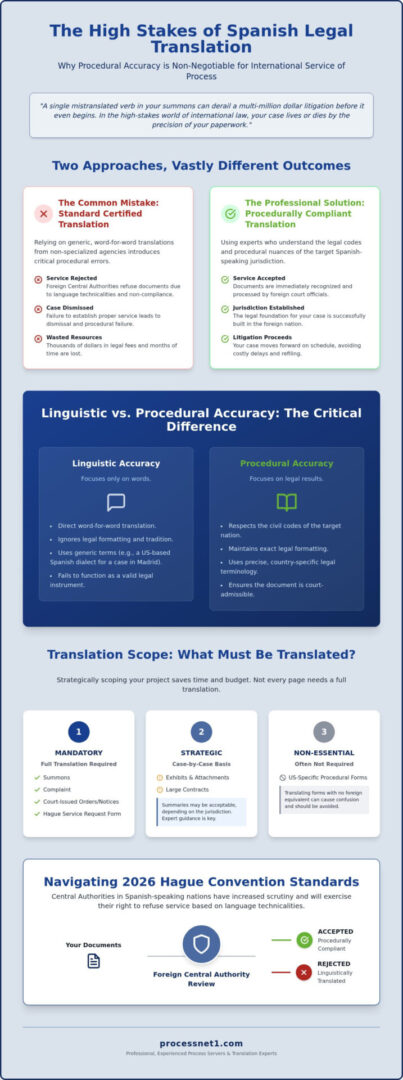
You can’t afford to treat translation as an afterthought. Many law firms make the fatal mistake of hiring a general agency for their spanish legal translation services, only to find their case dead on arrival in a foreign court. A standard “certified” translation might look good on paper, but it often lacks the procedural weight required for international service of process. If the foreign Central Authority or a local judge deems the translation insufficient, your service is invalid. That leads to dismissed cases and thousands of dollars in wasted legal fees. We’ve seen it happen! Translation is the primary bridge to establishing court jurisdiction in Spanish-speaking nations. Without a bridge built on legal precision, your litigation lacks a foundation.
Move beyond “word-for-word” translations. You need documents that are procedurally compliant. This means the translation must respect the legal traditions and specific civil codes of the destination country. We don’t just swap English words for Spanish ones. We ensure the document functions as a valid legal instrument in a foreign environment. Our “process server first” methodology means we understand exactly how a judge in Mexico or Spain will view your summons. We solve problems before they start.
The Legal Threshold for Admissibility
Court-admissible means more than just accuracy. It means the document meets the specific evidentiary standards of the destination country. Spanish isn’t a monolith. The legal terminology used in Mexico differs significantly from the phrasing required in Spain or Argentina. Using a US-based Spanish dialect for a case in Madrid is a recipe for disaster! Your Certificate of Accuracy must be robust enough to withstand intense scrutiny from a foreign magistrate who’s looking for any reason to reject your filing. We provide the authority you need to move forward without hesitation.
Procedural vs. Linguistic Accuracy
Linguistic accuracy is about words; procedural accuracy is about results. If a translator uses a generic word for “Summons” that doesn’t align with the specific legal code of the target nation, the service fails. We focus on maintaining the exact integrity of the legal formatting so the document is immediately recognizable to foreign court officials. In 2026, specialized legal expertise is mandatory for Spanish translation because international courts have increased their scrutiny of translated service documents to ensure strict treaty compliance. Don’t let a minor clerical error stall your litigation. Trust the veterans who have navigated these complexities since 1978!
Determining Your Translation Scope: What Must Be Translated?
Stop wasting your litigation budget on unnecessary paperwork. Most firms assume they must translate every single page in a 500-page evidence dump. That’s a myth! Scoping your project correctly is the difference between a streamlined case and a financial black hole. When you secure professional spanish legal translation services, the first step is identifying the core documents required to satisfy the foreign Central Authority. We don’t just translate; we strategize to ensure every word serves a procedural purpose.
Our “no-nonsense” approach focuses on the documents that actually matter for service of process. We identify “untranslatable” legal forms, such as specific US procedural certificates with no direct Spanish equivalent, and handle them with expert precision. This saves you time and prevents the foreign court from getting bogged down in irrelevant details. We’ve navigated these complexities since 1978, and we know exactly where to draw the line.
Mandatory Documents for Spanish Jurisdictions
You can’t skip the Hague Service Request Form. In 2026, many Central Authorities in Spanish-speaking nations have tightened their refusal criteria. If your request form isn’t in the target language, it’s coming back to you! You must also translate the “Essential Universals” of the lawsuit. This includes the Summons, the Complaint, and any specific court-issued orders or notices. These are the documents that establish the defendant’s right to due process. Without them, your service is dead on arrival.
Handling Exhibits and Attachments
Exhibits are where the confusion starts. Do you need a full translation of a 100-page contract? Not always. Some jurisdictions allow for summaries of evidentiary exhibits, provided the core facts of the claim remain clear. However, making this call without expert guidance is a massive risk. Consulting with a global process service network before you start can save you thousands in unnecessary costs. We look at your evidence through the lens of a process server, identifying what’s essential for the foreign authority to accept the package. Don’t pay for words that won’t move your case forward. If you want to avoid the trap of over-translation, it’s time to get a professional scope of your service documents from a partner who knows the field.
Step-by-Step Guide: Ordering Court-Admissible Spanish Translations
Ordering spanish legal translation services is a strategic operation, not a clerical task. Don’t settle for “fast and cheap” when your jurisdiction is on the line! You need a partner who understands the field, not just the dictionary. We’ve navigated these complexities since 1978, and we know that a successful service of process starts with how you prepare your files. Provide OCR-ready PDFs whenever possible. Blurry scans of hand-written notes or faint court seals can lead to transcription errors that a foreign Central Authority will use as an excuse to reject your entire package. Set clear deadlines that account for both the translation turnaround and the logistical time required for physical service in a foreign country.
Step 1: Document Audit and Preparation
Before you send a single page, perform a rigorous document audit. Ensure every signature, court seal, and official stamp is perfectly legible. If a translator can’t read a seal, they can’t translate it, and a foreign judge will notice the omission! You must also identify the specific Spanish-speaking country involved. A summons destined for Madrid requires different terminology than one headed for Mexico City. Finally, flag any time-sensitive “Return Dates” on your summons. In 2026, international backlogs are common; your translation partner needs to know exactly how much runway you have before the court’s deadline expires. We thrive on these tight windows and provide the energetic support you need to stay on track.
Step 2: Execution and Certification
Demand a word-for-word translation that leaves nothing out. This includes headers, footers, and even the smallest marginalia. Foreign authorities are famously pedantic; if they see text on the English original that doesn’t appear in the Spanish version, they may deem the translation incomplete. Ensure the certification is notarized if the destination country requires it. Many civil law jurisdictions won’t recognize a standard US corporate “certification” without a notary’s seal. Before finalizing your order, review our guide on certified translation for service of process to catch common procedural errors before they leave your desk. We provide absolute transparency throughout this process, ensuring your Certificate of Accuracy is robust enough to withstand the most intense foreign scrutiny.
Navigating Hague Convention Requirements for Spanish-Speaking Countries
Central Authorities are the ultimate gatekeepers of international litigation. In 2026, these entities have become increasingly strict about linguistic compliance. Don’t assume that a defendant’s English proficiency excuses you from translation requirements! When you’re serving process in Mexico, Spain, or Argentina, the Hague Convention provides the framework, but the local Central Authority holds the power. If your documents aren’t accompanied by professional spanish legal translation services, they won’t even make it past the front door. We’ve seen requests sit in limbo for months just because a translation was missing or informal. We’ve navigated these complications since 1978 and know how to avoid these traps.
Article 5 and the Power of Refusal
Article 5 of the Hague Convention is where most law firms trip up. It allows a Central Authority to require that the document be written in, or translated into, the official language of the state addressed. This is a procedural mandate, not a suggestion. Even if you’re serving a multinational corporation where the working language is English, the state often insists on its native tongue to protect its sovereignty and the rights of its citizens. Failure to comply leads to an immediate rejection of your request. Use this Hague Convention process service checklist to ensure your 2026 filings are fully compliant before you ship them.
- Mexico: Requires highly specific legal terminology that aligns with their civil law system.
- Spain: Often demands translations that include every single administrative stamp and seal.
- Colombia and Argentina: Frequently exercise their right to refuse service if the translation is in a different regional dialect.
Non-Hague Jurisdictions and Spanish Translation
What happens when a country isn’t a party to the Hague Convention? You’re forced into the “Letters Rogatory” trap. This involves moving documents through diplomatic channels, which is notoriously slow and expensive. In these cases, your translation must meet the “Formal Request” standards of foreign ministries. These aren’t just translations; they’re diplomatic instruments. The costs increase because the scrutiny is higher and the procedural steps are more numerous. We help you avoid these delays by providing procedurally compliant translations from the start. If you want to ensure your case moves forward without diplomatic friction, initiate your international service of process with our expert team today.
Choosing a Translation Partner Who Understands International Service
Don’t risk your litigation by hiring a generalist. Many agencies claim to offer spanish legal translation services, but they treat your summons like a marketing brochure or a technical manual. They lack the procedural intuition required to survive the scrutiny of a foreign Central Authority. You need a veteran who understands the high stakes of international law. We operate with a relentless “can-do” attitude, especially when dealing with hard-to-serve defendants in complex jurisdictions. We don’t just translate words; we prepare your case for victory!
The benefit of a single-source provider is undeniable. By integrating translation and service, you eliminate the communication gap that often leads to procedural rejections. We ensure the translation is perfectly aligned with the specific service requirements of the destination country. This streamlined approach saves time, reduces stress, and guarantees your documents are court-ready the moment they leave our hands. We move your case forward with operational precision and absolute reliability. For a comprehensive overview of how proper legal document translation for service protects your case at every stage, our definitive 2026 guide covers the full spectrum of requirements you need to meet.
The Process Service Network, LLC Advantage
Our founding in 1978 established us as the authoritative choice for global delivery. We’ve spent decades building a worldwide network that understands the nuances of local civil codes. Our seamless integration of international process service and legal translation means experts handle your paperwork at every stage. We bridge the dangerous gap between “translated” and “served” with absolute precision. You get a partner who has navigated every possible complication and possesses the infrastructure to handle your most difficult cases with ease. We thrive on the challenges that deter others!
Initiating Your Request with Confidence
Transparency is our baseline. We provide immediate, clear quotes for spanish legal translation services with no hidden variables or surprise fees. You won’t find extra charges for certifications or notarizations buried in our engagement structure. We speak the language of US litigation and understand the intense pressure of court-mandated deadlines. Our methodology is built for speed and accuracy, moving you quickly from a logistical problem to a legal solution. Don’t leave your jurisdiction to chance! Trust the seasoned veterans who prioritize your results above all else. Let’s get your documents served correctly the first time.
Secure Your Litigation Success with Precision
Your international litigation shouldn’t be stalled by a minor translation technicality. We’ve established how the Hague Convention demands absolute precision and why scoping your documents correctly protects your litigation budget. Success in 2026 requires more than just a bilingual dictionary; it requires a partner who understands the procedural mechanics of a foreign court. By securing expert spanish legal translation services from a team that understands the field, you ensure your case stays on track. We’ve navigated these high-stakes requirements since 1978!
We provide professional process serving worldwide with a relentless “can-do” attitude. As Hague Convention experts, we eliminate the gap between paperwork and physical delivery with absolute transparency. Don’t leave your jurisdiction to chance or hidden fees. We have the veteran infrastructure needed to handle even the most difficult cases with ease. It’s time to move forward with the confidence of a seasoned expert. Get a Transparent Quote for Spanish Legal Translation and International Service and let us handle the complexities for you today!
Frequently Asked Questions
Is a certified Spanish translation required for all Hague Convention cases?
Yes, if the destination country’s Central Authority mandates it under Article 5. Most Spanish-speaking nations have strict language requirements that must be met to ensure successful delivery. A standard translation simply lacks the legal weight needed for international litigation support. We provide the necessary certification and expertise to ensure your documents are court-admissible from day one. Don’t risk a rejection by skipping this vital step.
Can I use a local Spanish teacher to translate my legal documents?
No, using a teacher is a recipe for procedural disaster. Legal translation requires deep knowledge of civil law terminology and specific court procedures. A teacher might understand the language but won’t grasp the technical nuances of a Summons or Complaint. Using unverified sources leads to rejections and wasted court fees. Trust the experts who have handled these complexities since 1978 and understand the field.
How long does it typically take to translate a standard legal complaint into Spanish?
Turnaround times vary based on document length and technical complexity. A standard complaint typically takes a few business days to process correctly. However, you must also account for the time needed for certification and notarization. We prioritize efficiency to help you meet strict court deadlines. Our methodology is designed to move your case from translation to service without any unnecessary or frustrating delays.
What happens if the Spanish translation has a minor error?
Minor errors can lead to immediate rejection by the foreign Central Authority. Foreign judges often look for any technicality to refuse service and protect their jurisdiction. A mistranslated legal term or a missing court seal can stall your litigation for months. This is why we focus on procedural accuracy rather than just linguistic swapping. We catch these errors before they leave your desk and cause problems.
Do I need to translate the exhibits if the main complaint is in Spanish?
Generally, yes. Most Spanish-speaking jurisdictions require the entire service package to be translated for the defendant. While some Central Authorities might allow summaries for massive document sets, you shouldn’t gamble on it. We help you scope your project to identify exactly what is mandatory. This ensures you satisfy the court’s requirements while managing your litigation costs effectively and avoiding any procedural friction.
Does the translation need to be notarized for service in Mexico?
Yes, Mexico typically requires translations to be notarized and often apostilled for international validity. Civil law jurisdictions place a high value on formal certification from authorized entities. A simple corporate certificate isn’t enough to establish jurisdiction in Mexican courts. We handle these administrative hurdles as part of our comprehensive spanish legal translation services, ensuring your documents meet every local standard for 2026 compliance.
How much do Spanish legal translation services cost in 2026?
Pricing depends on the volume of text and the specific certification requirements of the target country. We provide transparent quotes that cover everything from the initial translation to the final notarized certificate. You won’t find hidden fees or surprise variables in our engagement structure. Contact us for an immediate assessment of your document set to secure your litigation budget with absolute certainty and professional confidence.
Can I serve papers in Spanish-speaking countries via mail without translation?
It’s highly unlikely and extremely risky for your case. Even if a country doesn’t explicitly prohibit mail service, the lack of a translation often violates the defendant’s right to due process under local law. Using professional spanish legal translation services is the only way to ensure your service is bulletproof. Don’t leave your case’s validity to chance when a single procedural mistake can lead to a dismissed lawsuit.
