

Top International Process Serving Companies: The 2026 Elite Provider Guide
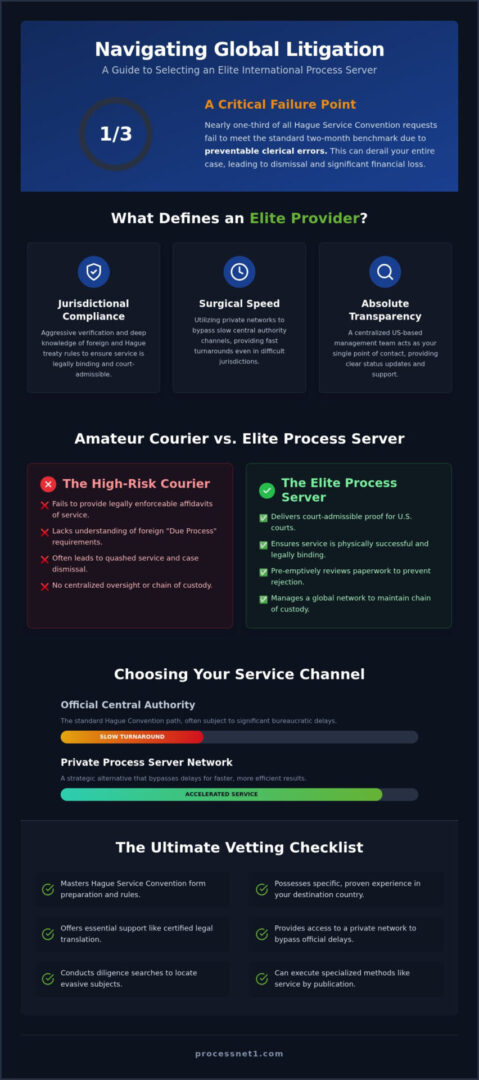
Nearly one-third of all Hague Service Convention requests fail to meet the standard two-month execution benchmark because of preventable clerical errors. You’ve worked too hard on your litigation strategy to let a minor procedural mistake in a foreign jurisdiction derail your entire case. It’s a frustrating reality that many legal professionals face when trying to identify the top international process serving companies. You need a partner that doesn’t just deliver papers. You need a veteran navigator who understands the high stakes of cross-border compliance and sovereignty.
We know the anxiety of waiting for status updates while costs climb and deadlines loom. You deserve absolute transparency and a team that treats your case with the urgency it requires. This guide reveals the critical criteria for selecting an elite provider who can navigate both Hague and non-Hague protocols with surgical precision. We’ll show you how to secure court-admissible proof of service and achieve fast turnarounds in difficult countries. Discover what separates the industry leaders from the rest and learn how they ensure your litigation stays on track in 2026.
Key Takeaways
- Elite providers prevent immediate dismissal by prioritizing aggressive verification and jurisdictional compliance over simple document delivery.
- Identify the top international process serving companies by vetting their mastery of Hague Form Preparation and their specific experience within your destination country.
- Understand the strategic advantages of using a private process serving network to bypass the slow turnaround times often found in official Central Authority channels.
- Learn how to secure court-admissible proof of service through essential support services like certified legal document translation and diligence searches.
- Discover how to navigate the most difficult cases using specialized methods like service by publication when traditional personal service attempts fail.
Navigating Global Litigation: What Defines a Top International Process Serving Company?
International litigation is a high-stakes environment where a single procedural error can lead to the immediate dismissal of your case. You can’t afford to treat document delivery as an afterthought. The top international process serving companies distinguish themselves through aggressive verification, surgical precision, and a deep-seated commitment to jurisdictional compliance. They don’t just move paper across borders; they secure the legal foundation of your entire lawsuit. Don’t settle for a simple courier when your case demands a strategic legal partner.
The elite provider profile is built on three pillars: compliance, speed, and absolute transparency. This often requires navigating the complex requirements of the Hague Service Convention, which serves as the mandatory framework for service between signatory nations. Failure to adhere to these specific treaty rules isn’t just a minor delay. It’s often a fatal blow to your litigation strategy that results in service being quashed by the court.
The Difference Between Delivery and Legal Service
Don’t confuse a courier with a process server. A standard courier might get a package to an address, but they cannot provide an enforceable affidavit of service that a judge will accept. Legal service requires a sophisticated understanding of “Due Process” in foreign jurisdictions, which varies wildly from one country to the next. Elite providers use an assertive, expert-led approach to ensure that document delivery is both physically successful and legally binding. They maintain a strict chain of custody, ensuring that every hand that touches your documents is vetted, authorized, and capable of producing court-admissible proof.
The Consequences of Choosing the Wrong Provider
The risks of hiring an amateur are staggering. You face jurisdictional challenges, quashed service, and the potential for your case to be thrown out entirely. In high-stakes corporate litigation, these delays translate into massive financial losses. Statistics show that nearly one-third of Hague Service Convention requests fail to meet standard execution benchmarks because of preventable clerical mistakes. Elite firms pre-emptively solve these issues. They review your paperwork for errors before it ever reaches a foreign central authority. They don’t just hope for success; they engineer it through relentless diligence and professional oversight!
Relying on “local servers” without a centralized US-based management team is a common trap for the unwary. Local agents often lack the understanding of US court requirements for affidavits and proof of service. A top-tier firm acts as your single point of contact, managing a global network while ensuring all proof of service is formatted correctly for your forum court. This centralized control is what maintains the chain of custody across borders and prevents your case from falling through the cracks of international bureaucracy. Demand a partner that provides a “can-do” attitude for even the most difficult-to-serve cases!
Core Competencies of Elite Providers: Hague Convention Mastery and Beyond
Success in international litigation depends on more than just finding a name in a directory. It requires a partner with deep technical mastery of complex treaties. This expertise is the primary reason why the top international process serving companies invest heavily in procedural knowledge. Getting the paperwork right is 90% of the battle! If your request is rejected by a foreign central authority, you don’t just lose time. You risk the entire legal standing of your case.
Elite firms navigate the specific nuances of Article 5 and Article 10 with surgical precision. While Article 5 dictates the standard path through central authorities, Article 10 allows for alternative methods like postal service or direct service by judicial officers. However, many countries object to these alternative methods. You need a veteran navigator who knows these objections by heart. For a deeper dive into these technical requirements, consult our Hague Convention Process Service: 2026 Definitive Guide.
Mastering the Hague Service Request Form
Clerical errors are the leading cause of delays in global service. Each country has specific “quirks” regarding how they process requests. Some require specific ink colors; others demand exact phrasing in the summary of the document. The Hague Conference on Private International Law provides the framework, but local interpretation varies wildly. An elite provider pre-emptively audits every form to ensure it meets these localized standards. We thrive on getting these details right the first time!
The Critical Role of Certified Translation
Automated translations are a recipe for legal disaster. Many jurisdictions require that served documents be translated into their official language to satisfy due process. If a translation is inaccurate, the service can be quashed immediately. Elite providers offer a single-source solution by integrating certified legal document translation with the service process. This synergy ensures that the translated text meets the specific legal standards of the receiving country. It also eliminates the communication gaps that occur when using separate vendors. Don’t let a translation error become a jurisdictional loophole for the defendant!
When dealing with non-Hague countries, the complexity increases. These cases often require Letters Rogatory, a formal request from a US court to a foreign court. This process is notoriously slow and requires a “no-nonsense” approach to move the needle. Whether you are dealing with a signatory nation or a difficult-to-serve non-Hague jurisdiction, we have the infrastructure to handle it. You can start the process today by initiating your international service with a team that possesses a proven track record of success.
Evaluating Your Options: Authorized Central Authorities vs. Private Networks
Choosing between the “Official” channel and a “Strategic” private channel is the most critical decision you’ll make for your case. While government channels provide institutional weight, they often move with the speed of a glacier. You need a solution that prioritizes your court deadlines, not administrative convenience. The top international process serving companies know that outbound private litigants require agility that bureaucratic systems simply cannot provide. Don’t let your litigation stall while waiting for a response from a foreign capital.
The Pros and Cons of Government-Affiliated Providers
While the U.S. Department of Justice has contracted with specific entities to manage inbound requests through 2030, outbound private cases require a different level of attention. The Hague Conference encourages Central Authorities to execute service within 90 days. However, nearly one-third of all requests fail to meet even a two-month execution benchmark! This is the primary trade-off. If you choose a government-affiliated path, you’re often trading operational speed for institutional authority. For high-stakes corporate litigation, this lack of flexibility is a deal-breaker. Elite firms pre-empt this by managing the process aggressively from the start.
The Advantage of a Global Process Service Network
This is where a private global process service network shines. We leverage deep relationships with local agents on every continent to ensure faster personal service. We don’t just send documents and hope for the best. We track them. If a defendant is evasive, we have the “can-do” attitude to pivot strategies immediately. We can transition to Service by Publication or initiate a Diligence Search to uncover new leads without waiting for a bureaucratic green light. For more strategic insights on navigating these choices, read International Process Service: The Definitive Guide (2026).
Transparency is our baseline. In a private network, you get real-time updates instead of waiting on bureaucratic mail. You’ll know exactly where your documents are and the current status of the service attempt. We provide a no-nonsense approach to communication that eliminates the uncertainty common in international law. Our veteran navigators handle the heavy lifting, ensuring you receive court-admissible proof of service with the speed your case demands. Demand a partner that operates with the same urgency you do!
The Ultimate Selection Framework: How to Vet an International Process Server
Selecting from the top international process serving companies requires more than a casual glance at a directory. You need a systematic vetting process to ensure your provider possesses the infrastructure to handle complex jurisdictional hurdles. Don’t settle for a courier with a passport. You need a veteran navigator who understands that every country has its own set of procedural traps. Follow this five-step framework to secure a partner that delivers results, not excuses!
First, verify their experience with your specific destination country. A provider who claims “global” coverage but has never navigated the central authority in Brazil is a liability. Second, assess their technical mastery of Hague Form Preparation and Letters Rogatory. If they stumble over these terms, your case is in trouble. Third, inquire about their “hard-to-serve” protocols. You need a firm that offers a Diligence Search to track down evasive defendants. Fourth, demand absolute transparency regarding timelines. Finally, confirm they provide a court-ready Affidavit of Service that meets your forum court’s specific standards.
Questions to Ask Before You Retain a Provider
Direct questions reveal the difference between a middleman and an expert. Ask them, “How do you handle evasive defendants in this specific country?” A top-tier firm will have a clear, assertive strategy. Inquire if they provide in-house certified legal translation to ensure documents are court-admissible. Most importantly, ask about their success rate with Service by Publication if personal service fails. You need a partner with a “can-do” attitude that doesn’t give up when a case gets difficult. Ready to move forward? Request a quote for your international service today and see our expertise in action.
Red Flags in International Process Serving
Protect your case by identifying red flags early. Be wary of providers who promise “guaranteed” service dates in Hague Convention countries. Because Central Authorities operate on their own schedules, such promises are often dishonest. Another red flag is a lack of specialized legal knowledge or a heavy reliance on generic couriers. If a provider gives vague answers regarding local laws and treaty compliance, they aren’t a strategic partner. They’re a risk. Demand a straight-shooting expert who prioritizes transparency and jurisdictional integrity above all else!
Why Process Service Network Dominates the Global Legal Support Market
Founded in 1978, Process Service Network, LLC has spent nearly five decades defining what it means to be a global leader. We don’t just participate in the industry. We lead it! While other firms shy away from complex jurisdictional hurdles, we thrive on them. This legacy of authority has established us as a veteran navigator among the top international process serving companies. Our infrastructure spans every continent, providing a relentless problem-solving approach to cross-border litigation that competitors simply cannot match. You need a partner that acts as a straight-shooting, transparent guide through the world’s most difficult legal landscapes.
Solving the Most Difficult International Service Cases
We specialize in the cases others refuse. Evasive defendants and convoluted corporate structures are no match for our elite Diligence Search capabilities. We find the “unfindable” by leveraging deep global intelligence and localized expertise. We don’t just guess where a defendant might be. We verify it! If traditional personal service attempts fail, we don’t hit a dead end. We pivot immediately. Our team utilizes Service by Publication as a final strategic move to ensure your case moves forward in the forum court. This “can-do” attitude turns international roadblocks into manageable procedural steps, ensuring no defendant can hide from the law.
Absolute Transparency and Unwavering Reliability
Transparency is the cornerstone of our operations at Process Service Network, LLC. We provide a single-source solution that integrates Legal Document Translation, Hague Form Preparation, and Diligence Search under one roof. This eliminates the bureaucratic delays and hidden variables associated with juggling multiple vendors. You’ll never have to worry about communication gaps or translation errors that quash your service. We’re serious about our obligations and energetic about your results! You receive court-ready proof of service designed to withstand the highest levels of judicial scrutiny.
Experience the difference of elite leadership and unwavering reliability. Don’t settle for uncertainty or the slow pace of government-affiliated channels. Partner with a firm that has navigated every possible international complication since 1978. We possess the infrastructure to handle your most difficult cases with ease and accuracy. Let us take the lead on your next international engagement and deliver the results your litigation demands!
Secure Your Cross-Border Litigation Success Today
International service of process is far too critical to leave to chance or bureaucratic delay. You’ve learned that the top international process serving companies must offer more than just delivery; they must provide technical mastery of the Hague Convention and aggressive diligence search capabilities. Whether you’re navigating Article 5 requirements or facing an evasive defendant in a non-Hague jurisdiction, your choice of provider determines the legal standing of your case. Don’t let a minor clerical error derail your entire litigation strategy!
Process Service Network, LLC has been serving the legal community worldwide since 1978. Our team specializes in the hard-to-serve cases that leave other providers at a standstill. With comprehensive legal document translation and jurisdictional expertise built into every engagement, we eliminate the uncertainty of global litigation. Secure court-admissible proof of service with a partner that values speed and transparency as much as you do. Our veteran navigators are ready to handle the heavy lifting for you!
Contact the Experts at Process Service Network, LLC for a Global Solution and experience the “can-do” attitude that has made us an industry leader for decades. Your case is too important for anything less than elite leadership. We look forward to helping you move your litigation forward with absolute confidence!
Frequently Asked Questions
How long does international process service typically take?
International process service timelines vary significantly based on the destination country and the method required. While the Hague Conference encourages a 90-day execution benchmark, nearly one-third of requests fail to meet even a two-month execution mark due to bureaucratic delays. Using a private network instead of a government channel can often speed up the process. We prioritize efficiency to help you meet your court deadlines without sacrificing jurisdictional integrity!
What is the Hague Service Convention and do I have to use it?
The Hague Service Convention is a mandatory treaty governing the transmission of judicial documents between signatory nations. If your target resides in a member country, you must follow its protocols to ensure service is legally binding. Failure to comply often results in service being quashed by the judge. We specialize in Hague Form Preparation to ensure your documents are accepted by foreign central authorities the first time!
Can I serve a foreign corporation in a US lawsuit?
You can absolutely serve a foreign corporation in a US lawsuit. Success depends on identifying the correct corporate officer or registered agent according to local laws. The top international process serving companies perform deep research into complex corporate structures before attempting delivery. This ensures that the service is physically successful and legally enforceable in your forum court. Don’t let a corporate shell game stall your litigation!
What happens if a defendant is actively evading service abroad?
If a defendant evades service, we pivot to aggressive Diligence Search protocols and alternative service methods. Our “can-do” attitude means we don’t give up when traditional attempts fail. We can often utilize Service by Publication to satisfy the court’s requirements for due process. This strategic move allows your litigation to move forward despite an uncooperative or “unfindable” party. We thrive on the cases that other firms refuse!
Do I need to translate my legal documents for international service?
Translation is nearly always a requirement for international service of process. Most countries demand that legal documents be served in their official language to satisfy their specific due process standards. We provide professional Legal Document Translation as part of our all-in-one service. This synergy ensures that your documents are court-admissible and that the defendant cannot claim they didn’t understand the nature of the lawsuit.
What is the difference between service by mail and personal service internationally?
Personal service involves an agent physically handing documents to the defendant, while service by mail uses postal channels. Many countries officially object to service by mail under Article 10 of the Hague Convention. Personal service remains the gold standard for top international process serving companies because it provides stronger evidence of delivery. It’s much harder for a defendant to challenge an affidavit from a professional process server than a mail receipt.
What is a Letter Rogatory and when is it necessary?
A Letter Rogatory is a formal request from a US court to a foreign court seeking judicial assistance. This method is necessary when serving documents in a country that is not a signatory to the Hague Convention. It is a slow, diplomatic process that often requires extended coordination between courts and government agencies. We act as your expert guide through this bureaucratic landscape to ensure your request is formatted correctly.
How do I prove to a US court that service was successful in another country?
You prove successful service by filing a court-ready Affidavit of Service or an official certificate from a foreign Central Authority. Our team ensures that every proof of service we provide meets the specific evidentiary standards of your US forum court. We handle the heavy lifting of verification so you can present your evidence to the judge with absolute confidence. Reliability and transparency are the cornerstones of our global operations!
