

Legal Diligence Search: The 2026 Definitive Guide
Your litigation isn’t dead just because a defendant went off the grid. It’s simply waiting for a tactical maneuver! Stalled cases and the threat of dismissal for lack of service are enough to keep any legal professional up at night. You need results, not excuses. We understand the pressure of satisfying strict judicial standards for a diligence search for legal proceedings. It’s the difference between a case that advances and one that’s unceremoniously tossed out. You’re rightfully concerned about vague standards, but that confusion ends here. We provide the clarity you need to move forward with absolute confidence.
This 2026 guide provides the definitive blueprint to locate the unfindable and satisfy the court’s requirements. We’ve navigated every possible complication since 1978. Now, we’re sharing that veteran expertise with you. You’ll learn exactly how to execute a search that stands up to the most rigorous judicial scrutiny and leads directly to a court-admissible Affidavit of Diligence. We’re breaking down the modern methodology for 2026, including the latest digital asset tracing and international skip tracing protocols. It’s time to stop the delays, secure successful service of process, and get your legal proceedings back on track immediately!
Key Takeaways
- Grasp the precise “Due Diligence” standards judges demand in 2026 to ensure your litigation moves forward without the threat of dismissal!
- Master the tactical execution of a diligence search for legal proceedings to locate elusive defendants and secure a court-admissible Affidavit of Diligence.
- Identify the five investigative pillars that reveal a defendant’s location by leveraging residential records and professional licensing data.
- Distinguish between searches for service and searches for assets to prioritize your resources and accelerate your path to a final judgment.
- Leverage the expertise of a global veteran to navigate complex international landscapes and find defendants that standard databases simply cannot reach!
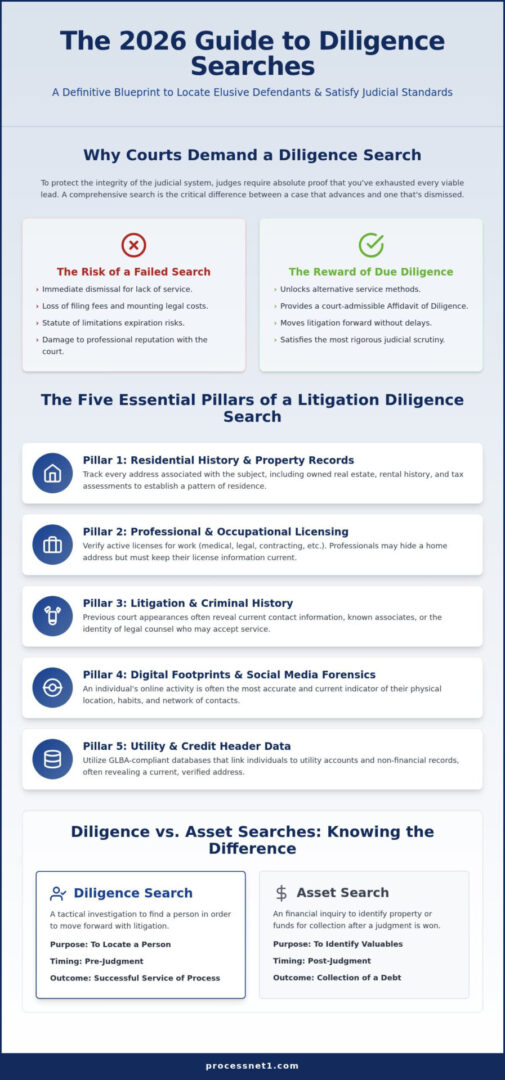
Why Courts Demand a Diligence Search for Legal Proceedings
Litigation in 2026 doesn’t tolerate guesswork! If you can’t find a defendant, you can’t simply throw up your hands and hope for the best. Courts require a rigorous diligence search for legal proceedings to protect the integrity of the judicial system. This isn’t a mere formality; it’s a high-stakes investigation that determines if your case lives or dies. Judges want absolute proof that you’ve exhausted every viable lead before they grant you special permissions to bypass personal service. Don’t let a “lazy” search derail your timeline or lead to a humiliating dismissal.
The “Reasonable Diligence” Standard
Every citizen has a constitutional right to notice. This is the bedrock of due process. You can’t take someone’s property or legal rights without giving them a fair chance to defend themselves in court. A simple Google search or a quick scroll through social media never satisfies a modern judge! Courts look for a comprehensive effort that goes far beyond basic public records. Due diligence in this context means demonstrating that you’ve hunted for the individual with relentless intensity. Reasonable diligence is the exhaustive effort to locate a defendant before seeking alternative service. If your search lacks depth, expect your case to stall immediately. A judge who isn’t convinced of your effort will deny your motions, forcing you to start the process from scratch. This costs you precious time and wastes your client’s money.
Unlocking Alternative Service Methods
When standard service fails, you need a tactical backup plan. A successful diligence search for legal proceedings is your ticket to a Motion for Substituted Service or Service by Publication. Without a verified, professional search, these doors remain locked. You must prove that the defendant is truly unlocatable or actively evading service before a judge will authorize these alternative methods.
The key to this transition is the Affidavit of Diligence. This document is a tactical weapon in your legal strategy. It outlines every database checked, every professional license reviewed, and every lead followed. It provides the court with the “can-do” evidence needed to authorize alternative methods. This is especially critical when handling international process service, where jurisdictional hurdles are even higher and the room for error is zero. Consider the consequences of a failed search:
- Immediate dismissal of the complaint for lack of service.
- Loss of filing fees and mounting legal costs.
- Statute of limitations expiration risks while you scramble to re-file.
- Significant damage to your professional reputation with the court.
Don’t settle for a surface-level investigation. Secure the results your case demands by executing a search that stands up to the most aggressive judicial scrutiny!
The Five Essential Pillars of a Litigation Diligence Search
A “complete” search isn’t a single database query. It’s a comprehensive investigation built on five critical pillars. To meet the legal definition of due diligence, your search must leave no stone unturned. Judges in 2026 expect a multi-layered approach that proves you’ve pursued every lead with professional intensity. Anything less is just a guess, and guesses don’t win motions. Your diligence search for legal proceedings must include these five essential categories:
- Pillar 1: Residential History and Property Records. We track every address associated with the subject, including owned real estate, rental history, and tax assessments.
- Pillar 2: Professional and Occupational Licensing. Many defendants hide their home address but maintain active licenses for work. We verify records for medical, legal, contracting, and other state-regulated professions.
- Pillar 3: Litigation and Criminal History. Previous court appearances often reveal current contact information or the identity of legal counsel who may accept service.
- Pillar 4: Digital Footprints and Social Media Forensics. In a digital world, an individual’s online activity is often the most accurate indicator of their physical location.
- Pillar 5: Utility and Credit Header Data. We utilize GLBA-compliant credit header information and utility connection records to find the most recent “active” location.
Traditional Search Methods
Don’t ignore the basics. Traditional methods remain the foundation of any solid investigation. We start by searching real property records and tax assessments to identify owned assets. Voter registration and DMV records are also vital, though access varies by jurisdiction. When digital trails go cold, we go old school. Contacting known relatives or former neighbors often yields the “missing link” that databases miss. These manual checks demonstrate to the court that you’ve performed a truly exhaustive search.
Modern Digital Forensics
The 2026 landscape demands sophisticated digital tactics. We analyze social media activity to establish a “last known location” based on recent posts, check-ins, and metadata. It’s not enough to find an old profile; we verify the “active” status of these accounts. Are they posting? Are they engaging with others? We also scour professional networking profiles and digital asset registries to find where the subject is currently conducting business. This digital trail is often the key to unlocking a successful service of process. If your current efforts are hitting a digital wall, a professional diligence search can bridge the gap and move your case forward immediately.
Due Diligence vs. Asset Searches: Knowing the Difference
Stop confusing these two distinct investigative tools! While they often overlap, their legal objectives are worlds apart. A diligence search for legal proceedings focuses on the constitutional requirement of notice. You’re proving to a judge that you’ve made every effort to find a defendant for service of process. An asset search, conversely, focuses on the “pot of gold” at the end of the rainbow. It’s about collection and judgment enforcement. One gets you into the courtroom; the other ensures the trip was worth the expense.
In high-stakes litigation, an asset search is frequently the second step in a comprehensive investigation. Why? Because tracing the money often leads you straight to the person. If a defendant is actively evading service, they’re likely still interacting with their financial interests. Identifying where they pay their mortgage or where they dock their boat provides a concrete physical location that a standard database might miss. Combining these methods provides maximum litigation leverage, especially when dealing with sophisticated parties who know how to hide.
Strategic Asset Identification
We don’t just look for a name on a mailbox. We hunt for bank accounts, brokerage holdings, and high-value personal property. Tracing real estate transfers and corporate filings reveals the subject’s current sphere of influence. For example, a “Certified Creditor Report” is a standard tool for judgment enforcement, but its preliminary findings are gold for process servers. When we identify a new property purchase or a recently opened business account, we’ve found a fresh trail to follow. These financial footprints are often more reliable than a “last known” residential address which may be years out of date.
The Interplay in International Cases
The stakes skyrocket when your defendant crosses borders. You must satisfy Hague Convention process service requirements with surgical precision. International cases require entity verification to ensure you’re serving the correct foreign subsidiary or individual. If you identify assets in a specific jurisdiction, like a bank account in Switzerland or a villa in France, it dictates your entire procedural roadmap.
This identification also ensures your legal document translation services match the identified jurisdiction perfectly. You can’t afford to guess the language or the local service rules. A veteran partner manages this interplay with ease, ensuring that your diligence search and asset tracing work in tandem. This dual-track approach proves to the court that your efforts were global, exhaustive, and legally beyond reproach. Don’t let your case stall at the border because you failed to connect the financial dots to the physical location!
How to Conduct a Diligence Search: A Step-by-Step Legal Framework
Stop winging your investigations! Executing a diligence search for legal proceedings requires more than just access to a computer; it demands a disciplined, step-by-step framework. Judges don’t reward “good intentions.” They reward documented, exhaustive effort. If your process is haphazard, your Affidavit of Diligence will fail under judicial scrutiny. Follow this battle-tested roadmap to ensure your search is legally bulletproof and your case stays on track.
- Step 1: Aggregate all “Last Known” information. Start by centralizing every data point you already have. This includes old residential addresses, known email accounts, phone numbers, and social media handles.
- Step 2: Execute deep-web and proprietary database searches. Move beyond the surface web. Use professional-grade tools to cross-reference data across multiple jurisdictions.
- Step 3: Verify findings through physical site visits or skip tracing. Don’t trust a database blindly. If a search suggests an address, send a professional to verify it or utilize skip tracing to confirm the subject’s current presence.
- Step 4: Document every attempt and “no-hit” for the court. A failed search attempt is still valuable evidence of your effort. Log every database queried and every door knocked.
- Step 5: Prepare the formal Affidavit of Due Diligence. Translate your investigative logs into a sworn statement that clearly demonstrates your compliance with the court’s standards.
Executing the Search
Tiered databases like TLO and LexisNexis are your primary weapons for gathering current contact info. These tools provide a high-level overview, but they aren’t infallible. When a defendant is actively hiding, standard databases often return stale data. This is where skip tracing becomes essential. It allows you to find evasive defendants by connecting obscure data points that typical searches miss. Document dates, times, and specific methods used for every search attempt. This methodical approach ensures your diligence search for legal proceedings satisfies the most skeptical of judges. If you want to skip the guesswork and secure a court-ready result, initiate your professional diligence search with our veteran team today!
Documenting the Results
Your “Proof of Diligence” report must be a masterpiece of transparency. It should contain a chronological log of every action taken, including the specific databases searched and the results obtained. Don’t hide “non-service” reports from professional servers; these are critical proof of your “reasonable diligence.” They show the judge that you actually tried to effect personal service at multiple locations. When you prepare for the hearing on substituted service, this documentation is your shield. It proves you’ve earned the right to use alternative service methods. A well-prepared affidavit transitions your case from a stalled investigation to an active litigation with momentum.
Why Process Service Network is the Elite Choice for Diligence
Don’t settle for mediocre legal support when your case is on the line! You need a partner that delivers results, not excuses. Process Service Network (PSN) isn’t just another service provider; we’re the elite authority in the field. Founded in 1978, we’ve spent over 45 years perfecting the art of the search. We find the “unfindable” because we have the global infrastructure to handle what others can’t. While competitors rely on the same stale, public databases, we utilize a proprietary network that goes where digital trails go cold. We operate with a “can-do” attitude that turns complex obstacles into successful outcomes!
Every diligence search for legal proceedings we conduct is designed to withstand the most aggressive judicial scrutiny. We don’t just provide data; we provide a solution. Our team delivers bulletproof documentation that satisfies the most rigorous court requirements. This includes the essential Affidavit of Diligence that judges demand before authorizing alternative service. We understand the specialized technical jargon of international law and procedural requirements, and we apply that expert knowledge to every investigation. Our results are reliable, transparent, and ready for court.
- Veteran Experience: Over 45 years of navigating hard-to-serve cases worldwide.
- Proprietary Reach: We access local, on-the-ground intelligence that databases miss.
- Judicial Accuracy: Documentation specifically formatted to meet 2026 court standards.
- Tactical Integration: Seamless coordination with international process service and Hague Convention process service filings.
Global Reach, National Expertise
We navigate complex international landscapes with absolute ease! Our seasoned veterans have seen every possible complication and possess the infrastructure to handle difficult cases across the globe. We take a “no-nonsense” approach to finding evasive defendants, acting as a relentless problem-solver for your firm. This unwavering reliability is why top law firms trust PSN for their most difficult and high-stakes cases. We don’t just search; we provide the definitive evidence needed to advance your litigation. Our global reach ensures that no defendant is truly out of reach.
Take Action on Your Case Today
Stop letting unserved defendants stall your litigation! You can’t afford another day of delay or the fear of a dismissed case. Get the professional diligence you need to move to Service by Publication or alternative service immediately. Our team is ready to act with the same speed and accuracy we’ve promised for nearly five decades. Contact the experts at Process Service Network for an immediate consultation. Let’s secure the results your case demands and get your legal proceedings back on track now!
Advance Your Case with Judicial Certainty
Your litigation timeline depends on the quality of your investigation. Don’t let a missing defendant stall your progress! You’ve learned that a modern diligence search for legal proceedings requires a multi-pillar approach that goes far beyond basic databases. Every step you take must be documented to withstand judicial scrutiny. This evidence is your only path to unlocking alternative service methods and moving toward a final judgment.
Since 1978, we’ve specialized in locating the unfindable across the globe. Our elite network of professional investigators understands the complexities of international law and Hague Convention compliance better than anyone else in the industry. We provide the bulletproof documentation you need to satisfy the court and advance your case with absolute confidence! Stop the delays and take control of your legal strategy right now. Contact Process Service Network for Elite Diligence Searches! We’re ready to solve your most difficult service challenges today.
Frequently Asked Questions
What is a diligence search for legal proceedings?
A diligence search for legal proceedings is an exhaustive investigative effort to locate a defendant for service of process. It satisfies the court’s reasonable diligence standard and proves you’ve attempted to provide notice before requesting alternative service methods. This process involves checking residential, professional, and digital records with surgical precision. It’s a tactical prerequisite for advancing litigation when personal service isn’t immediately possible. We ensure every search meets strict judicial requirements for 2026.
How long does a professional diligence search take?
Turnaround times depend on the complexity of the case and the defendant’s evasion tactics. Most standard searches are completed within a few business days. However, complex international cases or those involving sophisticated unfindable subjects may take longer to ensure total accuracy. We prioritize efficiency without sacrificing the depth needed for a court-admissible report. We move quickly to keep your litigation timeline on track and your clients satisfied with the progress.
Can I perform a diligence search myself for court?
You can try, but a self-performed search rarely satisfies a judge’s standard for reasonable diligence. Courts expect investigations to be conducted by neutral, professional third parties with access to proprietary databases. A simple internet search isn’t enough to meet these requirements. Professional investigators provide the necessary credibility and documentation that judges require. Using an elite veteran firm ensures your findings aren’t questioned during a hearing on substituted service or publication.
What happens if a diligence search fails to find the defendant?
A no-hit result isn’t a failure if it’s documented correctly. If an exhaustive search proves the defendant is unlocatable, you use that documented effort to petition the court for Service by Publication or other substituted methods. The goal is to prove you’ve exhausted all reasonable leads as required by law. We provide the detailed logs and affidavits needed to move your case forward even when the subject remains elusive or actively hides.
Is a skip trace the same as a diligence search?
No, they serve different legal purposes. A skip trace is a specific investigative technique used to find a person’s current location. A diligence search for legal proceedings is a broader, court-mandated process that includes skip tracing as one of its components. The search results in a formal report and affidavit that satisfy judicial notice requirements. We use skip tracing as a tactical tool within our larger diligence framework to find the unfindable.
What is an Affidavit of Due Diligence?
It’s a sworn statement that details every specific action taken to locate a defendant. This document lists the databases searched, the physical sites visited, and the results of those attempts. It’s a critical piece of evidence for your legal strategy. Judges review this affidavit to determine if you’ve met the constitutional standard for notice. We provide bulletproof affidavits designed to stand up under the most intense judicial scrutiny and advance your case immediately.
Do I need a diligence search for international process service?
Yes, it’s absolutely essential for international cases. Hague Convention compliance often requires proof that you’ve attempted to locate the defendant before initiating formal service through a Central Authority. International jurisdictions have even stricter standards for what constitutes a diligent effort. We specialize in navigating these complex global landscapes. Our elite network ensures your international search meets both domestic and foreign legal requirements with ease, preventing costly delays in your global litigation.
How much does a professional diligence search cost?
Costs vary based on the depth of the investigation and whether the search is domestic or international. Factors like the number of jurisdictions involved and the subject’s level of evasion influence the final investment required. While we don’t provide flat-rate pricing here, we focus on providing transparent, no-nonsense value for every engagement. Investing in a professional search saves you from the expensive consequences of a dismissed case or stalled litigation due to service errors.
