

Serving Court Papers Internationally: The 2026 Professional Guide
A single procedural error in a cross-border lawsuit can cost you months of litigation and thousands of dollars in wasted fees! Serving court papers internationally is not just a logistical hurdle; it is a high-stakes legal maneuver where precision is your only protection. You already know the crushing frustration of a jurisdictional dismissal simply because a foreign central authority rejected your paperwork. It’s a complex landscape where the rules change the moment you cross a border, and the stakes are too high for guesswork.
Master these protocols now to ensure your legal documents are served validly and without delay! This 2026 professional guide provides the definitive blueprint for navigating the 84 contracting parties of the Hague Service Convention and the rigorous requirements of Letters Rogatory. We eliminate the confusion surrounding foreign language translations and the fear of missed court deadlines. You’ll gain a clear understanding of the timelines and procedures necessary to secure legally valid proof of service every time. Stop worrying about jurisdictional hurdles and start executing with total confidence!
Key Takeaways
- Understand why domestic rules of civil procedure stop at the border and how the Hague Convention’s Central Authority acts as the essential gateway for global service.
- Learn the specific protocols for non-treaty nations, including the use of Letters Rogatory and diplomatic channels to reach even the most evasive defendants.
- Follow our professional roadmap for serving court papers internationally to ensure every document, from summons to subpoenas, meets strict local legal standards!
- Discover how integrated legal document translation and precise Hague form preparation eliminate the risk of your service being declared invalid by foreign courts.
- Secure legally valid proof of service and protect your litigation timeline by leveraging expert networks that manage the entire international service lifecycle.
Understanding the Framework: How International Service Differs
Domestic rules of civil procedure stop exactly where the ocean begins. Within the United States, serving process is often a straightforward administrative task. Once you cross international borders, however, the legal landscape shifts dramatically. You’re no longer just delivering documents; you’re performing a sovereign act on foreign soil. Serving court papers internationally requires a total departure from local habits to avoid immediate jurisdictional dismissal.
The primary reason for this complexity is judicial sovereignty. Most foreign nations view the delivery of legal documents from a U.S. court as an exercise of government power. If you attempt to bypass their established protocols, you aren’t just making a mistake; you’re violating their laws. This leads to three primary risks: your service is declared invalid, your case is dismissed, or you end up with a judgment that no foreign court will ever enforce. You need a strategy that respects international treaties while protecting your litigation timeline.
The Sovereignty Factor in Legal Delivery
Foreign governments take their borders seriously! Many countries consider “informal” service, such as using a private server without official authorization, to be an illegal intrusion. You must distinguish between formal methods, which respect the destination country’s authority, and informal methods that might be permitted only in specific, limited circumstances. Bypassing local laws is a recipe for disaster. If a foreign court believes its sovereignty was ignored, it’ll refuse to recognize any resulting U.S. judgment. Don’t risk your entire case on a shortcut that leads nowhere.
Determining Which Protocol Applies
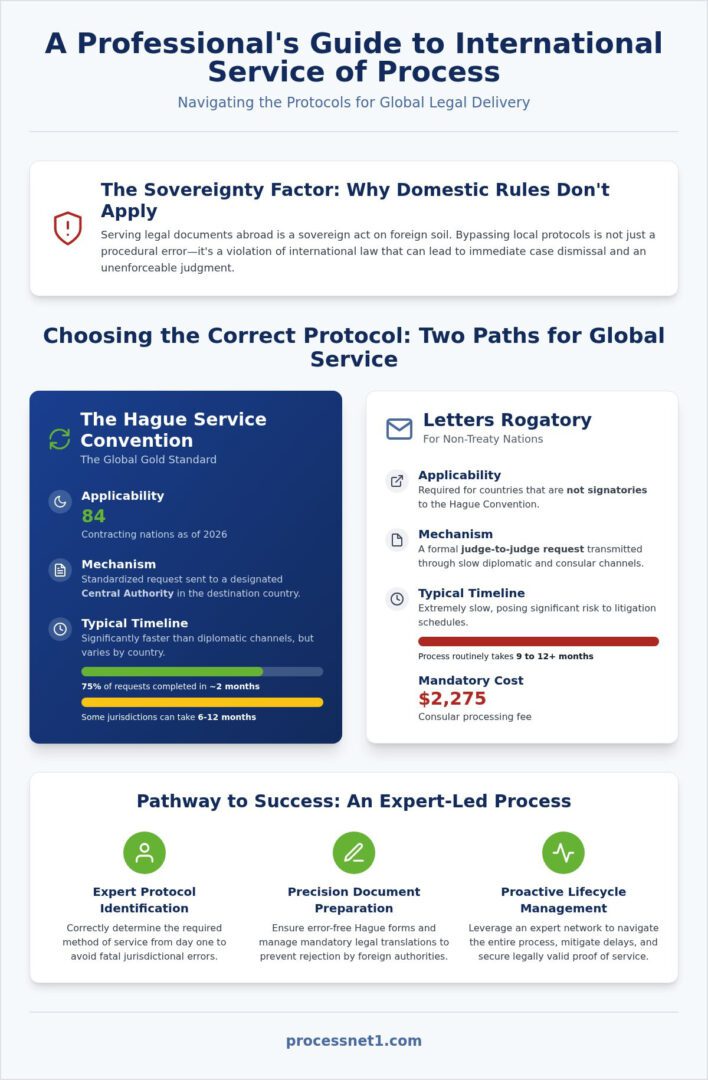
Success depends on choosing the right path from day one. There are three main routes for global document delivery. The Hague Service Convention is the gold standard, currently utilized by 84 contracting parties as of August 2026. It provides a streamlined, treaty-based framework that foreign courts respect. If the destination country isn’t a signatory, you must typically use Letters Rogatory. This traditional method involves a formal request from a U.S. judge to a foreign judge. It’s a slow process that often takes nine months to a year and carries a consular fee of $2,275.
For the most difficult cases involving evasive defendants, service by publication may be the final resort. However, you can’t simply choose the easiest method. You must verify the treaty status and local service rules of the destination country immediately. This is why consulting an international process service expert early is non-negotiable. We identify the correct protocol, manage the mandatory translations, and ensure every step aligns with both U.S. and foreign law. Get it right the first time!
The Hague Service Convention: The Global Gold Standard
The Hague Service Convention is the definitive multilateral treaty designed to streamline the service of legal documents across borders. With 84 contracting parties as of August 2026, it serves as the primary legal framework for serving court papers internationally while ensuring due process. This treaty eliminates the need for slow diplomatic channels, replacing them with a standardized mechanism that foreign courts recognize and respect. If your target country is a signatory, you must follow this path to ensure your judgment is enforceable.
The core of this framework is the Central Authority mechanism. Each member nation designates a specific government office to act as the official gateway for incoming service requests. Research indicates that 75% of document requests sent through these authorities are completed within two months. While this is significantly faster than traditional methods, some jurisdictions still require 6 to 12 months to finalize formal service. You need to account for these regional variations when planning your litigation timeline.
Mastering Hague Form Preparation
Precision is everything when dealing with international treaties! You must utilize the mandatory Model Form, which includes the Request, the Certificate, and the Summary of the document to be served. Don’t underestimate the complexity of these documents. Even a minor technical error or a missing checkbox can lead to months of administrative delay or an outright rejection by the foreign Central Authority. Partnering with a veteran team for Hague form preparation eliminates the guesswork that causes most dismissals.
The Non-Negotiable Requirement for Certified Translation
Most countries will not accept documents in English alone. You must provide a court-admissible legal translation that captures the exact technical meaning of your summons or complaint. Standard business translation is insufficient; foreign judges require a professional certification that guarantees accuracy for judicial proceedings. Certified translation is mandatory for Article 5 compliance because the Central Authority of the destination country may refuse to serve documents that are not provided in their official language. We integrate these professional translation services directly into the delivery process to ensure your paperwork is never rejected for linguistic non-compliance. Stop risking your case on amateur translations and use a certified expert who understands the nuances of global law!
Serving Non-Hague Countries and Evasive Defendants
What happens when the Hague Convention isn’t an option? You move into the traditional, more complex territory of Letters Rogatory. This is where many legal teams falter. Serving court papers internationally in non-treaty nations requires a deep understanding of diplomatic protocols and foreign judicial hierarchies. It is a world where the standard rules of civil procedure are replaced by diplomatic discretion and international comity. You cannot afford to guess when your case is on the line.
The Letters Rogatory Process Explained
The Letters Rogatory process is a formal request from a U.S. court to a foreign court seeking judicial assistance. This method moves through the U.S. Department of State and formal diplomatic channels. Documents must undergo rigorous authentication and legalization before they even leave the country. Because this method relies on the cooperation of foreign judges and foreign embassies, it is the traditional method of service for non-Hague countries. It is a significantly slower process that typically takes nine months to over a year to complete. It’s a methodical game of chess that demands absolute procedural perfection at every turn.
Elite Tactics for Locating Defendants
What if the defendant is actively hiding in a foreign jurisdiction? You can’t serve someone you can’t find! International skip tracing is vastly different from domestic searches. You need a global network that understands local privacy laws and data access in foreign jurisdictions. We conduct exhaustive diligence searches to track down current addresses even in the most difficult regions. This isn’t just about finding the individual; it’s about providing the court with a verified record of your efforts. Proving to a judge that you’ve exhausted every possible lead is essential for moving your case forward.
If a defendant remains unreachable after a verified diligence search, you may need to pivot your strategy. We manage the transition from failed personal service attempts to service by publication. This ensures your litigation remains on track by meeting the high evidentiary bar required for alternative service. Foreign courts are often reluctant to enforce U.S. judgments if service was performed informally, so sticking to these formal, court-approved methods is your only path to a successful outcome. Don’t let an evasive defendant stall your case. Use a partner who knows how to break through the silence of a foreign jurisdiction!
Step-by-Step Guide to Serving Papers Internationally
Success in serving court papers internationally requires more than just a stamp and an envelope. It demands a tactical, chronological workflow that leaves no room for error. You’ve already learned about the legal frameworks; now it’s time to execute. Follow this professional roadmap to ensure your documents reach their target and survive judicial scrutiny. Every step is a potential point of failure if handled with anything less than total precision.
- Identify the destination country’s treaty status. You must know if you are operating under the Hague Convention, the Inter-American Convention, or traditional diplomatic channels.
- Prepare the underlying legal documents. Your Summons, Complaint, or Subpoena must be clearly drafted and properly issued by the court of origin.
- Secure certified legal translations. Foreign courts require these to be court-admissible, meaning they must include a formal certification from a qualified translator.
- Complete the mandatory Hague forms or Letters Rogatory requests. These forms are technical and require absolute accuracy to avoid rejection by a foreign Central Authority.
- Submit the finalized package. Send it to the correct authority or an authorized local server who understands the laws of the destination country.
Initial Case Assessment
Start by determining the nature of your defendant. Is it an individual or a corporate entity? This distinction changes the service rules in many jurisdictions. Verify the exact physical address immediately. If the address is outdated or the defendant is evasive, you must initiate a diligence search before proceeding. Don’t wait for a deadline to loom! Consulting with an expert at this stage prevents the common procedural pitfalls that derail cases before they even begin. You need a clear target before you fire your first shot.
Executing the Service and Obtaining Proof
Once your documents are submitted, you must track the progress of your international request. You aren’t just waiting; you’re monitoring a complex bureaucratic machine that spans multiple time zones and legal systems. The ultimate goal is the Affidavit of Service. This document is the only currency that matters in U.S. courts. It must be in a format your local judge will recognize and accept without hesitation. Any deviation in the wording, authentication, or notarization can lead to a “failed service” ruling. Ensure your litigation remains on schedule by hiring a professional for international process service today. We handle the heavy lifting so you can focus on the law!
Why Expert Intervention is Essential for Global Success
Attempting to handle serving court papers internationally on your own is a high-risk gamble you cannot afford to lose. The “do-it-yourself” approach often leads to a cascade of expensive failures. A single mistranslated sentence or an incorrectly filed Model Form results in immediate rejection by foreign Central Authorities. These aren’t just minor delays; they are jurisdictional disasters that can lead to the permanent dismissal of your case. You lose time, you lose money, and you lose the chance to hold the defendant accountable. Don’t let a procedural technicality destroy years of litigation!
Process Service Network manages the entire lifecycle of global delivery with a “no-nonsense” approach. We don’t just mail documents; we orchestrate a complex international operation. Our team handles everything from precise Hague form preparation to integrated legal document translation. We leverage a global network of vetted professional servers who understand the ground-level realities of their specific jurisdictions. This infrastructure allows us to navigate complications that deter others, acting as your relentless problem-solver in the international landscape. We possess the global reach and modern methodology to handle even the most difficult cases with ease.
Eliminating Uncertainty in High-Stakes Litigation
Professional preparation is your primary defense against administrative rejection. When we prepare your package, we ensure every document meets the exact standards of the destination country’s Central Authority. You benefit from a single point of contact for worldwide service, eliminating the need to manage multiple foreign vendors across different time zones. We provide absolute transparency in fees and timelines from the start. You’ll never deal with hidden variables or unexplained costs. Clarity is our commitment to your success!
Take Control of Your International Case
Don’t let a foreign border stop your legal proceedings or jeopardize your court deadlines! Act fast to meet U.S. court requirements and secure your litigation timeline. Our infrastructure is built to handle the most difficult cases with operational precision and speed. You need a seasoned veteran who has successfully navigated every possible international complication to ensure your proof of service is court-admissible. Get started with Process Service Network for elite international service.
Execute International Service with Total Confidence
You now have the blueprint for navigating the high-stakes world of global legal delivery. Success in serving court papers internationally hinges on matching the right protocol to the right jurisdiction, whether you’re utilizing the Hague Convention or the rigorous Letters Rogatory process. Every document you send is an exercise of judicial power that must respect foreign sovereignty to remain valid. Don’t let your litigation stall because of a missing translation or a technical error on a Model Form.
Process Service Network has been the definitive authority in global legal support since 1978. We bring over 45 years of experience to every case, specializing in expert Hague form preparation and court-admissible translations. Our global network possesses the infrastructure to handle even the most difficult, hard-to-serve cases where others fail. Take control of your litigation timeline and eliminate the fear of jurisdictional dismissal today! We’re the relentless problem-solvers you need for complex international landscapes.
Secure Professional International Process Service Today and move your case forward with absolute certainty. Your global success starts with the right partner!
Frequently Asked Questions
Can I serve international court papers by mail?
Service by mail is technically permitted under Article 10(a) of the Hague Convention, but only if the destination country has not formally objected to it. Many nations view mail service as a violation of their judicial sovereignty. Even if your local court accepts it, foreign courts often refuse to enforce judgments based on mail service. You should always verify the specific objections of the target country before attempting this high-risk method.
How long does it typically take to serve someone in a Hague Convention country?
Most document requests sent through a Central Authority are completed within two months, which covers about 75% of cases globally. However, timelines vary significantly by region and can extend to 6 or 12 months in certain jurisdictions. Factors like local bureaucracy and the specific requirements of the destination country influence the speed of delivery. You must account for these potential delays when managing your litigation deadlines and court expectations.
What happens if I serve someone internationally incorrectly?
Improperly serving court papers internationally is a catastrophic mistake that leads to jurisdictional dismissal and unenforceable judgments. If you bypass a country’s formal protocols, you are violating their sovereignty. Foreign judges will likely refuse to recognize any U.S. court order resulting from invalid service. You’ll end up wasting thousands of dollars in legal fees and months of litigation time only to have your case thrown out on a technicality.
Do I need to translate my legal documents for international service?
You must translate your legal documents into the official language of the destination country to satisfy Article 5 of the Hague Convention. Most Central Authorities will reject English-only paperwork immediately. It is essential to use court-admissible legal translations rather than standard business translations. This ensures that the technical legal terminology is accurate and that the foreign court recognizes the documents as valid for official judicial proceedings.
What is the cost of serving court papers internationally?
The total investment for international process service depends on several variables, including the destination country, the required method of service, and the volume of translation needed. Formal methods like Letters Rogatory involve significant consular fees and administrative costs. While informal methods might appear cheaper, the risk of a dismissed case makes them far more expensive in the long run. We provide transparent fee structures to eliminate financial uncertainty from the start.
Can I serve a foreign corporation the same way as an individual?
You can serve a foreign corporation using the same international treaties, but the specific delivery requirements often differ. While individuals are served at their residence, corporations are typically served through a registered agent or at their principal place of business. You must identify the correct corporate officer or authorized representative according to the local laws of the destination country. Accuracy here is vital to ensure the corporation is legally bound by the proceedings.
What if I cannot find the defendant’s address abroad?
If you cannot find the defendant’s current address, you must initiate a professional diligence search immediately. This exhaustive investigation is required to prove to the court that you have made every effort to locate the individual. If the defendant remains unfindable after a verified search, you may then petition the court for service by publication. This strategic transition ensures your case remains active despite an evasive or missing defendant.
What is a Central Authority in the context of the Hague Convention?
A Central Authority is a designated government office in a Hague Convention country that serves as the official gateway for incoming service requests. These authorities receive documents from foreign litigants and arrange for service according to their domestic laws. They provide a standardized, treaty-based mechanism that ensures the service is legally valid. Understanding how to navigate these specific bureaucratic channels is the most critical step in achieving successful international delivery.
