

Court Document Translation: Requirements and How to Get It Right
Court document translation means converting a foreign-language document into English (or the reverse) so a court can read it, and attaching a signed statement that the translation is complete and accurate. US courts generally expect any foreign-language document offered as evidence to arrive with an English translation, and the party who wants to use the document usually pays for it. What changes from court to court is the wording of the certification, who may sign it, and the deadlines. Check the receiving court’s rule before you order anything.
TL;DR
- Foreign-language exhibits generally need an English translation plus a signed certification of competence and accuracy. The party relying on the document normally bears the cost.
- In the US, the person certifying does not need a translator credential. The signer must have translated or fully reviewed the work and must state that the translation is true and accurate.
- Rules differ by court and agency: immigration courts, state evidence rules and foreign courts each set their own format and timing.
- A translation that must also travel abroad with a summons or complaint should be planned together with service of process, so the wording and the Hague paperwork match.
- Our translations are priced at $0.29 per word, in 88 languages, and we handle them alongside service.
Table of Contents
- What court document translation actually covers
- What courts require before they accept a translation
- Who can certify a court translation
- Preparing the translated document for filing
- Translating court documents for use in another country
- Cost and timing
- How to choose a court translation provider
- Translation and service from one provider
- FAQ
- Sources
What court document translation actually covers
Written translation and courtroom interpreting are two different professions. A translator works on documents. An interpreter works on spoken testimony. The European e-Justice Portal draws the same line, noting that each needs its own qualifications and follows its own procedure. This article is about the document side.
The American Bar Association lists the kinds of papers that commonly need translation in legal work: birth certificates, pleadings and motions, immigration documents, contracts, marriage and divorce decrees, and transcripts. In practice, court translation falls into three situations:
- Evidence going into a US case. A foreign contract, email chain, medical record or judgment that a party wants the court to consider.
- Papers going out of a US case. A summons, complaint or motion that must be served on a defendant who reads another language, often abroad.
- Papers filed with an agency or tribunal. Immigration court is the best-known example, with its own written rules.
The first two are where litigators most often get tripped up, because the translation is treated as an afterthought until the deadline is close.
What courts require before they accept a translation
There is no single national rule. There is, however, a consistent pattern.
The translation plus a certification
The American Bar Association reports that US courts generally expect foreign-language documents presented as evidence to be translated. Discovery is looser: a producing party is not automatically required to translate what it hands over. So if you want to use a foreign-language document, plan to translate it yourself.
Federal immigration proceedings show the typical form. Under 8 CFR § 1003.33, a foreign-language document offered by a party must come with an English translation and a legibly printed or typed certification. The certification states that the translator is competent to translate and that the translation is true and accurate to the best of the translator’s abilities.
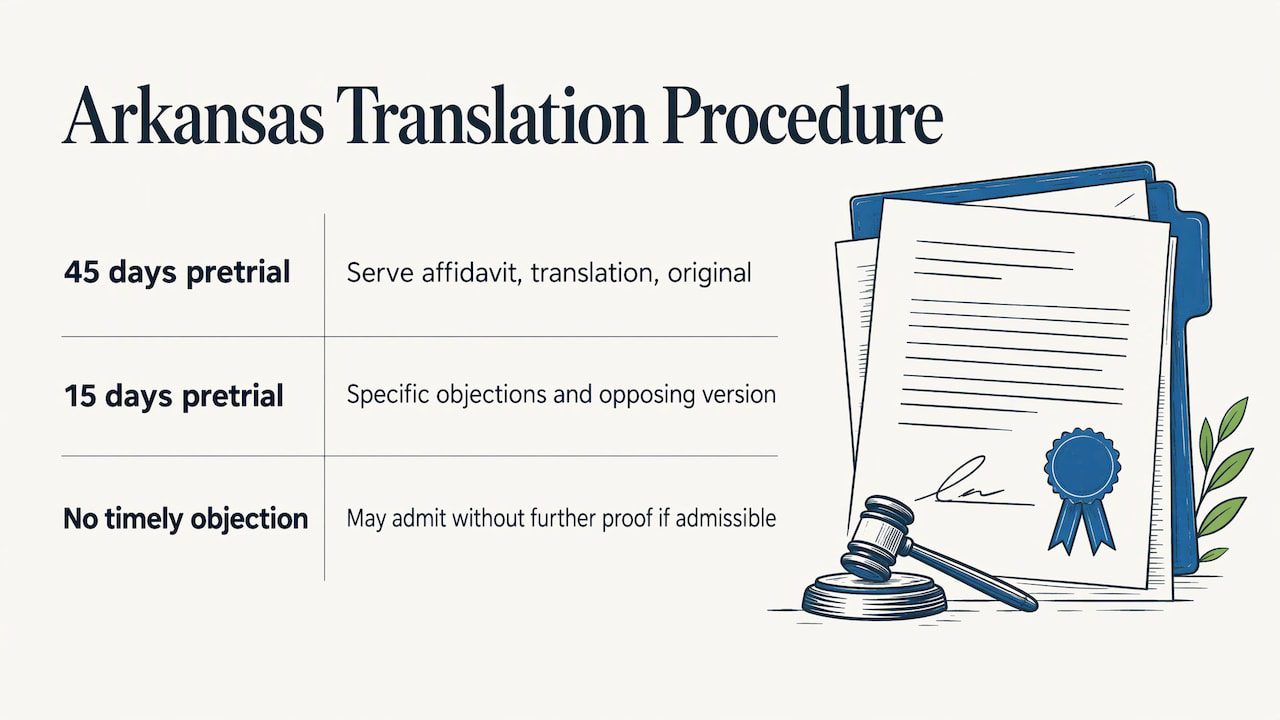
State rules follow a similar idea with more procedure. Arkansas Rule of Evidence 1009 requires an affidavit from a qualified translator stating the translator’s qualifications and certifying that the translation is fair, accurate and complete. The affidavit, the translation and the original foreign-language document must be served at least 45 days before trial. The opposing side can object, naming specific inaccuracies and offering its own version, at least 15 days before trial. Without a timely objection, the translation may be admitted without further proof, provided the underlying document is otherwise admissible.
Agency rules can be just as specific. Georgia’s regulations for documents filed in adjudications call for an authenticated English translation with a typed, signed translator affidavit that identifies the document and states competence and accuracy.
Authentication is less uniform than you might expect
The ABA also notes that proving a written translation is accurate is less standardized than qualifying an interpreter. A leading federal case required sworn testimony about the translator’s qualifications and the accuracy of the work, but parties often stipulate to accuracy instead. Both paths are common, so the safest approach is to have a certification and a translator who could testify if asked.
Who can certify a court translation
People often assume a “court-certified” or notarized translator is mandatory. In most US settings it is not. The American Translators Association says that a translator does not have to hold a translator credential to provide a certified translation. The translator, or an employee of a translation company, can certify it, provided the signer translated or fully reviewed the work.
The ATA recommends that the certification statement include:
- the translator’s qualifications;
- an affirmation that the translation is complete and accurate;
- identification of the translated document and its language;
- the translator’s name, signature and date.
That list maps neatly onto what the court rules above ask for. Some courts want more. Arkansas, for example, defines a “qualified translator” by reference to its Supreme Court interpreter-certification requirements and registry, and a court there may appoint a translator and tax the reasonable fees as costs. The ATA also advises asking about any special end-user requirements and adapting the statement to fit. Treat the receiving court’s rule as the controlling text.
When to add a notary
A notary does not verify that a translation is accurate. A notary confirms that the person signing is who they claim to be, and that the signature was made under oath where the rule requires an affidavit. If your court calls for a sworn or notarized translator’s statement, we offer notarization for a $25 fee on our services page.
Preparing the translated document for filing
Presentation matters. A clean, consistent package is easier for a clerk to accept and for a judge to read.
- Start with a legible source. A blurry scan produces gaps and guesses. Send the best copy you have, and keep the original available.
- Give instructions about purpose. The California Judicial Council’s model translation checklist advises using a professional translator, giving clear instructions about the document’s purpose and audience, and reviewing the result for grammatical, legal and substantive accuracy, including in its final format.
- Insist on independent review. The National Council of State Courts’ legal translation best practices recommend three layers: translation, editing, and independent review or proofreading.
- Attach the certification. For immigration court, the EOIR Policy Manual says to type and sign the certification, attach it to the foreign-language document, and include the translator’s competence and accuracy statements, address and telephone number. A certification covering several documents must identify each one.
- Mind the interpretation certificate. The same manual says an English affidavit or declaration signed by someone who is not fluent in English needs a certificate of interpretation confirming the person understood it and that it was accurately interpreted.
- Match the court’s formatting. Format rules can be exacting. Hong Kong’s Judiciary, for one, specifies double-line spacing, minimum font sizes of 13 for English and 14 for Chinese, 3 cm margins and matching placement of signatures and amendments, and it will not accept irregularly formatted documents. US courts have their own local rules, so read them before finalizing.
Translating court documents for use in another country
When the document will be used abroad, the foreign court’s rules govern, not ours. The first step is to ask that court, or local counsel, three things: which language the court requires, whether it demands a translation by a locally sworn or registered translator, and whether the original and translation must be bound or authenticated together.
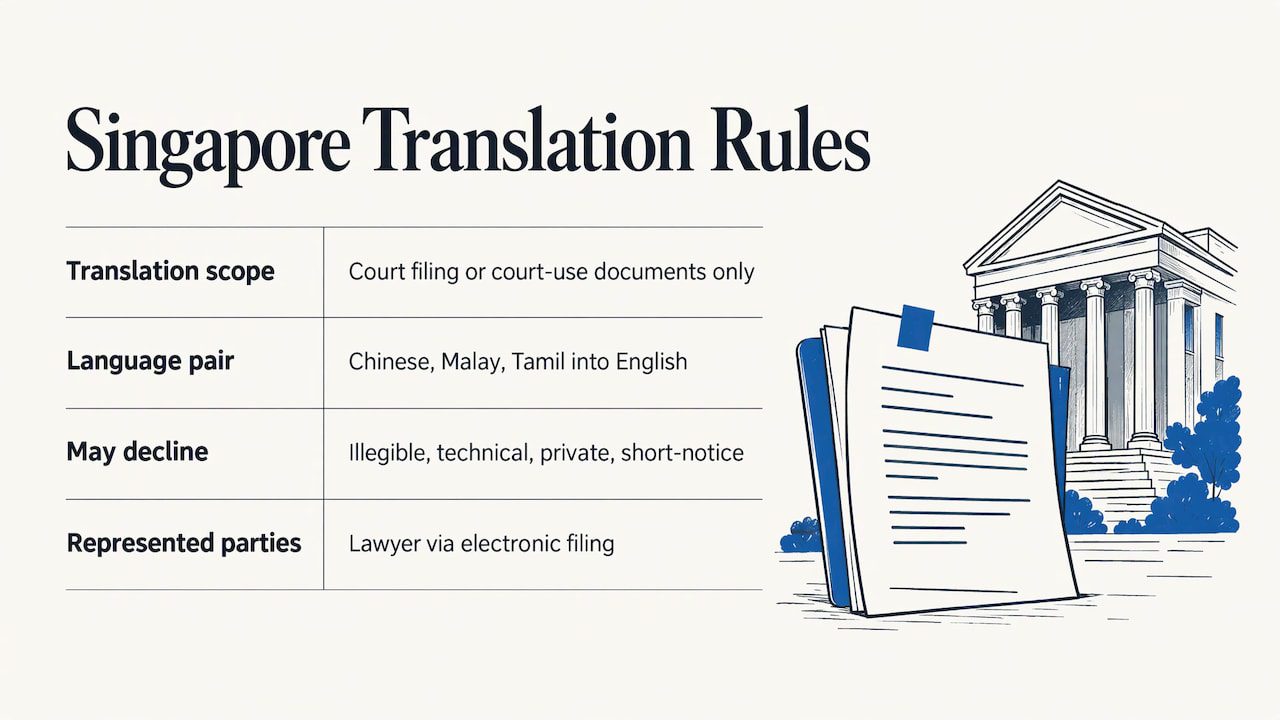
Some judiciaries translate for you and limit what they accept. The Singapore Judiciary provides translation only for documents to be filed or used in court, and only from Chinese, Malay and Tamil into English. It may decline illegible documents, documents with specialized technical terms, private-use requests and short-notice requests. Represented parties generally go through their lawyer by the electronic filing system. If your matter touches Singapore, our Singapore process server page explains how we handle service there.
For papers that have to be served abroad, the translation and the service channel are linked. The language of the translation, the way it is certified and the forms that accompany it all have to satisfy the receiving country. Our guides on certified translation for service of process and international service rules walk through that sequence. For a broader view of the translation side, see our legal document translation guide.
Country-specific questions come up constantly. Spanish is the language we see most often, and our Spanish legal translation guide covers it. If the defendant is in China, start with our guide to serving legal documents in China.
Cost and timing
Price and speed depend on length, language, subject matter and how readable the source is. Public benchmarks show the range of what courts and vendors allow for. Singapore’s judiciary asks for requests at least four weeks ahead, says completion takes at least four weeks or more depending on complexity and length, and charges $45 per translated page for its certified court-interpreter translations, with the total advised on completion. That is a government service with its own queue, not a general market rate.
Our own translation price is $0.29 per word. A 2,000-word contract comes to $580, and a 5,000-word agreement to $1,450. Counting words first, before you request quotes, is the fastest way to budget. Check what portion of your file is actually needed. Courts rarely need every page of a long exchange, and an attorney can often cut a bundle to the relevant exhibits before translation begins.
A few factors lengthen turnaround:
- handwritten or low-quality scans;
- dense technical or medical vocabulary;
- certification formalities such as notarization;
- an unusual language pair;
- a short filing window.
Order early. The Arkansas 45-day service window shows how much lead time a trial date can require, and many courts want translations well before a hearing.
How to choose a court translation provider
Look for a provider that can do the following:
- name the person who will sign the certification and describe that person’s qualifications;
- produce a certification that follows the receiving court’s wording, not just a generic template;
- run an independent review before delivery;
- keep the layout of the original so page references line up;
- deliver on a schedule tied to your filing date;
- cover the language you need.
If your translation sits inside an international case, a single provider that also handles service reduces handoffs. That is the reason we offer both.
Our perspective
In our work since 1978, translation is rarely the hard part of a case by itself. The hard part is the moment the translated paper has to be put in front of a defendant, or a foreign court, in a form that court will accept.
That is why we think of translation and service as one job. When the translator knows the papers will go through the Hague Convention, the wording and the certification can be prepared to fit that route from the start. We prepare the required Hague forms at no additional charge, and our translations cover 88 languages.
We also publish our prices because litigators budget for these costs early. A per-word translation rate, a flat notary fee and a stated starting price for international service let you see the cost before you commit.
Matthew
Translation and service from one provider
If you need court papers translated and delivered, we handle both. Our translation service is $0.29 per word, notarization is $25, and international service of process starts at $395. You can see the details on our translation and international service pricing page.
For service within the US, see our US process service options, and for the full list of fees, visit our services page. If the evidence you need is overseas, we also assist with taking evidence abroad.
FAQ
Does a court translation have to be done by a certified translator?
Not usually in the US. The American Translators Association says a translator need not hold a translator credential to provide a certified translation, and the signer may be the translator or an employee of a translation company who translated or fully reviewed the work. Some courts and states add their own qualification rules, so confirm with the receiving court.
Do I need to file the original document along with the translation?
Often the translation is attached to a copy of the foreign-language document. Immigration court rules call for the signed certification to be attached to the foreign-language document. Other courts have their own requirements, and some allow a certified copy to be filed without the original, so check the local rules.
Is a notarized translation the same as a certified translation?
No. A certification is the translator’s statement that the work is complete and accurate. Notarization confirms the identity of the person signing, and sometimes the oath. Use it only when the court or agency asks for a sworn or notarized statement.
Who pays for translating court documents?
The American Bar Association says the party who wants to use the foreign-language evidence should generally expect to cover the translation. Discovery rules may not require the producing party to translate documents it turns over.
How long does it take to translate court documents?
It depends on length, language, formatting and certification. Public court services can take weeks: Singapore’s judiciary asks for at least four weeks. A private provider can move faster, but give it the document count and your filing date at the start.
Sources
- Using Language Assistance Services during Legal Representation, American Bar Association
- Legal translators/interpreters, European e-Justice Portal
- Translations 101, American Bar Association
- 8 CFR § 1003.33, Translation of documents
- Arkansas Rule of Evidence 1009
- Georgia Rule 120-2-2-.08, Foreign-Language Documents
- What is a Certified Translation?, American Translators Association
- Model Translation Checklist, Judicial Council of California
- Proposed Legal Translation Best Practices
- EOIR Policy Manual, Documents
- Guidelines for Certification of Documents, Civil Cases, Hong Kong Judiciary
- Arrange for Translation of Court Documents, Singapore Judiciary
