

Out-of-State Process Servers: How to Serve Papers in Another State
If your case is filed in one state and the defendant lives or works in another, you usually don’t need a second lawsuit or a new court. You need a process server who is allowed to serve in the state where the defendant is, who follows the rules of your court, and who gives you a return of service your judge will accept. We at Process Service Network have served legal documents since 1978, and our US process service network covers jobs across the country, including the ones where the defendant is hard to find.
TL;DR
- Out-of-state service means delivering your summons and complaint to someone in a different state from the one where your case is pending. Your court’s rules decide what counts as valid service. The state where the defendant is located often adds its own requirements.
- Hiring one server who works in the defendant’s state is usually faster and cleaner than mailing papers to a sheriff there or trying to do it yourself.
- Most failures come from the wrong method, a wrong or stale address, a server who can’t prove the service, or a missed deadline. Fix those four and the rest is routine.
- If the defendant is dodging service or their address is unknown, you need an address search first and, if that fails, a court-approved alternative such as service by publication.
- If the defendant is outside the United States, a different set of rules applies, and the Hague Service Convention often comes into play.
Table of Contents
- What “out-of-state” service actually means
- Two sets of rules, and why both matter
- Who can serve the papers
- The methods you can use across state lines
- How to serve a defendant in another state, step by step
- When the defendant is hard to find or dodging service
- Proof of service: the part people underestimate
- What out-of-state service costs
- Serving a business in another state
- If the defendant turns out to be abroad
- How we handle out-of-state jobs
- Common mistakes that cost people weeks
- FAQ
- Sources
What “out-of-state” service actually means
Every civil case starts with notice. The defendant has to receive the summons and the complaint in a way the court accepts, or any judgment you win can be attacked later. When the defendant is in the same state as the court, that is mostly a local matter. When they are in another state, two questions come up at once:
- Does the court where you filed have power over this defendant? That is a question of jurisdiction, and it is separate from how you deliver the papers. A court generally needs some connection between the defendant and the state, such as living there, doing business there, or causing the dispute there.
- If it does, how may you deliver the papers across the state line?
This article deals with the second question. Your attorney, or you if you are representing yourself, has to settle the first one before spending money on service.
One point trips up many people: “out-of-state” does not mean “international.” Serving a defendant in Texas for a case filed in California is a domestic job. Serving one in Mexico or France brings in treaties and foreign law. If you are not sure which situation you are in, check the defendant’s address first. If it is outside the United States, start with our guide to international service rules.
Two sets of rules, and why both matter
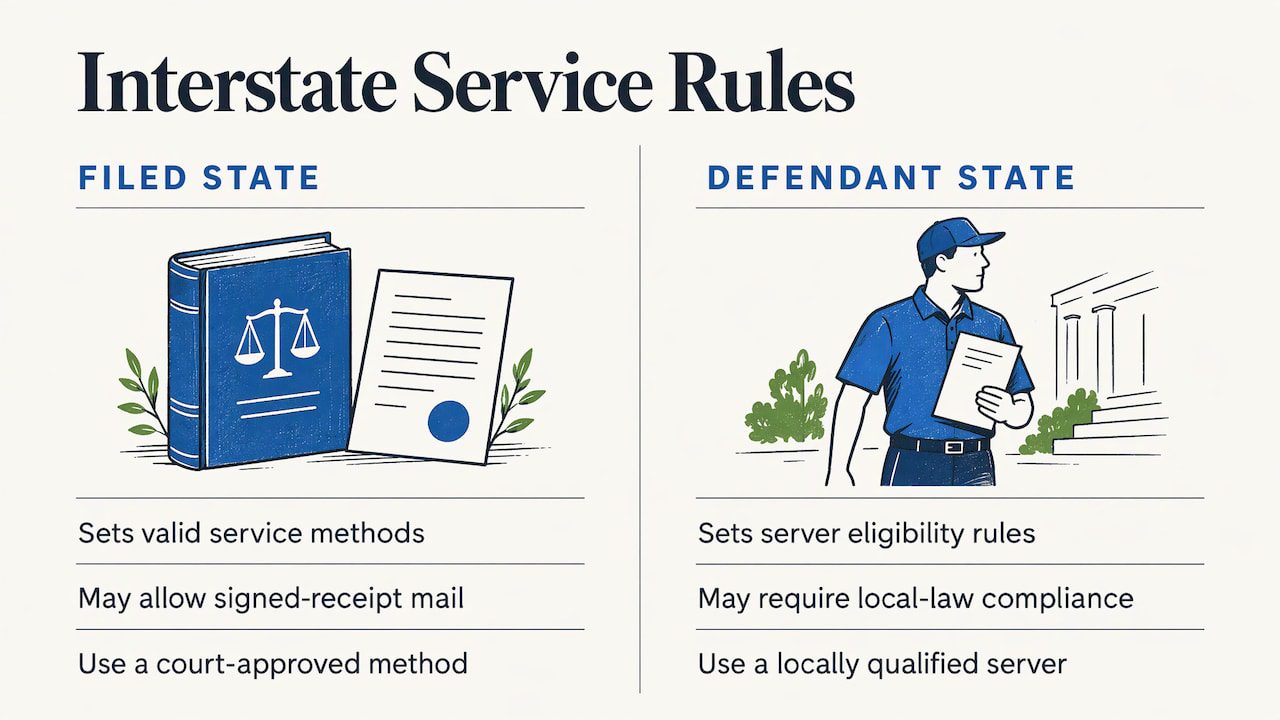
The most useful way to think about interstate service is that two states are involved.
The state where your case is pending. Its civil procedure rules say what methods are valid for a defendant outside the state. Many states say that service outside the state can be made the same way as service inside the state. Some also allow certified or registered mail with a signed receipt, and some allow a court order for another method.
The state where the defendant is. This state usually doesn’t care about your case, but it can care about who is handing papers to its residents. Some states license or register process servers. Others let almost any adult who is not a party to the case do it. A few expect the server to follow local law on top of the rules of your court.
In practice, the safe approach is to pick a method that satisfies your court and then use a server who is qualified where the defendant lives. That way you don’t have to guess whether a method valid in one place will survive a challenge in the other.
The details differ by state, so your first stop should be the civil procedure rules or statute of the state where you filed. Look for the sections on service outside the state. Your court’s clerk’s office or self-help center can point you to them. If you have a lawyer, ask them to confirm the method before the papers go out.
Who can serve the papers
In most places, the server has to be an adult who is not a party to the case. Beyond that, the rules vary.
- Some states require a registered or licensed process server, often with a bond or insurance requirement.
- Some states let a sheriff or constable do it for a fee, and for out-of-state papers a sheriff’s office may take longer because civil papers sit behind other duties.
- Some states allow any non-party adult, including a friend or co-worker.
You, as the plaintiff, can’t serve your own papers in nearly every court. That is true even if the defendant lives one street over from you.
There is a practical reason to use a professional server in the defendant’s state even where the rules would let you use a friend. A professional knows how to reach someone who isn’t answering the door, writes the details of each attempt in a way a judge will read as credible, and can testify about what happened if the defendant disputes service. A friend who dropped papers on a porch has none of that.
Our approach is to run out-of-state jobs through a network of professional process servers, so one order reaches a local server in the defendant’s area. You don’t have to search for a server in each state and vet them yourself. For papers going to an individual, our page on serving court papers on a person walks through what valid delivery looks like.
The methods you can use across state lines
Which methods are available depends on your court’s rules. These are the ones that come up most.
Personal delivery
A server hands the documents to the defendant. This is the strongest form of service because it is the hardest to dispute. If you have a good address and a defendant who isn’t hiding, this is the method to aim for.
Substituted service
If the defendant can’t be found at home or at work, many states allow the server to leave the papers with a competent adult at the home or with a person in charge at the workplace, and in many places also mail a copy. The rules about who counts as an acceptable recipient, how many attempts must come first, and what must be mailed vary a lot. This is the method most often challenged, so the server’s notes on each attempt matter.
Mail with acknowledgment
Some states allow you to mail the summons and complaint with a form the defendant signs and returns. It is cheap, but it depends on the defendant cooperating. If the form never comes back, you generally have to start over with personal service, and by then you have lost weeks. For a defendant you expect to dodge, skip it. If you do use it, keep a close eye on the clock.
Certified or registered mail
A few courts accept certified mail with a signed return receipt for out-of-state defendants. A signature from someone other than the defendant, or a receipt that never comes back, can leave you without valid service.
Court-ordered alternative service
If the usual methods have failed or can’t work, you can ask the judge to approve something else, such as posting, email, or publication in a newspaper or an approved legal notice site. You have to show the court what you tried first, which is why a documented, diligent search matters.
How to serve a defendant in another state, step by step
1. Check the court rules before you do anything
Find the section of your court’s rules or statutes on service outside the state. Note which methods are listed, whether a court order is needed, and what the deadline is for completing service after filing. Missing that deadline can get your case dismissed or force you to refile.
Where it goes wrong: people read the rules for the state where the defendant lives and ignore their own court’s rules. The case is in your court, so its rules control first.
2. Confirm the defendant’s address and who they are
You need a full legal name, a current home or work address, and ideally a description or photo so the server serves the right person. For a business, you need the exact legal entity name and its agent for service of process.
Where it goes wrong: a stale address is the most common reason attempts fail. If you aren’t sure, get the address verified before you pay for service attempts. We offer skip tracing and diligence searches for this.
3. Prepare the documents correctly
A server needs the summons, the complaint, any court-required notices or attachments, and enough copies. Check that the summons is signed and sealed by the clerk where your rules require it, and that the case number and party names match across every page.
Where it goes wrong: a missing attachment or an expired summons turns a successful delivery into a defective one.
4. Choose a server who works where the defendant is
Pick someone who regularly serves in that county or city and who meets that state’s requirements. Ask whether they can handle repeat attempts at different times of day, including evenings and weekends.
Where it goes wrong: sending papers to a distant sheriff’s office, then waiting weeks with little visibility into what’s happening.
5. Set the priority and the deadline
If your deadline is tight, say so at the time of the order. Rush service exists for this reason. Ask for status updates after the first attempt.
6. Get the proof of service back and review it
The server completes a return or affidavit of service that says who was served, when, where, and how. Read it as the judge would. Does it match the rules for the method you used? Is the date inside your deadline? Is the description of the recipient plausible?
7. File the proof with the court
Service doesn’t count in the case until the proof is filed. Some courts also require the proof to be notarized or to meet particular form requirements. A notary fee is a normal part of that, and we list ours at $25.
When the defendant is hard to find or dodging service
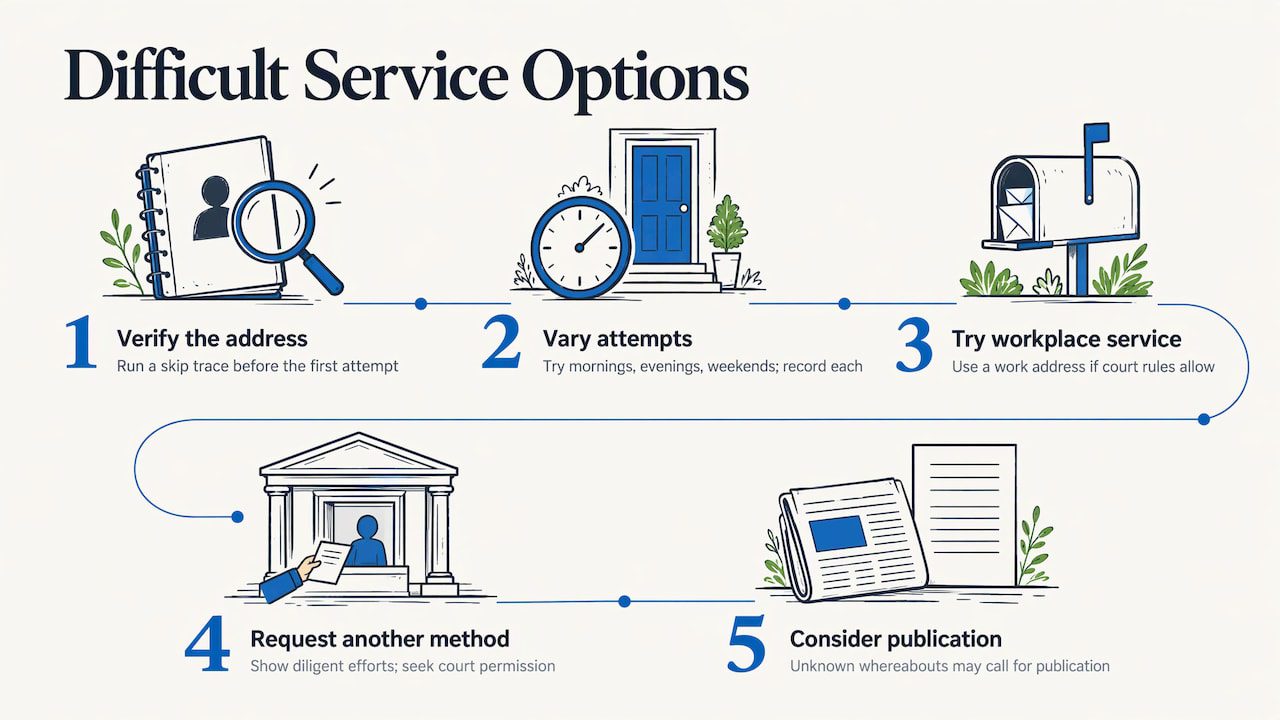
A defendant who moved, uses a post office box, or sees a server coming and doesn’t answer is the most expensive problem in interstate service, mainly because each failed attempt costs time and money. Here is a sensible order of work.
Verify the address first. A skip trace looks for current addresses, employers and other locations tied to a person. Doing this before the first attempt is cheaper than paying for three failed attempts at an old address.
Vary the attempts. A server who tries once on a weekday afternoon will probably miss a person who works days. Good attempts cover early mornings, evenings and weekends, and the notes record each one.
Consider workplace service. If the home address isn’t working, a work address may be the better route, as long as your court’s rules allow it.
Go to the court for another method. Once you can show diligent efforts, you can ask for permission to serve in a different way. If the defendant’s whereabouts are unknown, service by publication is often the path. Courts generally expect you to describe the searches you did, so keep every record.
We handle service by publication through our affiliate, Global Legal Notices, LLC, which runs an online legal notice publication system built to provide actual notice to defendants whose whereabouts are unknown. You can see how it works on our service by publication page and in our piece on why traditional publication has become obsolete.
Proof of service: the part people underestimate
Winning the delivery is only half the job. The court needs a sworn statement that the delivery happened. Rules differ on the form, but the contents are fairly consistent:
- the name of the person who served and that they are an adult and not a party
- the date, time and address of service
- the method used and who received the papers
- a description of the person served, where used
- the server’s signature, often under oath or in front of a notary
Some states ask a server who serves outside their home state to add details about their authority to serve where they did. If your server is not from the state where your case is pending, ask your court clerk whether any special affidavit language is expected.
If the defendant later says they were never served, the proof of service is the document the judge looks at first. Detailed, specific and consistent proof usually wins. Vague proof invites a motion to set aside a default judgment, which means doing the work over.
What out-of-state service costs
Prices vary by region, by how far a server has to travel, by how many attempts are needed, and by how fast you need it. Sheriff’s offices that handle out-of-state papers publish their own fee schedules, and they differ from county to county. Check the office’s current fee page before you send anything.
Here are our published prices, so you can see what a transparent quote looks like:
| Service | Price |
|---|---|
| Service of process, Los Angeles area | $95 |
| Service of process, California | $135 |
| Rush service | from $95 |
| International service of process | from $395 |
| Notary fee | $25 |
| Translations | $0.29 per word |
Nationwide service, service by publication and copy fees don’t have a single published price, so we quote those for your specific case. The thing to look for in any quote is whether it covers repeat attempts, the proof of service and notarization, or whether those show up later as extras. We state our pricing upfront and don’t charge hidden fees.
Serving a business in another state
Businesses add a wrinkle: you serve the entity through a person or agent the rules recognize, not just anyone at the front desk. Usually that is a registered agent, an officer, or a managing agent. A corporation that has a registered agent in the state may have to be served through that agent, and serving someone else at the office can fail.
Before sending the server out, confirm the exact legal name and the registered agent through the state’s business records. Our page on serving papers on a business covers who counts as a proper recipient.
If the defendant turns out to be abroad
Sometimes an address search turns up a defendant who has moved overseas, or a business with its only office outside the US. At that point you leave domestic out-of-state service behind. The method depends on whether the country has joined the Hague Service Convention, what the country allows, and whether your court has approved the method. Translations are often required, and timelines are longer than domestic service.
We serve in every country and prepare the required Hague forms at no additional charge. Our Hague Service Convention guide explains the treaty in plain terms, and our overview of serving legal documents abroad covers the options. If the country uses letters rogatory, see our letters rogatory guide. Documents that need translating are handled in 88 languages, and our court document translation page explains what courts expect.
How we handle out-of-state jobs
If you have a summons to get to another state, you can place one order with us instead of finding, vetting and managing a server in each location. We send the job to a professional process server in the defendant’s area, and you get fast service with the price stated before work starts. For defendants who are hard to reach, skip tracing and diligence searches are available, and service by publication is there if the court approves it.
You can see the full list of services and published prices on our services page, or send us the documents and the defendant’s last known address and we’ll quote the job.
Common mistakes that cost people weeks
- Starting service before checking the deadline. Courts set a time limit to complete service after filing. Count backward from it.
- Using the defendant’s state rules only. Your own court’s rules come first.
- Mailing papers and hoping. Mail methods need a signed response, and defendants who don’t want to be served don’t sign.
- Skipping the address check. A skip trace is cheaper than repeat failed attempts.
- Accepting thin proof of service. If it lacks times, dates or details, ask for a corrected version before you file it.
- Waiting too long to ask for a different method. If three or four good-faith attempts have failed, bring your record to the court rather than letting the deadline run out.
FAQ
Can I use any process server for out-of-state service?
Not always. Some states license or register their servers, and your own court may have requirements about who can serve. The safest choice is a professional who works in the defendant’s area and understands the rules of your court. That also gives you a server who can testify about the service if the defendant challenges it.
How long does out-of-state service take?
It depends on how easy the defendant is to find. A defendant with a verified address who is home can be served within days, especially with rush service. A defendant who avoids service or has moved can take weeks, and a court-approved alternative adds more time. Start early and keep your court’s service deadline in front of you.
What if the defendant refuses to take the papers?
In many places a server can still complete personal service by leaving the papers near the person after identifying them and telling them what the papers are. The exact rule depends on your court. Have the server record exactly what was said and done, since that is what the judge will rely on.
Do I need a new process server if my first one is in another state?
Usually you need one who can serve where the defendant is. A server in your home state may not be authorized there, or may not be practical to send. Using a network that reaches the defendant’s area avoids the problem.
What if I don’t know where the defendant is?
Start with a skip trace and document every search. If you can’t find an address after diligent efforts, ask the court for permission to use another method, often service by publication. We provide skip tracing and online legal notice publication through our affiliate, Global Legal Notices, LLC.
Sources
This article is based on general civil procedure practice. For the exact rule in your case, read your court’s rules on service outside the state. The Process Service Network pages referenced above:
- US process service anywhere
- Services and published prices
- Service by publication
- Serving court papers on a person
- Serving papers on a business
- Hague Service Convention explained
