
Process Service in Mexico: The 2026 Expert Guide to Legal Delivery
In Mexico, hiring a private process server isn’t just a mistake; it’s a procedural disaster that will get your case dismissed! While you’re likely used to the speed of private servers in the U.S., Mexican law strictly dictates that only authorized judicial officials can deliver legal papers. We understand the frustration of waiting months for the Mexican Central Authority only to face rejection over a minor translation error. You need a process that stands up in court, not a motion to quash that ends your litigation before it starts.
This 2026 guide empowers you to master the complex requirements of process service in Mexico with absolute precision. You’ll learn how to navigate the Hague Service Convention and the Ministry of Foreign Affairs to ensure your legal delivery yields court-admissible proof. We’ll break down the mandatory Spanish translation standards and provide a roadmap for predictable timelines. From preparing Hague forms correctly the first time to understanding the upcoming shifts in the National Code, we’re giving you the veteran strategy to secure successful service every time!
Key Takeaways
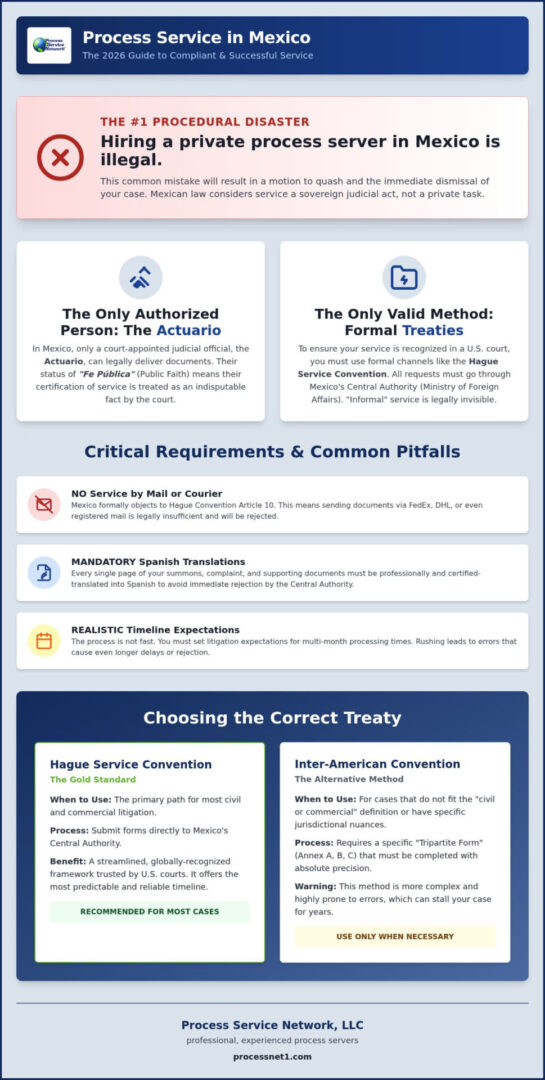
- Private process servers are strictly prohibited in Mexico because service is considered a sovereign judicial act. Only a court-appointed official can legally deliver your documents!
- You must use formal treaties like the Hague Convention to ensure your process service in Mexico stands up in a U.S. court.
- Avoid a rejection loop by providing certified Spanish translations for every page of your summons and complaint.
- Set realistic litigation expectations by accounting for the multi-month processing times typical of the Mexican Central Authority.
- Master Hague form preparation to eliminate technical errors that cause documents to be ignored or returned without service.
Understanding the Legal Landscape: Why Private Process Servers are Prohibited in Mexico
Mexico treats legal delivery as an exercise of state sovereignty. It’s not a private contract. If you hire a private “agent” to drop papers at a doorstep, you aren’t just wasting money; you’re handing the defense a winning motion to quash! For process service in Mexico to hold weight in a U.S. court, it must follow the formal channels dictated by Mexican law. Any attempt at “informal” service is legally invisible to the Mexican government and provides zero protection for your case.
The Role of the Actuario in Mexican Service
In the United States, almost any disinterested adult can serve a summons. In Mexico, that power is consolidated into a single judicial officer: the Actuario. These officials are court employees with a unique legal status known as “Fe Pública,” or public faith. This status means their certification of service is treated as an absolute, indisputable fact by the court. Only an Actuario has the legal standing to complete a delivery that survives judicial scrutiny.
When an Actuario performs the service, they act as the official voice of the Mexican judiciary. This is the only way to generate a return of service that a U.S. judge will recognize as valid under international law. If you don’t have an Actuario’s signature on your proof of service, your case lacks the fundamental “formal” requirements needed for cross-border enforcement. Don’t settle for anything less than a judicial official’s stamp of approval.
Mexico’s Objections to the Hague Convention Article 10
The Hague Service Convention provides several methods for delivering documents, but member nations can choose to opt out of specific provisions. Mexico has filed a formal objection to Article 10. This article usually allows for “service by postal channels” or the use of “judicial officers, officials or other competent persons” to deliver documents directly. Mexico explicitly rejects these shortcuts.
Because of this objection, sending your summons via FedEx, DHL, or certified mail is legally insufficient. You cannot bypass the government to reach the defendant directly. Mexico insists that all incoming requests must pass through their Ministry of Foreign Affairs to ensure they meet local constitutional standards. Mexico’s specific objections to Article 10 are the primary reason why so many international service attempts are dismissed by judges for improper procedure. Stick to the formal route to keep your litigation on track!
Hague Convention vs. Inter-American Convention: Choosing Your Method
Don’t get stuck in a procedural loop. Choosing the wrong treaty can stall your case for years! In 2026, the Hague Convention remains the gold standard for process service in Mexico, but it’s not the only tool in the box. You must identify which treaty applies to your specific case type to ensure your documents actually reach the defendant’s hands and provide a valid return of service for your U.S. court.
When to Use the Hague Convention
For the vast majority of civil and commercial litigation, the Hague Service Convention is your primary path. It’s a streamlined, treaty-based system that requires the Mexican government to acknowledge and process your request. When you utilize Hague Convention process service, you’re tapping into a globally recognized framework that U.S. judges trust implicitly. This method provides a level of reliability that “informal” methods simply cannot match.
The process involves submitting your request directly to the Secretaría de Relaciones Exteriores, which acts as Mexico’s Central Authority. This practical guide to serving papers in Mexico highlights the rigorous documentation standards required. If your case involves a known address and falls under civil or commercial law, the Hague route is faster and more predictable than any alternative. It’s the most direct way to get an Actuario to the defendant’s door.
The Inter-American Convention Alternative
Sometimes the Hague Convention isn’t an option. If your case doesn’t fit the “civil or commercial” definition or involves specific jurisdictional nuances, you might need the Inter-American Convention on Letters Rogatory. This treaty uses a specific “Tripartite Form” (Annex A, B, and C) that must be completed with absolute precision. Any error in these forms will result in an immediate rejection by the Central Authority, sending you back to square one.
While the Inter-American Convention is a valid legal channel, it’s notoriously slower than the Hague route. It often requires more administrative “hands” to touch the paperwork, which increases the risk of delays in the Mexican court system. However, it remains a vital fallback for matters that fall outside the scope of the Hague Convention. Comparing the two, the Hague Convention is the clear winner for speed, but the Inter-American Convention is your necessary backup for complex jurisdictional gaps. Navigating these treaties requires a veteran eye to avoid common pitfalls; securing expert Hague form preparation ensures your paperwork meets every treaty-specific requirement from day one.
Mandatory Translation and Documentation Standards for Mexico
Precision is your only defense against the “rejection loop.” If you submit a single page without a proper Spanish translation, the Mexican Central Authority will return your entire package without a second thought. This isn’t just about the summons and complaint. Every exhibit, attachment, and even the certificate of service must be translated. For process service in Mexico to be effective, your documentation must be linguistically flawless and legally compliant from the very first page.
Using machine translation tools like Google Translate is a recipe for disaster. Legal terminology is nuanced; a literal translation of a U.S. legal concept often makes no sense in a Mexican courtroom. The Central Authority in 2026 has zero patience for “informal” or uncertified documents. They expect a package that looks and reads like a professional judicial request. Utilizing legal document translation for service is the only way to ensure your paperwork survives the initial screening process.
Certified Translation Requirements
The Mexican judiciary requires more than just a bilingual speaker. Your translator must provide a formal certificate of accuracy that vouches for the integrity of the document. Local Mexican courts are notorious for rejecting translations that aren’t “legal-grade” or fail to capture the specific procedural language required by the Actuario. In cross-border litigation, court-admissible translation is defined by its ability to convey the exact legal intent of the original text without ambiguity or error. Don’t risk your case on a subpar translation that a local judge can easily pick apart.
Hague Form Preparation for Mexico
The USM-94 form is the heart of your service package. It’s the primary document that the Mexican Central Authority reviews before assigning your case to a local court. Even minor errors on this form can lead to months of wasted time. We frequently see law firms make simple mistakes, such as using outdated addresses for the Secretaría de Relaciones Exteriores or forgetting mandatory signatures. These “small” oversights are the leading cause of delays in process service in Mexico.
Expert preparation is always faster than trial and error. When you have a seasoned veteran handling your Hague form preparation, you eliminate the technical variables that cause documents to be ignored. You need a package that is ready for immediate judicial action. Ensure your USM-94 is perfect, your translations are certified, and your signatures are in place before you ship your documents south of the border.
Managing the Timeline: Why Service in Mexico Takes Months
Patience is a requirement, not a suggestion. If you’re expecting a two-week turnaround, you’re in for a rude awakening. In 2026, the timeline for process service in Mexico remains one of the longest in the international legal community. You’re dealing with a multi-layered bureaucracy that starts at the federal level and ends at a local court’s desk. Expecting anything less than six to twelve months is unrealistic. You must manage your client’s expectations from day one to avoid unnecessary friction during the wait.
Once your documents enter the system, they effectively disappear into a “Black Hole.” The Mexican Central Authority does not provide step-by-step tracking. You won’t get an email when the papers move from the federal office to the local jurisdiction. The only update you’ll receive is the final certificate of service or a notification of failure. This lack of transparency is exactly why you need a veteran partner who knows the system is moving even when the screen stays blank. We don’t just wait; we ensure every procedural box was checked before the documents left our hands.
Factors That Delay Service
Geography plays a massive role in your timeline. Serving a defendant in a major metropolitan hub is significantly faster than reaching someone in a remote rural area. Local court transit times vary wildly. Additionally, the Mexican legal system observes specific “vocation” periods. These are extended court holidays where judicial activity stops completely. If your documents arrive right before a vocation period, add another three to four weeks to your estimate. Bureaucratic hurdles at the Secretaría de Relaciones Exteriores are the final bottleneck. Their backlog is consistent and unforgiving.
Speeding Up the Process with Elite Diligence
The fastest way to fail is to provide a bad address. If the Actuario makes the trip and finds an empty lot, you’ve just wasted six months. A diligence search for legal proceedings is the only way to ensure the clock starts on a valid location. We use advanced skip tracing to find evasive defendants who think they can hide behind international borders. By confirming the address upfront, you eliminate the most common cause of non-service.
Our international process service experts understand that time is your most valuable asset. We manage the start-to-finish timeline by ensuring your package is bulletproof before it ever hits a Mexican desk. Don’t let your case stall due to a preventable error. If you’re ready to initiate service with a team that delivers results, contact Process Service Network today to get your documents moving immediately.
Seamless Legal Delivery in Mexico with Process Service Network, LLC
Law firms across the country don’t just need a vendor; they need a veteran partner who understands that process service in Mexico is a high-stakes judicial maneuver. We’ve seen it all. From documents disappearing into the “Black Hole” of the Central Authority to the technical nuances of the Inter-American Convention, we know exactly where the pitfalls lie. Our team provides a comprehensive, no-nonsense infrastructure designed to ensure your service is court-admissible and beyond reproach. While dealing with international treaties and foreign judicial officers, there’s no room for trial and error.
We specialize in the difficult cases. If a defendant is evasive or the location is challenging, we don’t back down. While other servers might refuse to touch complex international matters, we thrive on them. Our seasoned experts navigate the Secretaría de Relaciones Exteriores with the confidence that only comes from decades of successful deliveries. We handle the paperwork, the certified translations, and the local coordination so you can focus on winning your case. We’ve built the infrastructure to handle the high-stakes tasks that keep attorneys up at night.
The Process Service Network, LLC Advantage
Founded in 1978, Process Service Network, LLC brings over 45 years of global legal delivery experience to your litigation team. We’ve navigated every possible complication and possess the infrastructure to handle even the most difficult cases with ease. We’re not just a middleman. We provide a full suite of litigation support, including certified legal document translation and elite diligence searches to find defendants who think they are out of reach. Our commitment to absolute transparency means you’ll always know exactly where your case stands. We pair professional assertiveness with a “can-do” attitude to solve problems that would deter less experienced firms. We’re the definitive choice for those who refuse to settle for procedural uncertainty in their process service in Mexico.
Initiate Your Service in Mexico Today
Don’t let the clock run out on your litigation. Because the Mexican judicial system operates on its own timeline, every day you wait is a day your case remains stalled. To get started, simply submit your summons, complaint, and any exhibits to our team for a comprehensive review. Our experts will examine every page to ensure your package meets the strict 2026 standards of the Mexican Central Authority. We’ll verify your documentation, confirm your Hague forms are perfect, and initiate the formal process immediately. Our energy and unwavering confidence are backed by a track record of absolute reliability. Initiate your process service in Mexico with the experts at Process Service Network, LLC.
Secure Your Litigation with Precision Service
Successful litigation in Mexico requires strict adherence to sovereign judicial protocols. You’ve seen why private servers are a procedural liability and how the Hague Convention serves as your primary legal shield. Remember that certified translations and flawless Hague form preparation are the only ways to bypass the Central Authority’s “rejection loop.” Missing a single signature or using an uncertified translator can set your timeline back by six months or more!
Process Service Network, LLC has been the authoritative voice in international delivery since 1978. We are specialists in Hague Convention Article 5 compliance and provide certified legal translations recognized by foreign authorities worldwide. Don’t let your case stall in the Mexican bureaucracy or face a motion to quash. Our seasoned experts possess the infrastructure to handle your most complex, high-stakes assignments with absolute transparency and a no-nonsense attitude. We’ve navigated these waters for decades and know how to get results for process service in Mexico.
Get Expert Process Service in Mexico Now
Your case deserves the reliability of a veteran partner who handles the paperwork so you don’t have to. Let’s get your documents served with absolute precision today!
Frequently Asked Questions
Can I serve a defendant in Mexico by certified mail or FedEx?
No, you cannot use mail or private couriers. Mexico filed a formal objection to Article 10 of the Hague Convention, which prohibits service by postal channels. Any attempt to use FedEx or DHL will result in your case being dismissed for improper service. You must follow the formal judicial route to ensure your delivery is recognized by both Mexican and U.S. courts. Stick to the official channels to protect your litigation.
How long does it typically take to serve legal papers in Mexico via the Hague Convention?
Expect a timeline of six to twelve months for completion. This duration accounts for the initial processing at the Ministry of Foreign Affairs and the subsequent transit to local courts. Bureaucratic backlogs and judicial vocation periods often extend these estimates beyond what many attorneys expect. We recommend initiating process service in Mexico as early as possible to account for these unavoidable administrative delays and ensure your litigation remains on its intended schedule.
Is a Spanish translation required for all legal documents served in Mexico?
Absolutely. Every single page of your legal package, including exhibits and the summons, must have a certified Spanish translation. Mexico strictly enforces Article 5 of the Hague Convention regarding language requirements. If you submit untranslated documents, the Central Authority will reject the entire package immediately. Don’t risk a rejection loop by cutting corners on translation; professional, legal-grade Spanish versions are mandatory for successful service results.
What happens if I use an informal process server in Mexico?
Your service will be declared void and legally non-existent. Mexico does not recognize private individuals as authorized to deliver legal papers. Because service is considered a sovereign judicial act, it must be performed by a court-appointed official known as an Actuario. Using an informal server is a fast way to hand the defense a winning motion to quash. Protect your case by using only the verified, formal treaty methods we provide.
Who is the Central Authority for Hague service requests in Mexico?
The designated Central Authority is the Ministry of Foreign Affairs, known locally as the Secretaría de Relaciones Exteriores (SRE). They are the exclusive gatekeepers for all incoming international service requests. The SRE reviews your documentation for treaty compliance before forwarding it to the appropriate local court for execution. Navigating this federal entity requires precise paperwork and a deep understanding of their current administrative standards and specific formatting preferences for 2026.
Can I serve a subpoena in Mexico under the Hague Service Convention?
The Hague Service Convention is primarily for the delivery of summons and complaints in civil or commercial matters. If you need to compel testimony or produce documents, you typically must use the Hague Evidence Convention instead. Serving a subpoena for evidence involves a different set of forms and judicial requirements than standard process service in Mexico. Always verify the specific nature of your legal request to choose the correct international treaty for your case.
What if I do not know the exact address of the defendant in Mexico?
You must perform a diligence search before submitting your request. The Mexican Central Authority won’t conduct skip tracing or investigate a defendant’s whereabouts on your behalf. If you provide an incorrect or vague address, your documents will eventually be returned as unserved after months of waiting. We utilize elite diligence searches to find evasive defendants and confirm their current location before the formal service process even begins. Don’t guess on the address.
Are there any alternatives to the Hague Convention for service in Mexico?
The primary alternative is the Inter-American Convention on Letters Rogatory. While the Hague Convention is the preferred method for most civil cases, the Inter-American Convention is a vital secondary treaty for matters involving specific signatories in the Americas. It requires a specialized Tripartite Form and can be even more time-consuming than the Hague route. We help you determine which treaty provides the most reliable and legally sound path for your specific jurisdictional needs.
