

Hague Convention Article 5 Service: Mastering International Legal Delivery
Your entire international litigation strategy is only as strong as your proof of service! You’ve likely spent months building a complex case, only to feel the crushing weight of uncertainty when it’s time to send documents across borders. You’re right to be concerned about the extreme delays from foreign Central Authorities and the confusing translation requirements that change from one country to the next. A single procedural slip-up can lead to a devastating case dismissal. We understand that “good enough” doesn’t cut it when your professional reputation and your client’s success are on the line!
This guide empowers you to master the Hague Convention Article 5 service with absolute confidence. You’ll learn how to navigate the technicalities of international legal delivery to ensure every document is served with precision and backed by a valid Certificate of Service. We’re stripping away the guesswork and replacing it with a proven methodology for total treaty compliance. We’ll explore the specific requirements of major nations, the critical role of expert translation, and the exact steps required to secure a result that stands up in any court. Let’s turn a complex hurdle into your strategic advantage!
Key Takeaways
- Understand the mandatory role of the Central Authority and why Article 5 is the foundation for legally binding international delivery.
- Distinguish between standard local protocols and “particular methods” of service to ensure your documents meet specific court requirements.
- Master the translation and documentation standards that prevent your Hague Convention Article 5 service from being rejected for minor clerical errors.
- Recognize the critical jurisdictions where Article 5 is the only valid path to successful service due to specific treaty objections.
- Learn how to navigate the unwritten rules of foreign states to slash processing times and secure a valid Certificate of Service with total confidence!
Understanding Hague Convention Article 5 Service: The Central Authority Mandate
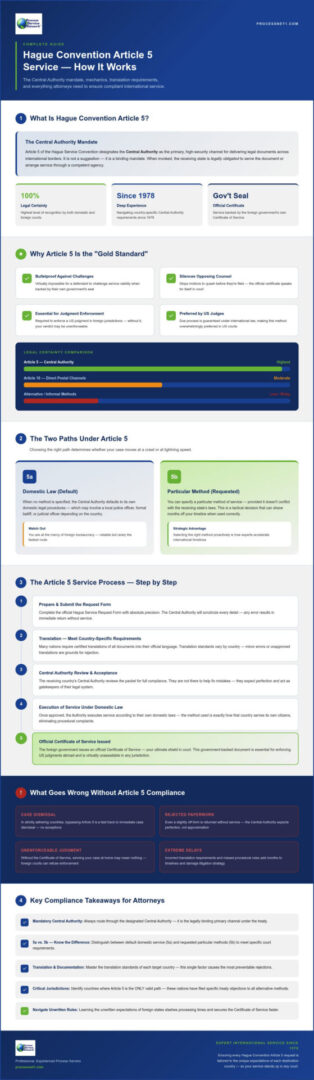
Don’t let your international litigation stall before it even starts. Article 5 of the Hague Service Convention establishes the Central Authority as the primary, high-security channel for delivering legal documents across borders. It isn’t just a suggestion; it’s a mandate. When you utilize a Hague Convention Article 5 service, the receiving state is legally bound to either serve the document themselves or arrange for its service through a competent agency. For US plaintiffs, this method offers the absolute highest level of legal certainty. This protocol ensures that the due process rights of the defendant are respected under international law, which is why US judges overwhelmingly prefer this route. In countries that strictly adhere to this protocol, bypassing Article 5 is a fast track to an immediate case dismissal. You need a Hague Service Convention overview to understand that while other methods exist, this is the only path that guarantees your service will be recognized by both domestic and foreign courts.
The Role of the Central Authority
Every nation that signs the treaty must designate a specific Central Authority to handle incoming requests. Think of them as the gatekeepers of their country’s legal system. Their first job is to scrutinize your Hague service request form for total compliance. If your paperwork is even slightly off, they’ll send it back without hesitation. The process is methodical and requires a “no-nonsense” approach to documentation. These authorities aren’t there to help you fix your mistakes; they expect perfection. Our team has been navigating these specific requirements since 1978, ensuring that every request we submit is tailored to the unique expectations of the destination country. Once approved, the Authority executes service according to their own domestic laws. This ensures the delivery is performed exactly how that country expects its own citizens to be served, leaving no room for procedural complaints later.
Why Article 5 is the “Gold Standard”
Service via Article 5 results in an official Certificate of Service issued directly by the foreign government. This document is the ultimate shield against “bad service” claims. It’s virtually impossible for a defendant to challenge the validity of service when it’s backed by their own government’s seal. This level of certainty is non-negotiable in high-stakes litigation. While alternative methods might seem faster on the surface, they often lack the sovereign backing that Article 5 provides. When you have an official government certificate in your hand, you possess a bulletproof record of compliance. This doesn’t just satisfy the judge in your home court; it silences the opposition’s legal team before they can even file a motion to quash. Beyond the initial case, this certificate is essential if you ever need to enforce a US judgment in that foreign jurisdiction. Without it, your victory might be nothing more than a piece of paper that no foreign court will respect. We eliminate the guesswork so you can focus on winning your case!
The Mechanics of Service: Local Protocols and Particular Methods
Success in international litigation often hinges on how you choose to move. Under Article 5, you aren’t stuck with just one option. You have two distinct paths to delivery, and picking the right one determines whether your case moves at a crawl or at lightning speed. Mastering the Hague Convention Article 5 service means understanding the critical difference between internal domestic law and a requested particular method. While many attorneys leave this choice to chance, we treat it as a tactical decision that can shave months off your timeline. We don’t just follow the rules; we use them to your advantage.
Service Under Domestic Law (5a)
When you don’t specify a method, the foreign Central Authority defaults to Article 5(a). This means they’ll use their own internal legal machinery to effect service. In some nations, this involves a local police officer dropping off the papers. In others, it requires a formal bailiff or judicial officer. This path is reliable for establishing jurisdiction, but it’s rarely the most efficient. Because you’re relying on a foreign government’s bureaucracy, you’re at the mercy of their schedule and staffing. If their system is backed up, your case is stuck in the queue. It’s the “safe” route, but for high-stakes cases, it often lacks the urgency you require.
Requesting a Particular Method (5b)
This is where the real strategy begins. Article 5(b) allows you to request a “particular method” of service. You can ask for personal delivery by a private agent or a specific type of recorded mail that provides better tracking than the local government standard. As long as the method isn’t “incompatible” with the law of the destination state, the Central Authority must comply. This Cornell Law analysis of the Hague Convention highlights how this flexibility was designed to bridge the gap between different legal systems. However, you must explicitly state this request on your Hague forms. If you don’t ask, you won’t get it. We specialize in identifying exactly which “particular methods” each country will actually accept, preventing the Central Authority from rejecting your request as incompatible.
Don’t settle for the slow lane. We’ve been navigating these local protocols since 1978, and we know how to push for the fastest possible results without risking legal validity. If you want to ensure your documents are handled with the urgency your case deserves, consider a professional International Process Service to manage the technicalities of your particular method request. We eliminate the uncertainty so you can move forward with total confidence! Our global network of agents allows us to execute these particular methods with a precision that government officials simply can’t match. We turn a bureaucratic hurdle into a streamlined process that keeps your litigation on track.
Translation Requirements and Documentation Compliance
Precision is your only protection against rejection! Incomplete or inaccurate translations are the primary reason Central Authorities bounce service requests back to US courts. When you initiate a Hague Convention Article 5 service, you must recognize that Article 5 explicitly grants the receiving state the right to demand a translation into its official language. This is a gatekeeping mechanism. While some jurisdictions might only require a translated summary and warning, others mandate that the entire legal packet be translated. For example, Germany requires all documents to be in German or accompanied by a German translation for formal service. Failing to provide these documents in the correct language doesn’t just cause delays; it invites an “Informal Service” rejection that can derail your entire litigation timeline.
Navigating Language Barriers
Don’t guess which language is required! You must determine the official language of the specific region within the destination country. The “Summary of the Document to be Served” must always be translated to ensure the defendant is properly notified of the legal action against them. Without this, your service lacks the court-admissible proof required for future enforcement. We provide certified legal document translation to eliminate these risks entirely. We ensure your documents speak the local language of the law, preventing the costly clerical errors that less experienced servers often overlook. We handle the technicalities so you don’t have to!
The Importance of Certified Translation
Certified translations are a non-negotiable requirement for international litigation! Professional translation ensures the defendant cannot later claim they didn’t understand the summons or the nature of the lawsuit. This is about bulletproofing your case against due process challenges. Our team integrates translation directly into our Hague form preparation services. By handling the translation and the form preparation simultaneously, we maintain total consistency across your entire filing. This no-nonsense approach guarantees that your service packet is compliant the first time it reaches a foreign desk. We thrive on the technical details that deter others, acting as your reliable guide through these complex linguistic landscapes. Our infrastructure is built to handle the most difficult cases with ease, ensuring your documents are served with absolute precision.
Article 5 vs. Alternative Methods: Choosing Your Strategic Path
Don’t fall into the speed trap! While Article 10 might look like a tempting shortcut, it’s often a dead end for your litigation. Choosing between these methods isn’t just about timing; it’s about the ultimate enforceability of your judgment. We help you weigh the surface-level speed of Article 10 against the ironclad security of a Hague Convention Article 5 service. If you value the long-term success of your case, you need to understand where the shortcuts stop working and where the mandatory protocols begin. We don’t just follow the rules; we own the process to ensure your service is bulletproof!
When Article 5 is Mandatory
In many major jurisdictions, you simply don’t have a choice. Countries such as Germany, China, and Japan have formally objected to Article 10. This means that service by mail or a private process server is legally void in their eyes. If you attempt an alternative method in an “objecting” country, you’re handing the defendant a golden ticket for a jurisdictional challenge. The service will be void, and your case could be dismissed before it even gains momentum. Article 5 is the only mandatory path that guarantees your service is recognized under international treaty law. It protects your case from future dismissals and ensures your hard work isn’t thrown out on a technicality. We’ve seen these “Article 10 traps” ruin cases, and we’re here to make sure that doesn’t happen to you.
Comparing Speed and Cost
Let’s talk about the reality of the timeline. A Hague Convention Article 5 service generally takes between 4 and 12 months to complete. That might seem like a lifetime in a fast-moving case, but it yields a government-issued Certificate of Service that is virtually unassailable. Article 10 is certainly faster, but it’s a high-risk gamble. If you expect to seize assets in a foreign country later, that foreign court will scrutinize every detail of your service. If they find it doesn’t meet their strict standards, they won’t enforce your US judgment. For example, while service by mail under the Hague Convention in Canada is technically permitted under Article 10(a), relying solely on the postal channel without understanding the provincial Central Authority requirements can expose your case to the same enforceability risks as any other objecting jurisdiction. It’s also worth noting that when your defendant is located in a non-treaty country entirely, you may need to pursue service of process via letters rogatory through diplomatic channels — a complex but legally unassailable alternative for jurisdictions outside the Hague framework. Our strategic advice is simple: use Article 5 when the stakes are high and asset seizure is on the horizon. It’s the only way to ensure your victory is more than just a piece of paper that no foreign court will respect. We provide the infrastructure to handle these difficult cases with ease, acting as your seasoned veteran in the field.
Stop guessing and start winning! Contact us today for an International Process Service that prioritizes your case’s long-term security and absolute compliance. We eliminate the uncertainty so you can move forward with total confidence!
Eliminating Delays: Why Professional Preparation is Non-Negotiable
Precision isn’t just a goal; it’s your only defense against a bureaucratic dead end. A foreign Central Authority isn’t your partner. They’re examiners looking for any reason to reject your request. Even the smallest clerical error, a missing signature, or a slightly off-center stamp can lead to an immediate rejection. When you initiate a Hague Convention Article 5 service, you’re stepping into a world of rigid protocols where “close enough” doesn’t exist. We’ve spent decades navigating the unwritten rules of foreign authorities. We know which countries require specific ink colors and which ones will reject a form for a minor spacing issue. You don’t have time to learn these lessons through trial and error. Trust the global experts who’ve been perfecting this process since 1978.
The PSN Advantage in Hague Service
We don’t just fill out forms. We engineer them for success. Our team provides expert preparation of Hague Convention process service requests that meet the exact standards of the destination state. Once the documents are sent, our work is only beginning. We don’t sit back and wait for a foreign government to move at its own pace. We engage in relentless follow-up with foreign Central Authorities to keep your case moving forward. Our “no-nonsense” approach gets results where others fail because we understand the internal mechanics of these agencies. We handle everything from the initial form preparation to the final delivery tracking, ensuring you’re never left in the dark.
Your Next Steps for Global Success
Don’t let your case stall in a foreign bureaucracy. Take control of your international litigation today. Your first step is simple: contact us for a comprehensive review of your service needs. We’ll analyze your case, identify the most efficient path forward, and prepare your documentation with surgical precision. Leverage our global network to find and serve even the most evasive defendants. Whether they’re hiding behind corporate shells or moving between jurisdictions, we have the infrastructure to track them down. We ensure your service stands up to the highest level of judicial scrutiny, both at home and abroad.
- Expert review of your specific translation and protocol requirements.
- Preparation of bulletproof Hague forms that avoid common rejection traps.
- Real-time tracking through our vetted global agent network.
- Securing a government-issued Certificate of Service that guarantees jurisdiction.
We thrive on the challenges that deter others. Let us be your reliable guide through the complex international landscape. We move with the same speed and accuracy we promise to our clients. Contact us now and turn your international service hurdles into a streamlined victory!
Secure Your International Judgment Today
Your litigation strategy deserves a foundation that cannot be shaken. Mastering the Hague Convention Article 5 service is the only way to guarantee that your foreign delivery survives the scrutiny of both US and international courts. We’ve established that the Central Authority mandate is the gold standard for legal certainty, especially in countries that object to alternative methods. Success requires more than just filling out a form; it demands surgical precision in translation and a deep understanding of local protocols. Don’t let your case get lost in a sea of foreign bureaucracy!
Since 1978, we’ve provided the authoritative global reach and “can-do” attitude needed to handle the most difficult cases with ease. We eliminate the guesswork by providing comprehensive Hague form preparation and expert legal translation within a single, efficient workflow. Our team is ready to act as your straight-shooting, transparent partner in global legal delivery. It’s time to move your case forward with absolute confidence!
Get Expert Hague Article 5 Service Now and ensure your documents are served with the speed and accuracy your case requires. We thrive on the challenges that deter others, and we’re ready to help you win!
Frequently Asked Questions
What is the difference between Article 5 and Article 10 of the Hague Convention?
Article 5 is the primary channel for service through a foreign Central Authority, providing a government-backed certificate of delivery. It’s the mandatory path in countries that object to alternative methods. Article 10 allows for direct service via mail or judicial officers, but only in consenting states. While Article 10 is faster, Article 5 offers the ironclad legal certainty required for enforcing US judgments abroad. We always prioritize the Central Authority route for high-stakes litigation.
How long does service of process take under Hague Article 5?
Processing times typically range from 4 to 12 months depending on the destination country’s bureaucracy. For instance, German authorities often complete the process within three months, including shipment time. Other jurisdictions may take much longer due to staffing or local procedural hurdles. We mitigate these delays through relentless follow-up and expert preparation. Our goal is to ensure your documents move through the foreign system without being sidelined by clerical errors.
Is a translation always required for Article 5 service?
Translation requirements depend on the specific declarations of the receiving state. Article 5 gives Central Authorities the right to demand translations into their official language. Germany and Japan, for example, require all documents to be translated to ensure the defendant understands the summons. Failing to provide a certified translation is the leading cause of service rejections. We integrate expert translation into our workflow to ensure your packet meets every local standard.
Can I serve a foreign corporation using Article 5?
Yes, Article 5 is a standard and highly effective method for serving judicial documents to foreign corporations. You must identify the corporation’s registered office or principal place of business within the contracting state. The Central Authority then executes service according to their domestic laws. This provides a bulletproof record of notification. It prevents corporate defendants from claiming they weren’t properly served under international treaty law during future jurisdictional challenges.
What happens if the foreign Central Authority refuses my Article 5 request?
The Authority will return your request with a summary of objections, usually citing incomplete forms or missing translations. You’ll have to correct the errors and restart the entire submission process, which can add months to your timeline. We eliminate this risk by scrutinizing every detail of your Hague Convention Article 5 service request before it leaves our office. We navigate the unwritten rules of foreign authorities to ensure your first submission is successful.
How do I prove service was successful under Article 5?
Success is proven through an official Certificate of Service issued directly by the foreign Central Authority. This document is part of the mandatory, standardized form provided by the HCCH. It serves as conclusive evidence that service was executed according to both the treaty and the receiving state’s domestic laws. This certificate is your ultimate shield. It silences the opposition’s legal team and satisfies the court’s requirements for a valid international delivery.
Does Article 5 apply to all types of legal documents?
It applies to all civil or commercial judicial and extrajudicial documents, including summonses, complaints, and subpoenas. However, it doesn’t apply to criminal matters or tax and administrative cases. Ensuring your documents fall within the “civil or commercial” scope is the first step in a successful Hague Convention Article 5 service. We help you verify document eligibility to avoid immediate rejections by foreign authorities. We handle the technicalities so you can focus on your case.
Can I use a private process server in conjunction with Article 5?
You can request a “particular method” of service under Article 5(b), which may include delivery by a private agent. The Central Authority must honor this request unless it’s incompatible with their domestic law. This is a tactical move to increase speed and reliability in jurisdictions where government service is notoriously slow. We specialize in identifying which countries permit these particular methods. We give your case a significant operational advantage by using our global agent network.
