

How to Serve Someone Internationally: The Definitive 2026 Legal Guide
A single procedural error in a foreign jurisdiction can kill your case before it ever reaches a courtroom. You’ve worked too hard on your litigation to let a missed translation or an improper Hague form derail your progress. Mastering how to serve someone internationally is no longer just a logistical hurdle. It’s a high-stakes strategic maneuver where precision is your only shield against dismissal. Whether your defendant is in London, Beijing, or Mexico City, the rules of engagement are strict in 2026.
You likely feel the weight of the red tape and the constant fear that a technicality will lead to a tossed case. It’s exhausting to decipher the conflicting requirements of 84 different Hague Convention signatories while the clock ticks. This guide gives you the definitive roadmap to navigate these waters with total confidence. You’ll learn how to secure court-admissible proof of service and ensure your documents carry absolute authority. We’ll break down the latest Hague protocols, explain the necessity of certified translations, and show you how to handle even the most evasive defendants abroad.
Key Takeaways
- Understand why domestic service rules fail at the border and how to adapt your strategy for international jurisdictions.
- Identify when to utilize the streamlined Hague Service Convention versus the traditional, more complex Letters Rogatory path.
- Master how to serve someone internationally by prioritizing certified legal translations that satisfy the strict requirements of foreign Central Authorities.
- Learn the tactical steps for conducting international diligence searches to locate evasive defendants and satisfy judicial requirements for alternative service.
- Discover how leveraging a professional global network bypasses bureaucratic delays to secure court-admissible proof of service with absolute precision.
What Does It Mean to Serve Someone Internationally?
Crossing an international border transforms a routine legal task into a high-stakes diplomatic operation. International service is the formal delivery of legal notice to a party located in a foreign nation. Don’t assume your local rules apply once you cross the shoreline! Domestic methods like substitute service or “nail and mail” are often illegal abroad. If you fail to respect the laws of the receiving country, your hard-won judgment becomes a worthless piece of paper. This is about more than just delivery; it’s about satisfying the fundamental principle of due process in a global legal landscape.
Understanding how to serve someone internationally requires a shift in perspective. You aren’t just following a judge’s order; you’re navigating the sovereign rights of another country. Procedural errors aren’t just minor mistakes. They are jurisdictional fatal flaws that can lead to the immediate dismissal of your case. You must ensure that every document is delivered with absolute authority and compliance to avoid the nightmare of an unenforceable judgment.
The Core Challenge of Sovereignty
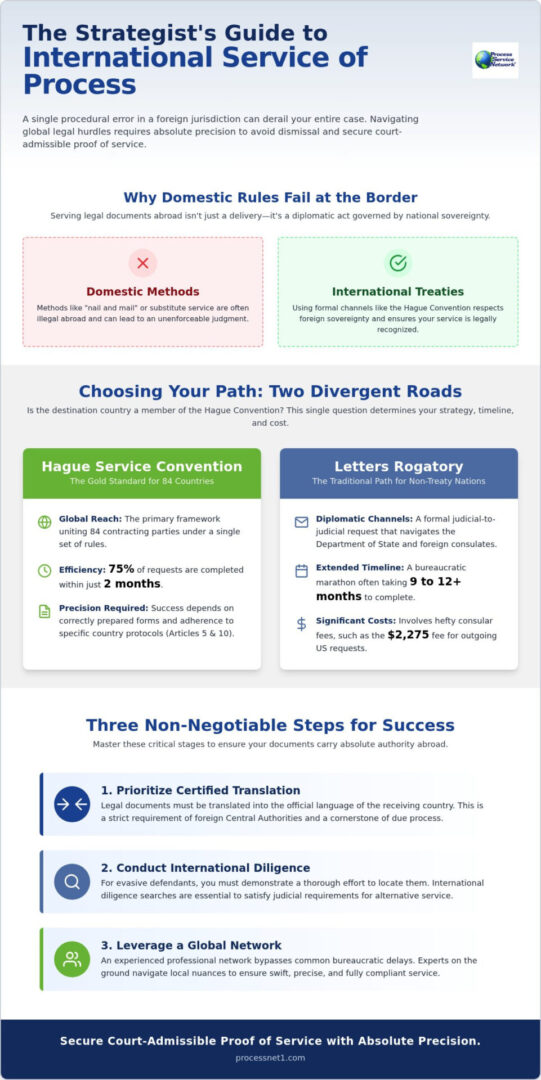
Foreign governments view the service of process as a judicial act. When you attempt to serve papers on their soil without permission, you’re infringing on their national sovereignty. This is why you can’t simply drop documents in the mail and hope for the best! Many nations reject postal service entirely. To bridge this gap, countries rely on international treaties to standardize the process. The Hague Service Convention is the primary framework, currently uniting 84 contracting parties under a single set of rules. Using these treaties ensures your service is recognized by both your domestic court and the foreign authority. It’s the only way to guarantee your case stays on track.
When Do You Need International Service?
You need formal international service whenever a defendant resides or is headquartered outside your home country. This applies to individuals in family law disputes or small claims, as well as massive foreign corporations in commercial litigation. Speed is your greatest asset here! Statute of limitations deadlines don’t pause just because a defendant is overseas. Whether you are dealing with a breach of contract or a child custody matter, knowing how to serve someone internationally with precision prevents the clock from running out on your case. Don’t let a procedural delay turn into a permanent loss. You need a clear roadmap to move from the initial filing to court-admissible proof of service without wasting time on bureaucratic red tape.
The Hague Service Convention vs. Letters Rogatory
Determining how to serve someone internationally begins with a single question: is the destination country a member of the Hague Service Convention? As of August 2026, there are 84 contracting parties to this treaty. It’s the undisputed gold standard for cross-border litigation. Why? Because it works! Research indicates that 75% of document requests sent through Central Authorities are completed within just two months. Compare that to the alternatives, and the choice is clear.
If the country isn’t a signatory, you’re looking at Letters Rogatory. This is the slow, traditional path. It involves a formal request from your local court to a foreign court. It’s a bureaucratic marathon that often drags on for nine months to over a year. You’ll deal with diplomatic channels and hefty consular fees, such as the $2,275 fee for outgoing US requests. Understanding the nuances of how to serve someone internationally ensures you don’t waste a year on the wrong procedural track.
Mastering the Hague Convention Process
The Hague process is efficient, but it’s not a DIY project. You must identify the specific Central Authority in the receiving nation. Each country has its own Article 5 requirements for local protocols. Get these wrong, and your request is rejected instantly! Be especially wary of Article 10, which discusses service by mail. Many countries have opted out of this provision. Relying on it without verifying the country’s specific objections is a common trap that leads to unenforceable service. For precise results, many professionals rely on expert Hague form preparation to ensure every box is checked correctly.
When the Hague Fails: Letters Rogatory
When you’re dealing with non-treaty nations, Letters Rogatory are your only option. This judicial-to-judicial request requires drafting documents that meet the exacting standards of foreign courts. You can’t just send a standard US summons. The request must navigate the Department of State and foreign diplomatic channels. It is a grueling 12-month wait in many cases. Success depends on your ability to draft a request that a foreign judge will actually honor. Don’t leave this to chance. Precision in drafting is the only way to survive the bureaucratic wait.
Certified Translation: The Non-Negotiable Step
Your case lives or dies by the quality of your translation. If you’re figuring out how to serve someone internationally in a country like France, China, or Brazil, stop and check the language requirements immediately. Most foreign Central Authorities act as strict gatekeepers. They will reject English-only documents without a second thought. They won’t even process your request until it’s in their official language. This isn’t just a polite suggestion; it’s a legal barrier that can stall your litigation for months.
Don’t confuse a standard translation with a court-admissible legal translation. There’s a massive difference! A basic translation might capture the general meaning, but a legal translation ensures procedural equivalence. This is about protecting the record. You must ensure the defendant cannot later claim in court that they didn’t understand the nature of the lawsuit. If a judge finds the translation was vague or inaccurate, your service could be quashed. Providing a precise, professional translation eliminates this defense and keeps your case moving forward with absolute authority.
Legal Accuracy in Every Language
Using Google Translate is a recipe for a dismissed case! Legal jargon is notoriously difficult to move between languages. Complex terms like “summary judgment,” “estoppel,” or “injunction” don’t always have direct equivalents in Spanish, Chinese, or Arabic. A single mistranslated word can change the entire meaning of a pleading. To satisfy foreign courts and US judges, you need certified affidavits of translation. This document is a sworn statement from the translator, confirming their competence and the accuracy of the work. It’s the only way to prove to the court that the defendant received a true and correct version of the legal notice.
Strategic Translation Timing
Timing is a critical factor in your litigation strategy. You don’t just translate the summons; you must translate the entire complaint and all supporting exhibits. This can be a massive undertaking for document-heavy commercial cases. Because this process adds time to your overall service schedule, you need to start early. Budget for professional translation as a core litigation cost from the very beginning. It’s not an area where you want to cut corners. Investing in high-quality, in-house translation services ensures that your documents are ready for the Central Authority the moment they’re filed. Mastering how to serve someone internationally means planning for these linguistic hurdles before they become emergencies.
Locating Evasive Defendants with International Diligence
Evasive defendants often believe that crossing a border makes them untouchable. They are wrong. While an unknown or invalid foreign address presents a massive challenge, it’s a hurdle that can be cleared with the right intelligence. You cannot simply throw up your hands and tell the judge you can’t find them. The court requires a showing of “due diligence” before it will allow you to proceed with alternative methods. This is a rigorous standard. You must prove that you’ve made every reasonable effort to track the defendant down. Learning how to serve someone internationally means knowing how to hunt for the unfindable when the trail goes cold.
Judges are skeptical of plaintiffs who move too quickly toward alternative service. They want to see a documented, exhaustive search. This is where international skip tracing becomes your most powerful tool. It’s a specialized process that combines digital footprints with local, on-the-ground verification. If you skip this step, you risk having your case dismissed for a failure of due process. You need a partner who can navigate foreign databases and local residency customs to find a verifiable location for service.
Elite Tactics for Finding Parties Abroad
Finding a defendant in a foreign country requires more than just a laptop and an internet connection. It demands access to global databases and a network of local field agents who know the terrain. We don’t just look for an address; we identify residency patterns and asset locations that confirm a target’s presence. This level of investigation is critical for surviving a motion to quash. Every search result, every agent report, and every database hit must be part of your formal record. This documentation proves to the court that you’ve acted in good faith. If you need to find a missing defendant, initiate a professional diligence search to secure the proof you need.
Service by Publication: The Last Resort
Service by publication is the strategic final move when all other efforts fail. It’s a powerful tool, but it’s also the most heavily scrutinized. You must obtain a specific court order for alternative service, which requires a mountain of evidence showing that personal service is impossible. Once granted, you have to navigate the legal notice requirements of foreign newspapers. These rules vary wildly from one nation to the next. One wrong step in the publication process can invalidate the entire service. This method requires a meticulous paper trail that links your due diligence search directly to the final notice. It’s the ultimate “no-nonsense” approach to ensuring your litigation continues, even when the defendant is hiding.
Why Global Networks Outperform Bureaucracy
Relying on government Central Authorities often feels like sending your case into a black hole. While these agencies are legally recognized, they often lack the urgency required for active litigation. Private process servers act as your boots on the ground, providing a level of accountability and speed that public clerks cannot match. When you need to know how to serve someone internationally without losing months to administrative stagnation, a private global network is the only logical solution. We prioritize your deadlines because we understand that every day of delay is a day your client’s interests are at risk.
A professional network provides access to local specialists who understand the unwritten rules of their specific jurisdictions. This isn’t just about delivery; it’s about navigating local customs and court expectations that aren’t found in a manual. Our servers are persistent. They don’t just make one attempt and walk away. They are relentless problem-solvers who pursue evasive defendants until the task is complete. This results in an Affidavit of Service that is robust, detailed, and ready to withstand the most aggressive judicial scrutiny. You get a clear roadmap from filing to proof, ensuring your case maintains operational momentum.
The Process Service Network, LLC Advantage
We have spent decades navigating the world’s most complex legal systems. This history has built a foundation of straight-shooting transparency and operational precision. You won’t find hidden variables or surprise fees in our engagement structure. We provide clear, action-oriented communication at every stage of the process. From handling intricate Hague form preparation to managing in-house legal document translations, we ensure every technical requirement is met the first time. We thrive on the high-stakes challenges that often deter other firms, acting as your reliable guide through difficult international landscapes.
Take Action: Stop Guessing and Start Serving
Procedural delay is a silent killer in international litigation. Don’t let your case expire while you guess about foreign protocols or wait for a government agency to find its rhythm. Knowing how to serve someone internationally is a major competitive advantage, but only if you execute with speed and accuracy. Our team is ready to initiate your global service request immediately, moving you quickly from a logistical problem to a court-admissible solution. Dominate the legal landscape with Process Service Network, LLC!
Secure Your Litigation with Absolute Precision
International service of process is a high-stakes strategic maneuver. You’ve learned that domestic rules stop at the shoreline and that the Hague Convention is your most efficient path forward. You now understand why certified translations are non-negotiable and how to handle even the most evasive defendants through meticulous diligence searches. Precision in these steps isn’t just a preference; it’s the only way to ensure your case survives judicial scrutiny.
Mastering how to serve someone internationally requires more than just reading the rules. It demands a partner with the global infrastructure to execute. We’ve been serving the legal community since 1978, providing comprehensive Hague form preparation and a global network of professional servers. Don’t let bureaucratic red tape or linguistic barriers derail your progress. Take control of your case today and move forward with total confidence.
Get Expert International Process Service Now!
You have the roadmap. Now, take the final step to secure your results. Your case deserves the authority and reliability that only a seasoned global expert can provide.
Common Questions About International Process Service
How much does it cost to serve someone in another country?
Costs vary significantly based on the destination and the required method. If you’re using the Letters Rogatory path, the consular fee alone is $2,275. For Hague Convention countries, fees depend on the specific requirements of the foreign Central Authority. You also need to budget for certified translations and potential skip tracing. International searches to locate a defendant typically range from $300 to $1,000. Always confirm the current rates for your target jurisdiction to avoid surprises.
How long does international service of process typically take?
Your timeline depends heavily on the procedural path you choose. Service through the Hague Convention is the fastest option; 75% of document requests are completed within two months. If you’re forced to use Letters Rogatory for non-treaty nations, prepare for a much longer wait. These judicial requests often take nine months to over a year to process through diplomatic channels. Speed is a primary reason why mastering how to serve someone internationally via the Hague path is preferred.
Can I serve someone abroad via email or social media?
Electronic service is gaining traction but typically requires specific court authorization. While there’s a growing movement toward accepting email or social media service, it’s rarely the default method. You must demonstrate that traditional methods are impractical or that the defendant is actively evading service. Check both your local court rules and the laws of the destination country, as some nations strictly prohibit electronic service as a violation of their national sovereignty.
What is a Hague Central Authority and how do they work?
A Central Authority is the designated government agency responsible for receiving and processing international service requests. Each of the 84 Hague Convention signatories must have one. When you submit a request, the Authority reviews your documents for compliance with local laws and then arranges for service according to their internal protocols. They act as the official gatekeeper, ensuring that the service of process respects their national sovereignty while fulfilling your legal requirements.
What happens if the country is not part of the Hague Convention?
You must use the Letters Rogatory process if the destination country isn’t a Hague signatory. This involves a formal request from your trial court to the foreign judiciary. It’s a complex, traditional method that moves through diplomatic channels and the Department of State. Because it lacks the standardized framework of a treaty, it’s significantly slower and more expensive. It requires meticulous drafting to ensure the foreign court recognizes and executes your request without delay.
Do I need to hire a lawyer to serve someone internationally?
While you aren’t strictly required to hire a lawyer, the procedural complexity makes professional assistance essential. Navigating international treaties, foreign laws, and translation requirements is difficult for non-experts. Small errors can lead to case dismissal or unenforceable judgments. Many litigants choose specialized process serving firms to handle the logistics and ensure compliance. This ensures your documents are delivered with absolute authority without needing to manage the intricate legal red tape yourself.
Is service by mail legal under the Hague Convention?
Service by mail is addressed under Article 10, but it’s often a legal minefield. Many countries have specifically opted out of this provision, making postal service invalid in their jurisdictions. Even if a country hasn’t formally objected, US courts often require additional proof of delivery that standard mail can’t provide. Relying on mail without verifying the specific objections of the destination country is a high-risk strategy that often leads to contested service.
What is an Affidavit of Service in an international context?
An Affidavit of Service is the formal proof that your legal documents were successfully delivered. In an international context, this document must satisfy both your local court and the standards of the foreign jurisdiction. It details the exact time, place, and method of delivery. When learning how to serve someone internationally, securing a court-admissible affidavit is the ultimate goal. Without this verified proof, you cannot move forward with your case or obtain a default judgment.
