

Foreign Service Requirements: Serving Legal Papers Abroad
If you landed here looking for diplomat careers, this isn’t that page. This one covers the requirements for serving court papers on someone in another country: which rules apply, which forms and translations you need, what it costs, and what proof the court wants back. The short version is that foreign service goes wrong on paperwork details, not on the delivery itself. A form filled in wrong or a translation that doesn’t meet the destination country’s rules can cost you months. We handle international service of process every day and prepare the Hague forms ourselves at no additional charge, so you can hand over the file and not guess at the details.
TL;DR
- Your own court’s rules decide whether you must serve abroad. The treaty or the foreign country’s rules decide how.
- For most countries that are party to the Hague Service Convention, you send a mandatory request form plus the documents, usually in duplicate, to the destination country’s Central Authority.
- Translation depends on the destination country. Plan on translating unless the recipient is known to read English.
- The Convention doesn’t apply when the recipient’s address is unknown. That’s a different problem with different tools.
- Proof of service comes back as a certificate. File it with the court.
Table of Contents
- Start with your own court’s rules
- When the Hague Service Convention applies
- The Central Authority route, step by step
- What it costs
- How long it takes and what proof you get
- When the Central Authority route won’t work
- Mistakes that cost the most time
- Who does what when you work with us
- FAQ
- Sources
Start with your own court’s rules
A common misunderstanding is that the Hague Convention tells you when you have to serve someone overseas. It doesn’t. Your court’s rules do. In a US federal case, that means Federal Rule of Civil Procedure 4, and in a state case it means that state’s rules. Those rules say who has to be served and how. If service means sending papers to another country, the Convention then supplies the channel, but only if the destination country has signed it.
The Convention is a delivery system, not a rulebook for what counts as good service. Think of it as a set of pipes. Your court decides what has to go through them, and the destination country decides what it will accept at the other end.
So before you do anything abroad, answer three questions:
- Does the court require formal service on this person, or is there a domestic option, such as a US agent or registered office?
- Which country is the recipient in, and is it a party to the Hague Service Convention?
- Do you have a complete, current street address there?
The third question matters more than people expect. We cover that below.
Our guide to international service of process rules goes into the federal and state side in more detail.
When the Hague Service Convention applies
The Convention applies when all of these are true:
- The case is civil or commercial. Criminal and tax matters are outside it.
- The papers have to be sent from one member country to another.
- The recipient’s address is known.
The address condition is written into Article 1. If you don’t know where the person is, the Convention doesn’t apply, and you’ll need a different approach, usually a court order for alternative service. More on that later.
To check whether a country is a member, use the status table on the Hague Conference’s website. Membership grows over time, so a list in an article like this one goes stale. Check the table for your country on the day you file. Each country also publishes its own declarations: which Central Authority takes requests, whether it accepts postal service, and what language it wants. Those declarations are where most of the surprises are.
For a plain-language walkthrough of the treaty, see our Hague Service Convention overview.
The Central Authority route, step by step
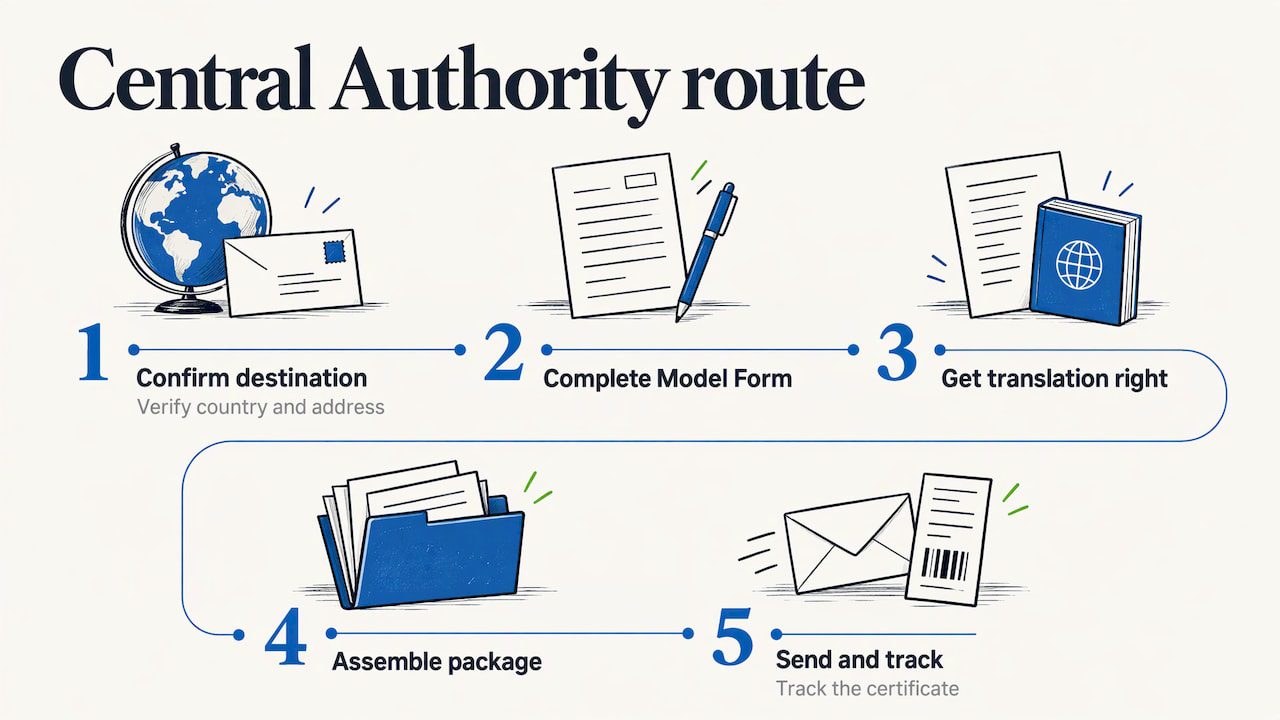
This is the main channel under the Convention, and it’s the one most US cases use. Here’s the routine, with where it tends to break.
Step 1: Confirm the country and the address
Look up the destination country’s declarations. Note the Central Authority’s address, the language it requires, and any objections it has filed to other methods like postal delivery.
Where it goes wrong: a partial address. Some Central Authorities will return a request that has only a P.O. box or a city name. Get a full street address with postal code before you start. If you’ve only got an old address, run it down first. We offer skip tracing and diligence searches for exactly this, and it’s cheaper to find out now than after a rejection.
Step 2: Complete the Model Form
The request goes on a standard document called the Model Form, which the Convention sets out. It has three parts:
- The request, which names the requesting authority and the recipient and says how you want the papers served.
- The certificate, which the foreign authority fills in and returns to you.
- The summary of the document to be served, which describes the case in short form.
The form is mandatory for the main channel. A letter or cover note won’t substitute for it.
Where it goes wrong: the request has to be signed by someone with the authority to sign it under the rules of the forwarding state. In the US, that can be a court officer, an attorney or any official or judicial officer competent under the court’s rules. A form signed by the wrong person is a common reason for a rejection. The method you request also matters. Asking for a method the destination country doesn’t allow stalls the whole request.
We prepare these forms as part of our Hague work at no extra charge. Our page on Hague form preparation shows what that looks like.
Step 3: Get the translation right
The Convention itself doesn’t set a translation rule for every country. The destination country’s declaration does. Many require the papers and the form in their official language. Even when a country doesn’t insist, the US Department of Justice’s guidance for litigators advises translating unless you know the recipient understands English.
Where it goes wrong: three places.
- Wrong language. Some countries have more than one official language, and the Central Authority may accept only one.
- No translation certificate. Where a translation is required, you’ll often need a statement from the translator that it’s accurate.
- Partial translation. Translating the complaint but not the exhibits, or not the Model Form summary, is a typical gap.
We translate into 88 languages at $0.29 per word, and our certified translation for service page explains what certification covers. For a general look at what courts expect, read our court document translation article.
Step 4: Assemble the package
A standard package contains:
- The completed Model Form.
- The documents to be served (summons, complaint, and any exhibits or orders).
- Translations, where required.
- A duplicate set of everything. Central Authorities typically keep one set and serve the other.
You don’t need an apostille or other legalization for the main channel. The Convention removes that step. People still order apostilles out of habit and lose time and money.
Where it goes wrong: missing duplicates, loose pages, and documents that don’t match the summary on the form. Check that the page count and the description line up.
Step 5: Send it and track it
You send the package to the Central Authority named in the destination country’s declaration. It serves the papers itself or arranges for them to be served, using its own domestic method. It then returns the certificate from Part 2 of the Model Form, which says what happened.
Where it goes wrong: silence. Central Authorities vary a lot in speed. Build in time, and follow up in writing if you hear nothing. The Convention sets no overall deadline, so how long it takes depends on the country. That’s one reason to start early. Our Article 5 service guide covers the details of this channel.
What it costs
Two kinds of costs apply.
Central Authority fees. Under Article 12, the Central Authority’s own service is free of charge. But you pay if the authority has to use a judicial officer or a particular method you asked for. Some countries do charge for that, and the amounts differ by country.
Your own costs. These are form preparation, translation, copies, notarization if needed, shipping, and the time of whoever manages the file.
Here are our published prices so you can budget:
| Item | Price |
|---|---|
| International service of process | from $395 |
| Translations | $0.29 per word |
| Notary fee | $25 |
| Hague form preparation | no additional charge |
Translation is the line that grows fastest. A 40-page complaint at several hundred words per page adds up quickly, so get a word count before you commit to a budget. Our international service costs guide walks through a full budget.
A quick example: say your complaint, summons and exhibits come to 8,000 words and the destination country needs a translation. At $0.29 per word, translation alone is $2,320. Add the international service fee from $395, and the translation clearly outweighs the service fee. Cutting down exhibits to what you actually need can make a real difference.
How long it takes and what proof you get
The Convention has no general completion deadline, and processing times depend on the country. Some return certificates in a few weeks. Others take months. Ask for current timing before you set a hearing date or a deadline that depends on service.
The proof is the certificate. If service worked, it states the method, the place, the date and the person who received the papers. If it failed, it states why. A completed certificate is generally accepted by US courts as evidence that service followed the rules, and you file it with your proof of service.
There’s also a safety valve. In countries that have made the relevant declaration, a judge may consider a default judgment if no certificate has come back after a set waiting period (the Convention text says at least six months) despite reasonable efforts to get one. Keep a record of every follow-up you send, since a judge will look for it.
In US federal court, the usual 90-day service deadline in Rule 4(m) doesn’t apply to service in a foreign country. That doesn’t mean there’s no clock. Courts still expect you to pursue service diligently, so a file that sits for a year with no follow-up can draw questions.
When the Central Authority route won’t work
Sometimes the standard route is closed or too slow. Here are the main situations, by type.
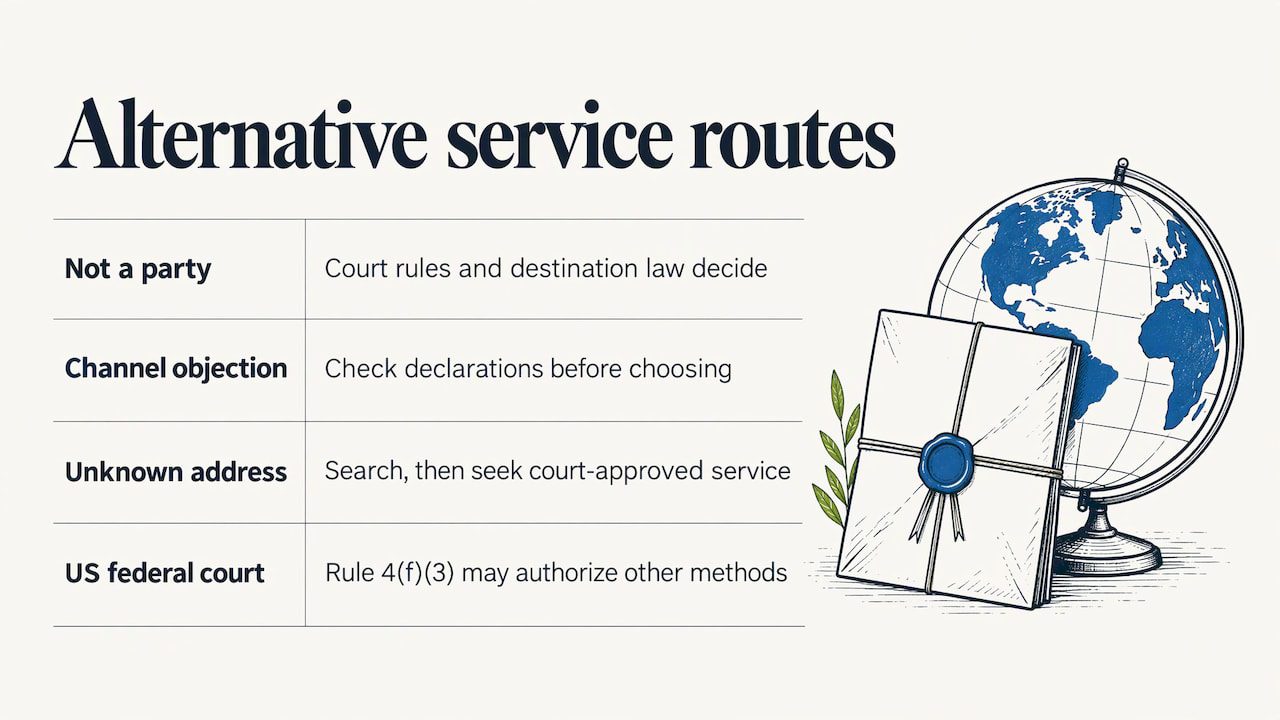
The country isn’t a party to the Convention. Then your court’s rules and the destination country’s law decide the method. Options can include letters rogatory (a formal court-to-court request), service through the foreign country’s own rules, personal delivery where allowed, or mail with a signed receipt where the foreign country doesn’t prohibit it. The key point is that service must satisfy both your court and the destination country.
The country objects to certain channels. The Convention allows alternatives such as consular channels, postal channels and direct contact with local officials, but each country can object to them. Check the declarations before you pick one. A postal service that a country has objected to won’t hold up.
The address is unknown. The Convention doesn’t apply. The usual path is to search for the person, and if that fails, ask the court to approve alternative service, including publication. We run the search and, through our affiliate Global Legal Notices, LLC, offer an online legal notice publication system. Our article on online legal notice service explains how publication works, and service by publication is where to start an order.
The court allows alternative service. In US federal court, Rule 4(f)(3) lets a judge authorize other methods, which in some cases have included email or social media. Courts usually want to hear why ordinary treaty service is inadequate or too burdensome in your case. Don’t assume it will be granted.
China has its own quirks. See our guide to serving legal documents in China. We also have pages for Spain, Mexico and the Netherlands.
Mistakes that cost the most time
These are the ones we’d flag first:
- Starting without a full address. Confirm it before drafting anything.
- Assuming one rule for every country. Each country’s declarations differ. Read them for the specific destination.
- Translating late. Translation is often the longest step, and a changed complaint means a new translation.
- Leaving out the duplicate set. It’s an easy miss and a cause of rejection.
- Ordering an apostille you don’t need. The main channel doesn’t require one.
- Not calendaring follow-ups. Silence from a Central Authority isn’t a result. Follow up in writing and keep copies.
- Using the wrong signer on the form. Check who is competent to sign under your court’s rules.
The Hague Conference also publishes a practical handbook on the Service Convention, updated in 2025, which many practitioners keep on hand.
Who does what when you work with us
If you’re a law firm with a docket to protect, an individual with a hard-to-serve defendant abroad, or a business with a cross-border dispute, the work splits like this. You send us the documents and tell us the recipient and country. We prepare the Hague forms at no additional charge, translate in any of 88 languages, and handle service. Our pricing is published and upfront, with no hidden fees, so you can budget before you commit. For cases where the person can’t be found, we do skip tracing and diligence searches, and we run service by publication.
Start on our international service page or see the full price list on the comparison chart.
FAQ
Do I always need to use the Hague Convention to serve someone abroad?
No. The Convention applies only when your court requires sending papers abroad, the destination country is a member, the matter is civil or commercial, and the address is known. If any of those is missing, other rules apply.
Do I need an apostille on documents served abroad?
Not for the Convention’s main channel. It removes the legalization requirement. Translation is a separate question, and it depends on the destination country.
How much does it cost to serve papers in another country?
The Central Authority’s own service is free under the Convention, but costs arise if a particular method or judicial officer is used. Your own costs are mostly form preparation and translation. Our international service starts from $395, and translation is $0.29 per word.
How long does foreign service take?
There’s no fixed deadline in the Convention, and it varies by country. Plan for weeks at the fast end and months at the slow end. Follow up in writing if you hear nothing.
What if I don’t know where the person is?
The Convention doesn’t apply when the address is unknown. You’ll need to locate the person, or ask the court to approve another method such as publication. We run searches and offer online legal notice publication for this.
Sources
This article draws on our own guides to international service:
- Hague Service Requirements
- Hague Service Convention Explained
- International Service Rules
- International Service Costs
- Certified Translation for Service
